

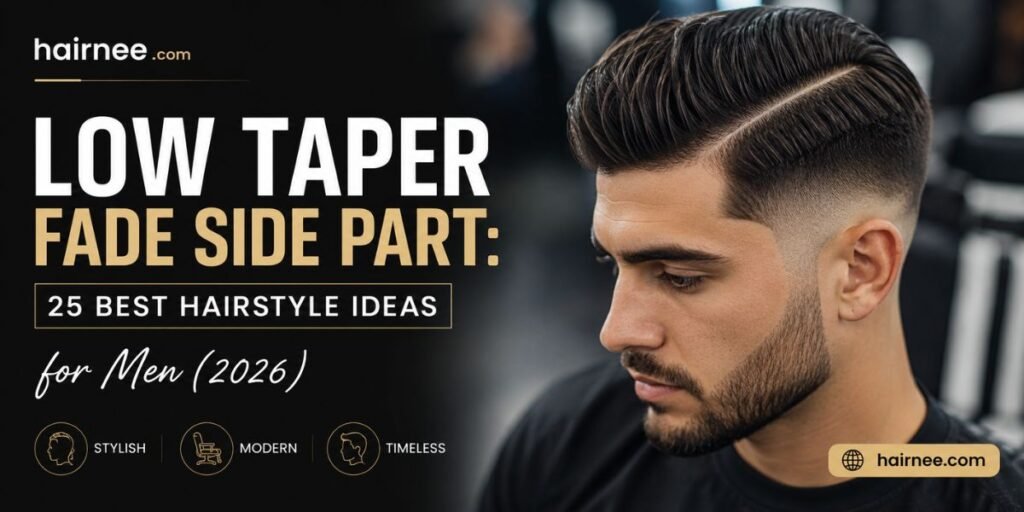
A low taper fade side part pairs a soft, low fade around the ears and neck with a crisp, defined part on top. It’s one of the easiest ways to look sharp without spending twenty minutes in front of a mirror every morning.
This guide walks through 25 low taper fade side part styles, how to talk to your barber, which face shapes and hair types suit it best, and how to style and maintain the cut at home. By the end, you’ll know exactly what to ask for in the chair.
What Are Low Taper Fade Side Part Hairstyle?
A low taper fade side part is a haircut where the sides fade gently from short to longer starting near the ear, while the top hair is combed into a clear side part. The two techniques work together, not separately.
The fade keeps things tidy without drawing attention to itself, and the part gives the top structure. That combination is why barbers describe it as one of the most “safe but sharp” cuts a man can ask for.
What Is a Low Taper Fade?
A low taper fade is a fade that starts low, right around the ear line and nape, rather than climbing up toward the temple. It stays close to the skin only at the very bottom edge.
Because the blend sits low, it grows out slowly and doesn’t create an awkward gap between visits. Men who don’t want a bold, high-contrast look tend to prefer this over a mid or high fade, and it’s often confused with a drop fade, though a drop fade curves down further behind the ear instead of staying level.
As a general low taper haircut, it’s less about one exact look and more about where the blend sits on the head — everything else on top is flexible.
What Is a Side Part Hairstyle?
A side part hairstyle splits the top hair along a line that runs from the crown toward the forehead, with one side left fuller than the other. It’s one of the oldest men’s haircuts still in regular rotation.
Today’s version isn’t pressed flat the way older side parts were. Barbers now leave extra root height so the style has some lift and doesn’t sit stiff against the scalp.
Why This Haircut Is Popular in 2026
This cut is popular in 2026 because it looks intentional without needing heavy product or daily maintenance. Men want a haircut that reads as put-together on a video call and just as fine after a gym session.
A few reasons it keeps showing up in barber chairs this year:
- It works across ages, from a teenager’s first “grown-up” haircut to a fifty-year-old executive
- It suits straight, wavy, curly, thick, and thin hair with only small tweaks
- The low blend needs fewer touch-ups than a skin fade or high fade
- It reads well on camera, which matters for headshots and video meetings
- A barber can dial the fade height or top length up or down without changing the core shape
The bigger trend behind it is simple: natural texture is in, and stiff, over-gelled hair is out. A low taper fade side part gives you structure while still letting your hair move like hair.
Also Read This Low Taper Fade Straight Hair: 35 Best Hairstyles for Men in 2026
Benefits of a Low Taper Fade Side Part
The biggest benefit is versatility — this cut moves from boardroom to weekend without needing a redo. A quick comb and a small amount of product take it from casual to formal.
Beyond looks, it’s practical. The low blend grows out cleanly, so you can stretch the gap between barber visits without the sides looking patchy or overgrown.
- Works with a suit, a uniform, or a plain t-shirt
- Needs fewer trims than high or skin fades
- Flatters most face shapes with small adjustments
- Pairs naturally with a beard or a clean-shaven look
- Easy enough to style at home with basic tools
Top 25 Best Low Taper Fade Side Part Hairstyle
Here are 20 ways to wear this cut, from the classic barbershop version to bolder, more current takes. Bring one or two of these as reference photos when you sit down in the chair.
Classic Low Taper Fade Side Part
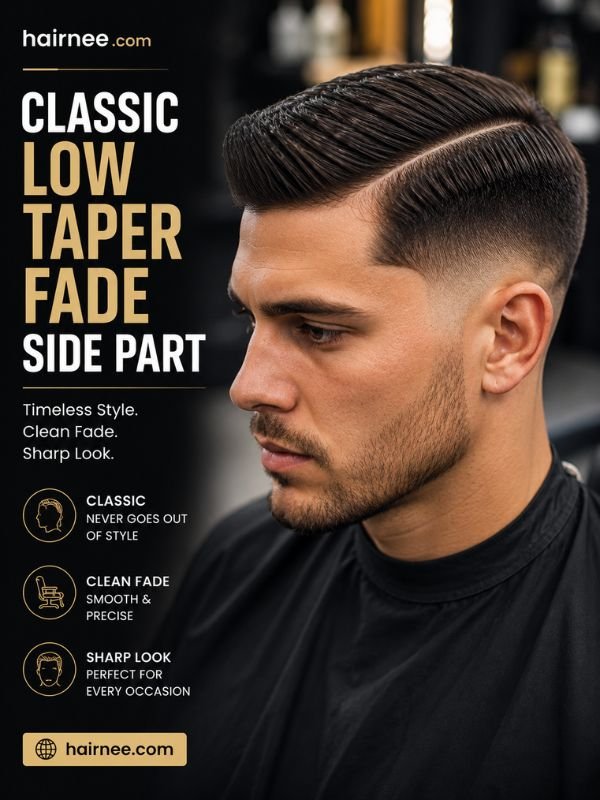
The classic version keeps two to three inches on top, combed into a straight, unfussy part. The fade stays subtle, so nothing about the cut screams for attention.
This is usually the go-to first-timer style because it photographs well and rarely looks dated — it sits close to a modern take on the old Ivy League cut. A light cream pomade on damp hair is all it needs to hold through the day.
Suitable hair type: straight or slightly wavy. Maintenance: every three to four weeks.
Modern Low Taper Fade Side Part
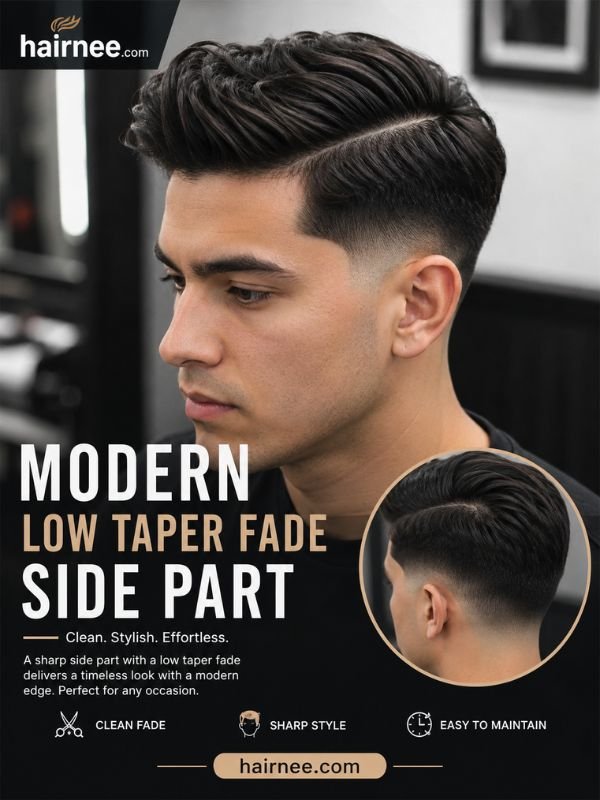
The modern take lifts the roots slightly before combing the top over, giving the part more life than a flat comb-down. It’s finished with matte cream rather than shine.
Barbers usually point-cut the top section here instead of a blunt cut, which softens the edges and lets hair fall more naturally into the part.
Suitable hair type: medium density, straight or wavy. Maintenance: every three weeks.
Textured Low Taper Fade Side Part
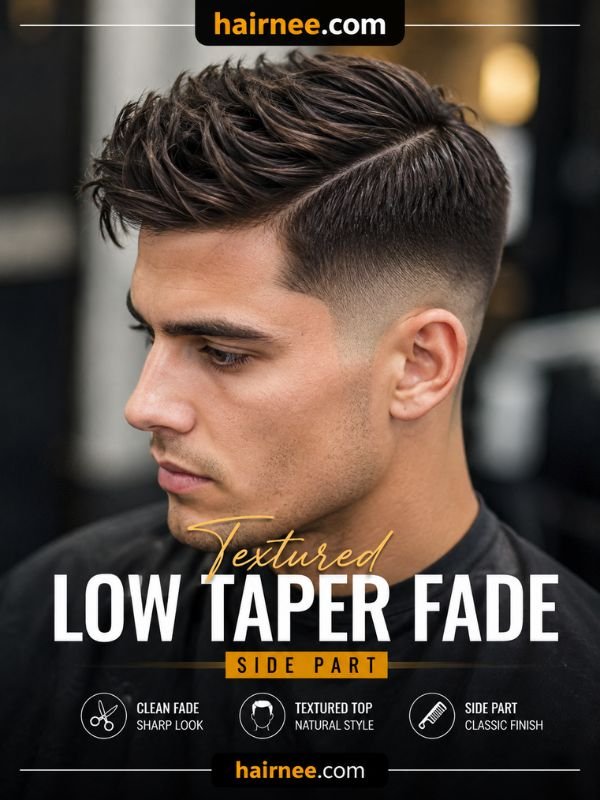
This version relies on layered cutting to build visible texture on top, so the hair breaks into soft pieces instead of lying as one flat sheet. The low taper keeps the sides from competing with that texture.
A nickel-sized amount of matte clay worked through dry hair brings out the separation without adding shine.
Suitable hair type: thick or dense hair. Maintenance: scissor trim every four weeks.
Short Low Taper Fade Side Part
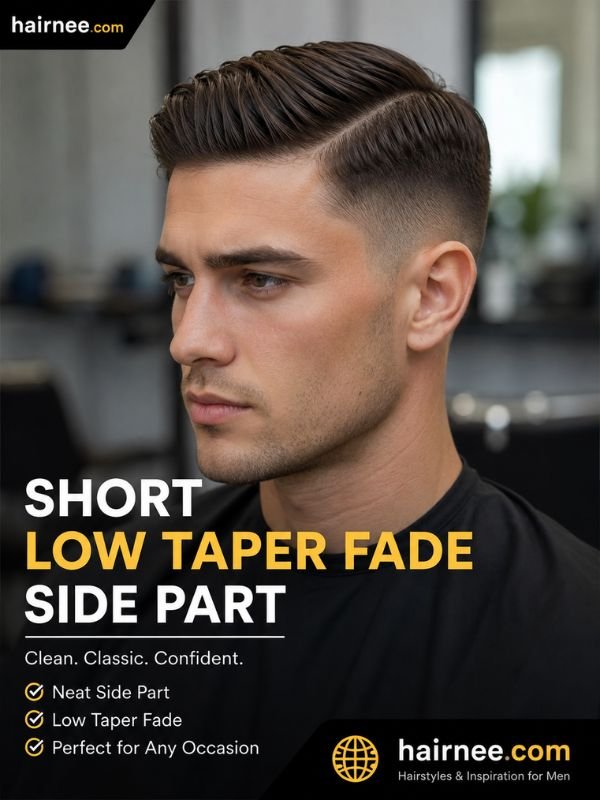
The short version trims the top to under two inches, which makes styling almost a non-event — a light cream and a quick sweep to the side is enough. It’s a favorite among guys who don’t want to think about their hair before 8 a.m.
The low taper cleans up the neck and temple without shortening the whole head, so it still reads as a “haircut” rather than a buzz.
Suitable hair type: fine to medium straight hair. Maintenance: every two to three weeks.
Long Low Taper Fade Side Part
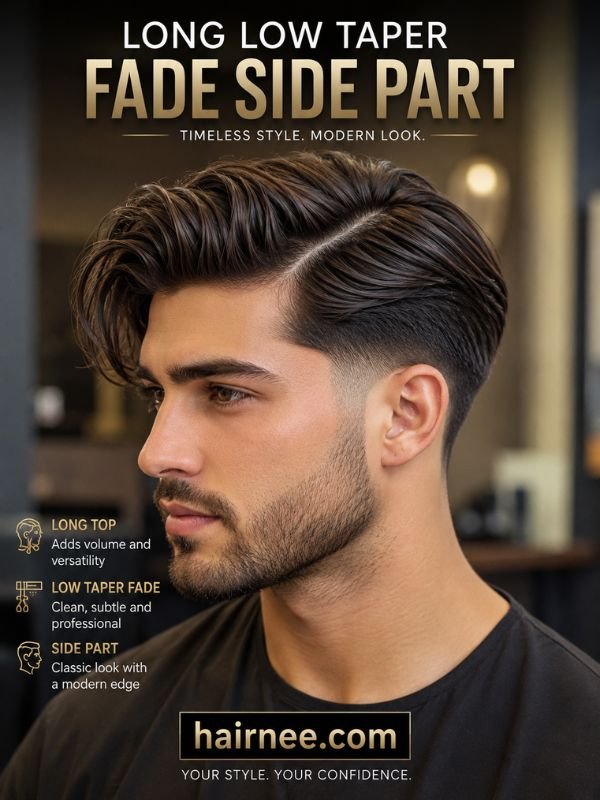
This one keeps four to five inches up top so the hair can flow across the head instead of just sitting there. It leans more relaxed than the shorter versions but still has clean, barbered edges underneath.
A sea salt spray on damp hair before blow-drying gives it enough grip to hold the sweep without looking wet or heavy.
Suitable hair type: wavy or straight hair. Maintenance: every four to five weeks.
Low Taper Fade Side Part with Hard Part
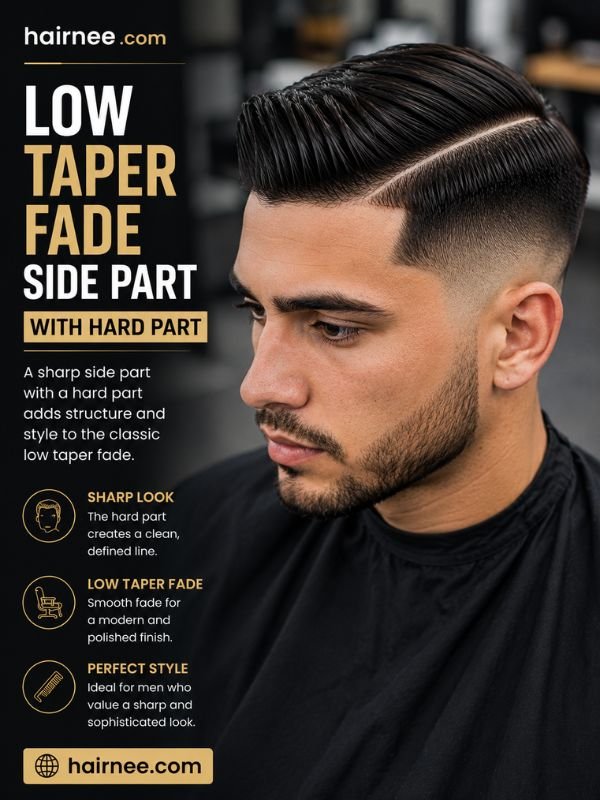
A hard part, also called a razor part, uses a blade shaved directly into the natural part line, creating a sharp visual break between the top and the fade. It’s a small detail that changes how graphic the whole cut looks.
Because the line needs upkeep as hair grows, this version suits guys who don’t mind a touch-up every couple of weeks.
Suitable hair type: straight and thick hair. Maintenance: touch up the line every two weeks.
Low Taper Fade Side Part with Beard
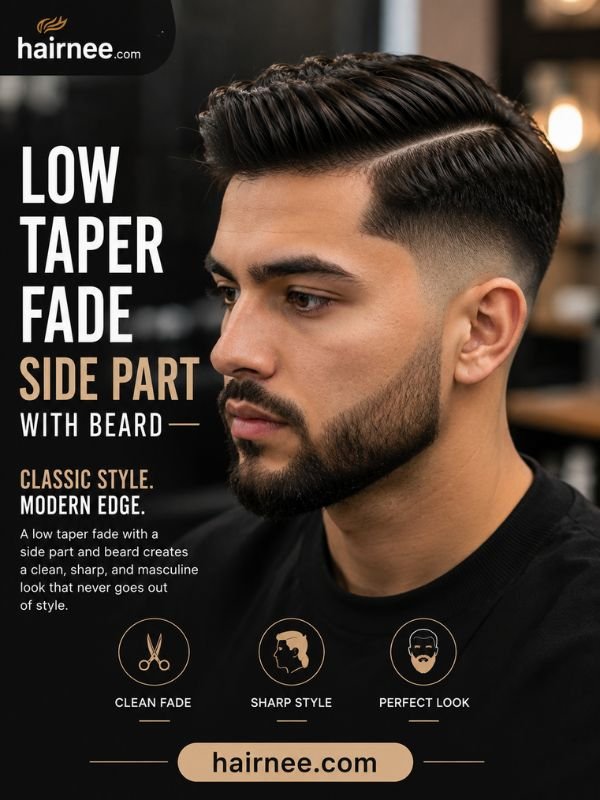
Here, the fade blends straight down into a full beard instead of stopping at the sideburn. The result is one continuous line from hairline to jaw rather than two separate grooming choices.
Keeping the beard trimmed to a similar level of neatness as the fade is what makes this look cohesive instead of mismatched.
Suitable hair type: works with any hair type paired with facial hair. Maintenance: trim beard and taper together every three weeks.
Low Taper Fade Side Part with Line Up
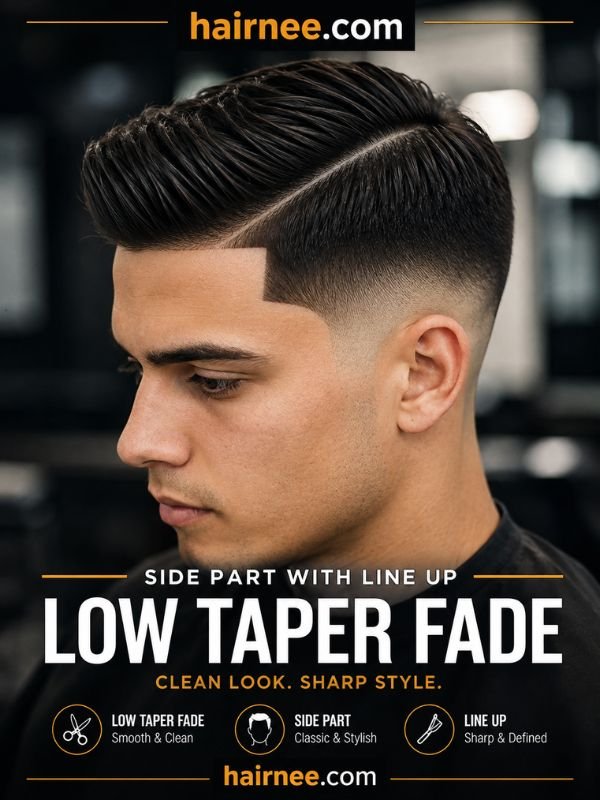
A line up sharpens the front hairline and temples into crisp, straight edges. Combined with the side part and low taper, it gives the whole head a boxier, more defined outline.
This is a high-upkeep detail — the edges soften fast, so it needs the most frequent touch-ups on this list.
Suitable hair type: coarse, thick, or straight hair. Maintenance: edge-up every one to two weeks.
Straight Hair Low Taper Fade Side Part
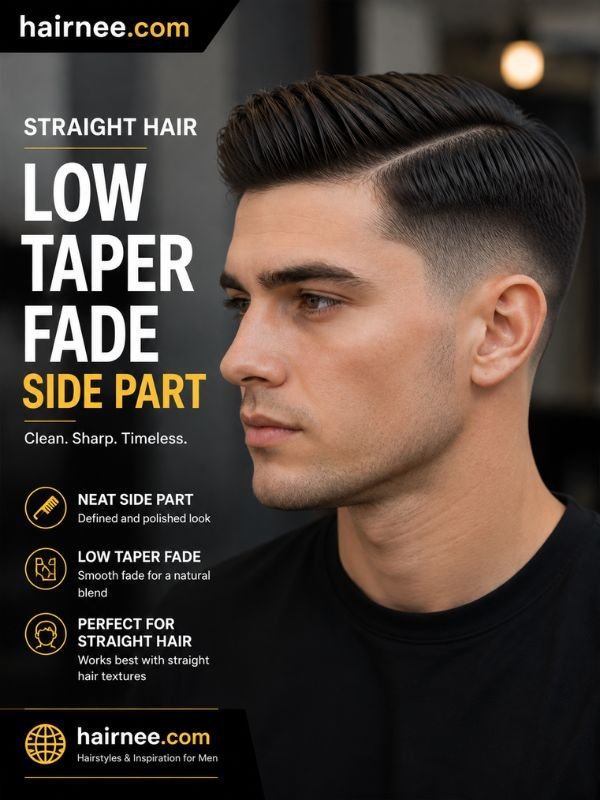
Straight hair sits flat against the head almost on its own, which makes the part line easy to keep crisp with minimal product. The low taper trims bulk from the sides without fighting the hair’s natural direction.
A light-hold cream or gel is usually enough — straight hair rarely needs anything heavier to stay in place.
Suitable hair type: straight hair. Maintenance: every three to four weeks.
Wavy Hair Low Taper Fade Side Part
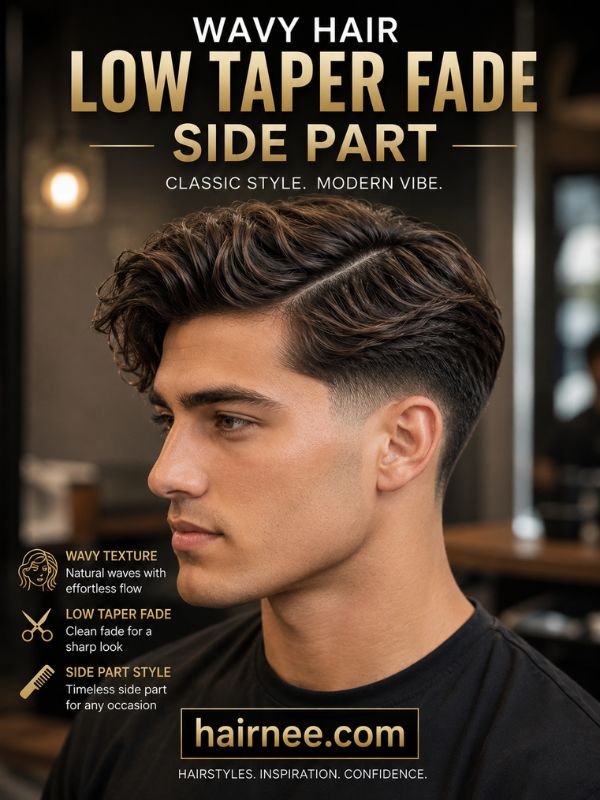
Wavy hair adds natural S-shaped movement to the part, so the style looks textured without any extra effort. The low taper keeps the neck and ears clean while the waves do the work on top.
A scrunch of wave cream into damp hair, left to air dry, brings out the pattern without weighing it down.
Suitable hair type: wavy hair. Maintenance: every four weeks.
Curly Hair Low Taper Fade Side Part
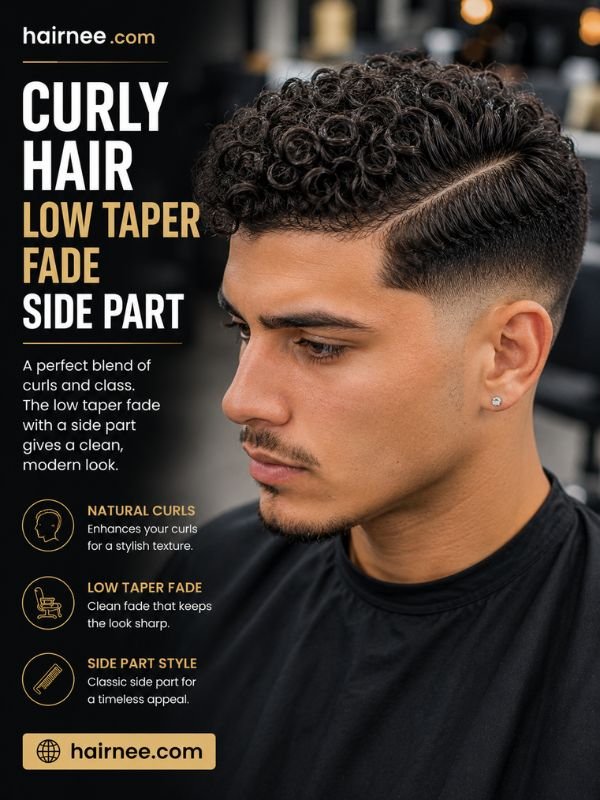
On curly hair, the barber parts along the curl’s natural direction rather than forcing a straight line. This is a common request among Black men and other men with coarse, curly textures, since the low taper keeps the area around the ears controlled without flattening the curl pattern on top.
A curl-defining cream on wet hair keeps the coil pattern visible instead of letting it frizz out.
Suitable hair type: curly or coily hair. Maintenance: every three to four weeks.
Thick Hair Low Taper Fade Side Part
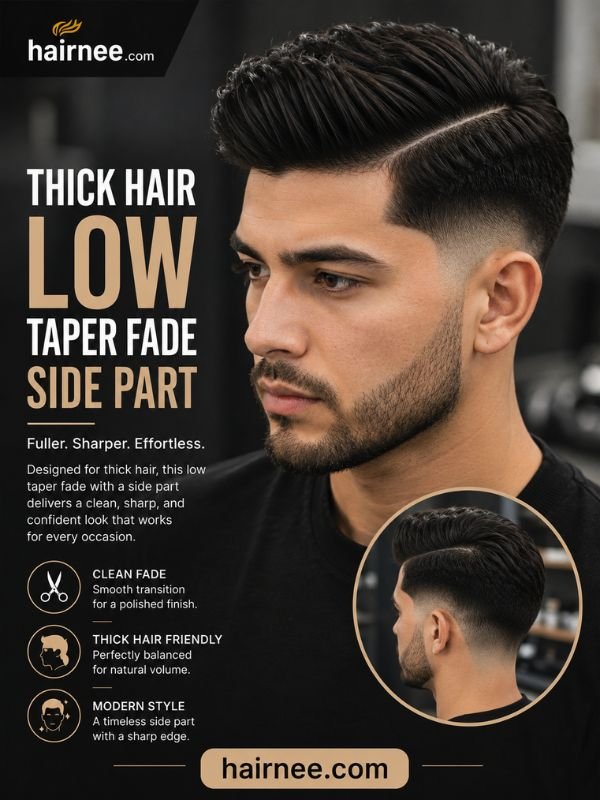
Thick hair holds shape well but can look bulky if left untouched. The low taper removes weight from the sides while the barber thins the top so it lies down instead of standing off the head.
A stronger clay applied to dry hair helps tame that extra density without flattening it completely.
Suitable hair type: high-density, thick hair. Maintenance: every three weeks.
Thin Hair Low Taper Fade Side Part
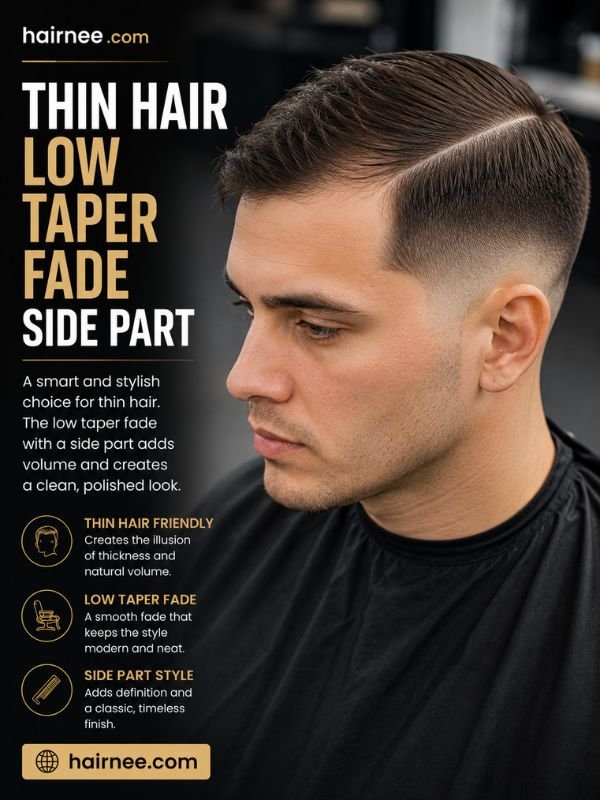
Thin hair can look sparse if the sides are shaved too high, which is exactly why a low taper works better here than a skin fade. Leaving hair on the sides keeps the top looking fuller by comparison.
Texturizing powder at the roots adds a bit of lift and covers thin patches better than a heavy pomade would.
Suitable hair type: fine or thin hair. Maintenance: every three weeks.
Low Taper Fade Side Part with Volume
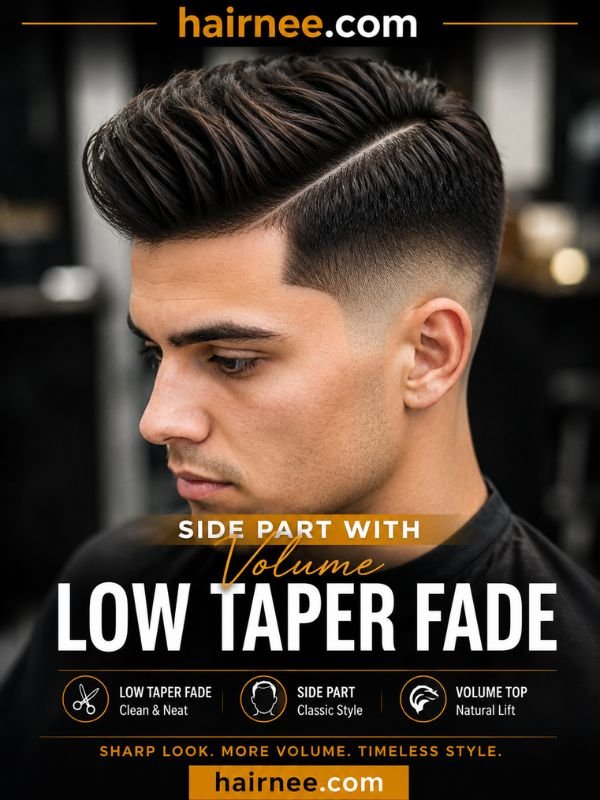
This variation is built around height rather than length — the top gets a root lift from blow-drying upward with a round brush before the part is combed in. It’s a good option for guys who want a bit more presence on top.
Because the low taper stays quiet at the sides, all the visual attention lands on the height at the crown.
Suitable hair type: medium to thick hair. Maintenance: every three to four weeks.
Professional Low Taper Fade Side Part
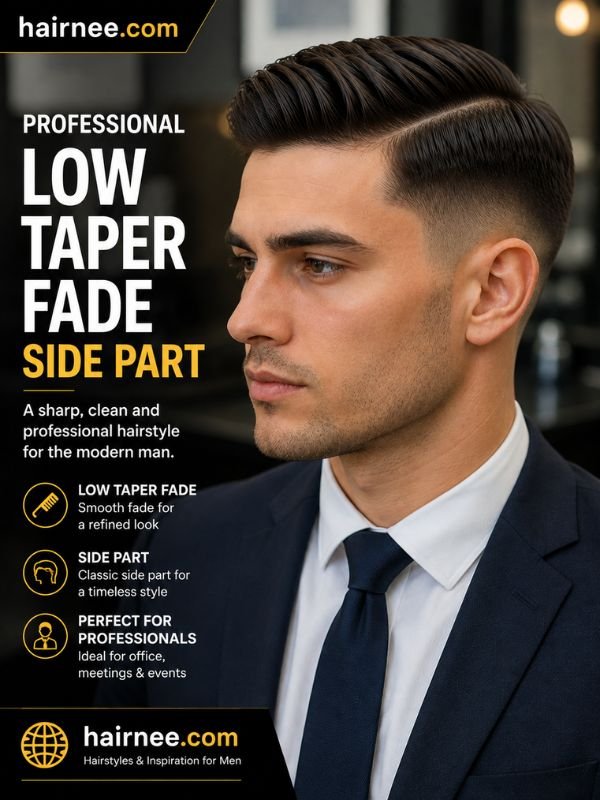
Built for offices and formal settings, this is the most conservative version — subtle fade, precise part, matte finish instead of shine. It clears almost any workplace dress code without a second look.
A fine-tooth comb and a light cream pomade are all it takes to keep it looking deliberate rather than overdone.
Suitable hair type: works with all hair types. Maintenance: every three weeks.
Low Taper Fade Side Part for Teen Boys
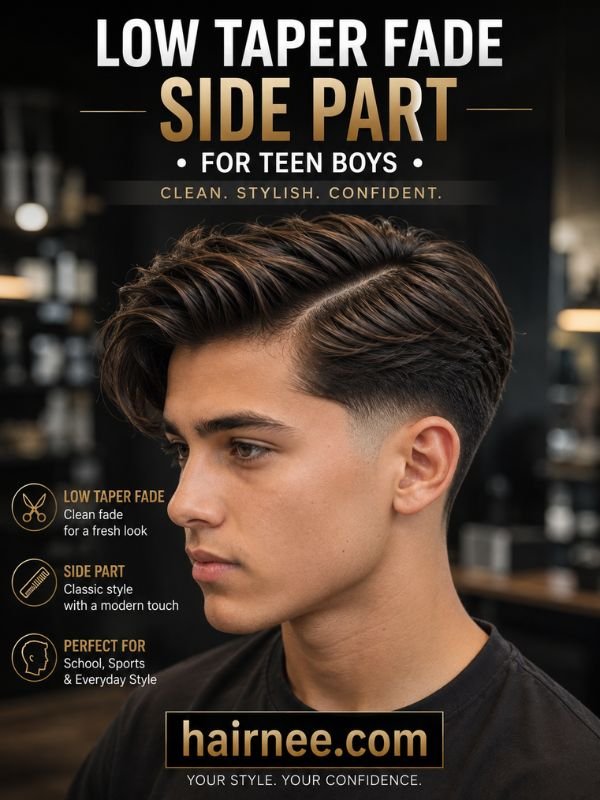
This version keeps things low-effort and school-friendly — soft fade, medium top length, no razor lines that need constant upkeep. It’s popular with younger guys because it still looks current without breaking dress codes.
A finger-styled matte paste keeps it looking natural rather than overly styled for class.
Suitable hair type: straight or wavy hair. Maintenance: every four weeks.
Asian Low Taper Fade Side Part
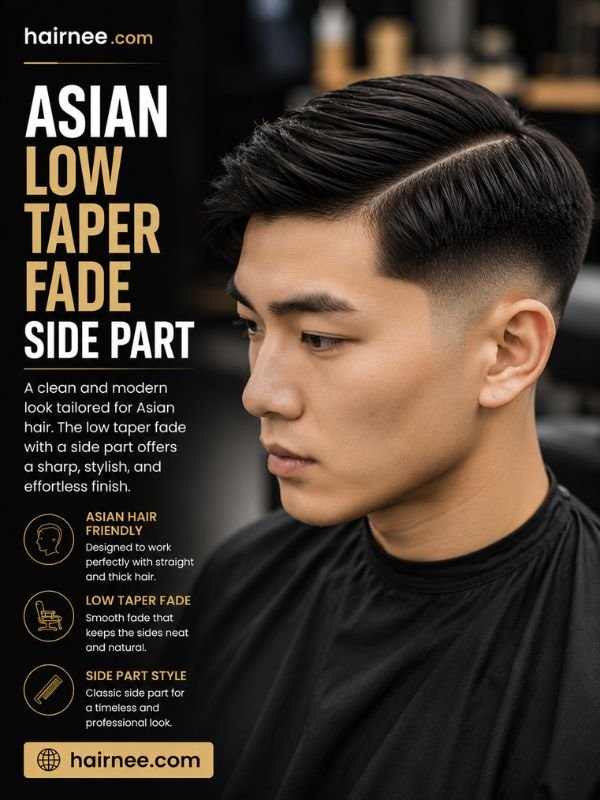
Asian hair is often thick, straight, and grows outward rather than falling flat, which is where the low taper helps most — it keeps the sides from sticking out. Leaving extra length on top adds the weight needed to hold the sweep down.
A stronger wax applied while blow-drying sideways gives coarse, straight strands enough grip to stay in place.
Suitable hair type: coarse, straight hair. Maintenance: every three weeks.
Blonde Low Taper Fade Side Part
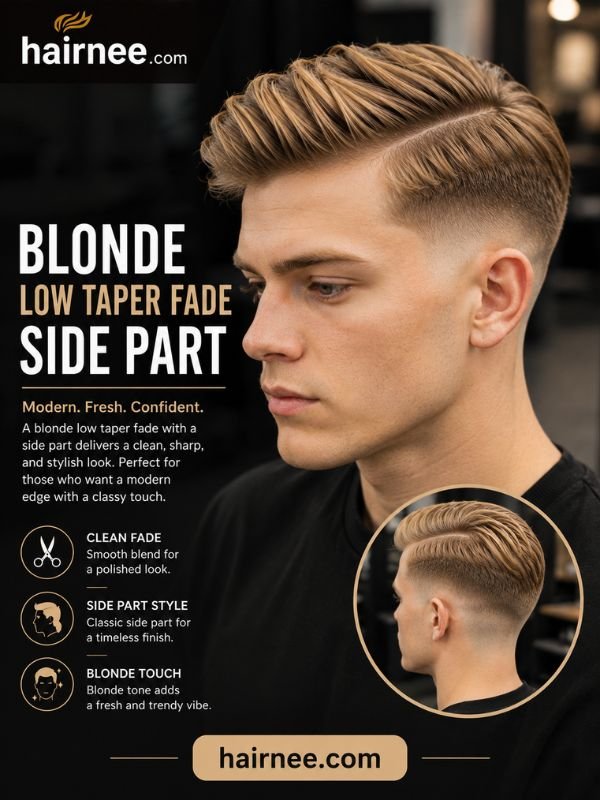
Lightened or natural blonde hair shows the fade’s gradient more clearly than dark hair does, creating a soft transition from golden top to skin. The side part adds structure that blonde hair sometimes needs to avoid looking flat.
Lighter products work best here — anything heavy tends to make blonde hair look greasy rather than glossy.
Suitable hair type: blonde, fine, or medium hair. Maintenance: every three to four weeks.
Layered Low Taper Fade Side Part
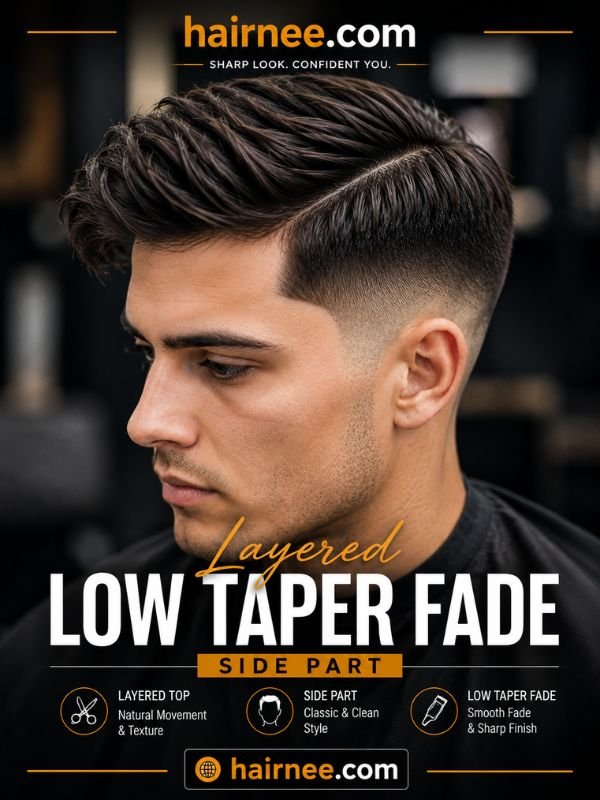
Layering cuts the top hair at different angles so it moves and separates instead of sitting as one solid block. When combed to the side, the layers cascade rather than lying flat.
A styling cream worked through with fingers, not a comb, keeps that separation loose instead of overly neat.
Suitable hair type: medium to long hair. Maintenance: every four weeks.
Trending Low Taper Fade Side Part Hairstyle
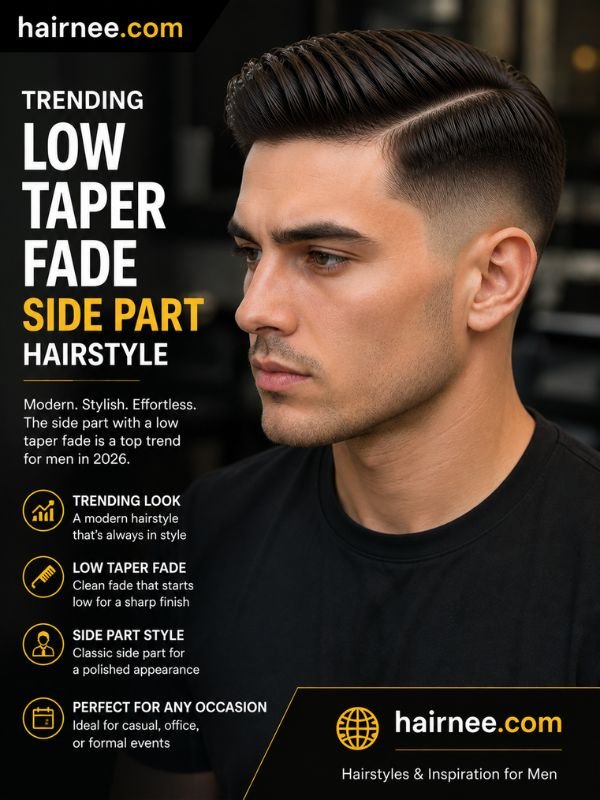
The current trending take softens everything — a deeper side part, a fringe piece dropping slightly toward the brow, and a finish that looks almost undone. It’s the version showing up most on social feeds right now.
Blow-drying the front forward before combing it diagonally to the side gives it that lived-in, not-too-styled look.
Suitable hair type: wavy or straight hair. Maintenance: every three weeks.
Low Taper Fade Side Part with Fringe
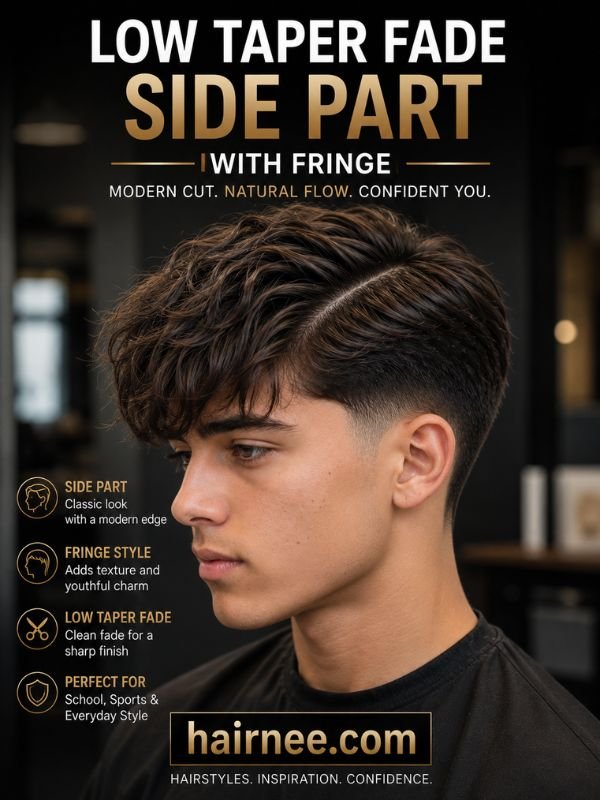
This version drops a section of top hair forward over the brow instead of sweeping every strand to one side. The side part still shows through, but the fringe softens the forehead and adds a bit of edge.
It works especially well on men who want the structure of a part without looking too formal — the fringe piece keeps things casual even in a suit.
Suitable hair type: straight or wavy hair. Maintenance: every three to four weeks.
Low Taper Fade Side Part Undercut
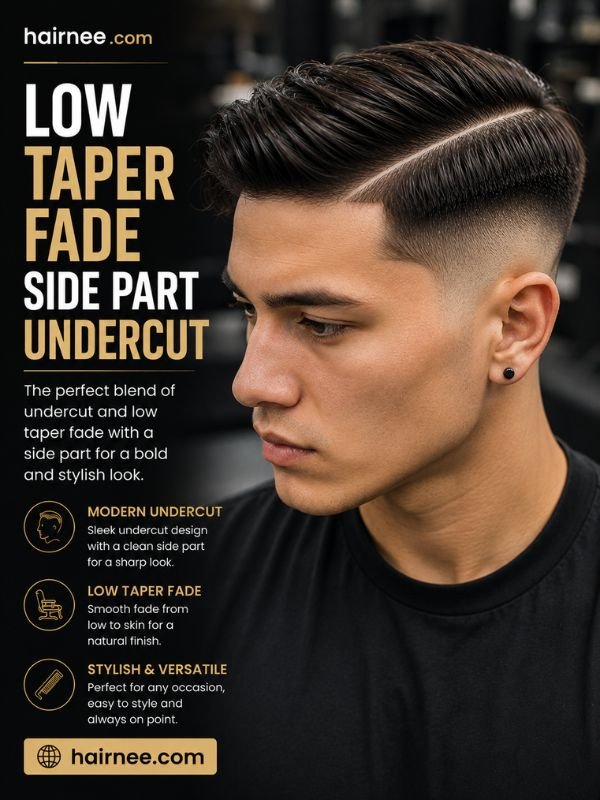
An undercut version pushes the fade higher on the back and sides than a standard low taper, while keeping the front and part detail the same. The contrast between the shorter sides and the top is more noticeable here.
This suits men who want the side part’s neatness but with a bit more edge and definition around the head.
Suitable hair type: thick or medium-density hair. Maintenance: every three weeks.
Low Taper Fade Side Part Pompadour
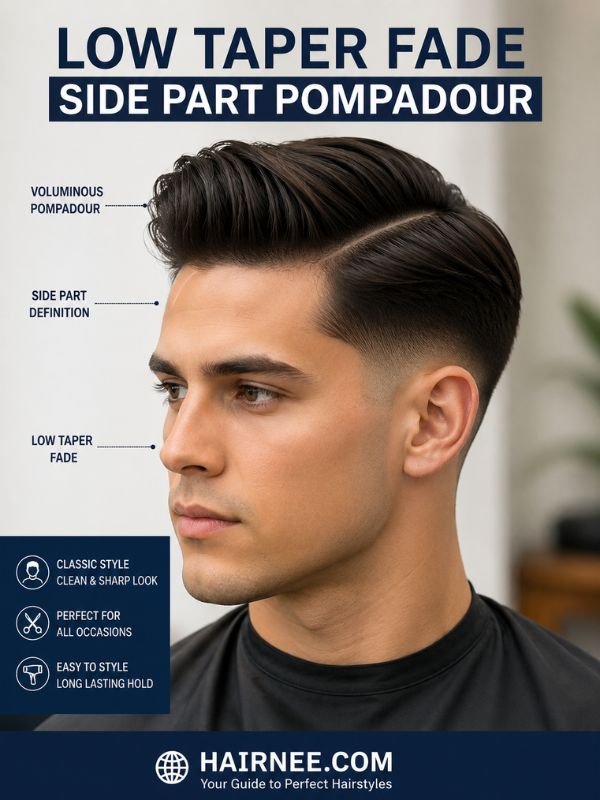
This take borrows height from the pompadour, lifting the front section up and back before the rest falls into a side part further down the head. It’s a bolder, more formal option than the standard cut.
A strong-hold pomade and a round brush are what hold the lift in place through a full day.
Suitable hair type: medium to thick hair. Maintenance: every three to four weeks.
Salt and Pepper Low Taper Fade Side Part
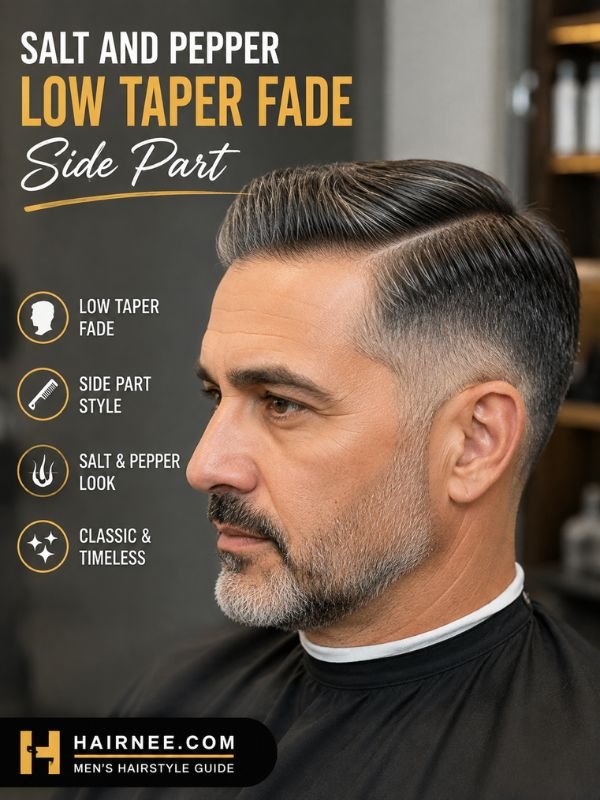
Gray and salt-and-pepper hair shows the fade’s blend differently than solid dark or light hair, often creating a subtle two-tone effect between the top and sides. Many men find this version ages the whole look in a sharper, more distinguished direction.
Keeping the sides slightly longer than a typical low taper helps blend gray regrowth more gracefully between trims.
Suitable hair type: gray, silver, or salt-and-pepper hair. Maintenance: every three to four weeks.
Low Taper Fade Side Part for Older Men
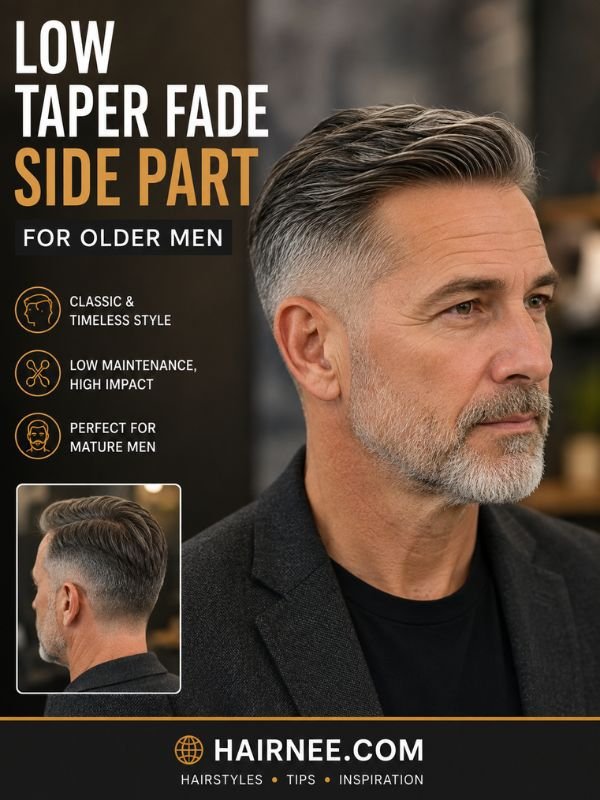
This is a lower-contrast, easy-care version built for men who want a neat, age-appropriate cut without a lot of daily fuss. The fade stays soft, the top length is moderate, and the part is combed rather than razored.
It’s a reliable choice for retirement-age men who still want to look sharp for family events, church, or the office.
Suitable hair type: works with most hair types and densities. Maintenance: every four weeks.
Also Read This Low Taper Fade Straight Hair: 35 Best Hairstyles for Men in 2026
How to Ask Your Barber for a Low Taper Fade Side Part
The fastest way to get this cut wrong is saying “just fade it” and hoping for the best. Barbers hear that request a dozen different ways, so specifics matter more than you’d think.
Use this quick checklist before you sit down:
- Low taper fade — sides and back only, not a skin fade
- Top length — somewhere between two and four inches
- Part style — natural comb part or a shaved hard part
- Line up — optional, mention it either way
What to tell your barber
Say something like: “Low taper on the sideburns and neckline, enough length on top for a side part, nothing shaved above the ear.” That one sentence covers height, length, and finish.
Best clipper guard numbers
Most barbers blend a couple of guard sizes rather than using just one, moving from very short at the nape up to longer near the top. The table below is a rough starting point — your barber will adjust it to your hair density.
| Fade Zone | Common Guard Number | Result |
| Nape and around the ears | #1 or #1.5 | Very short, close to the skin |
| Mid blend area | #2 to #3 | Gradual transition zone |
| Upper sides | #3 to #4 | Blends into the top length |
| Top section | Scissor or clipper-over-comb | Length depends on the style |
Recommended fade height
A genuine low taper fade starts about one to one and a half inches above the ear, well below the temple. Anything higher starts drifting into mid-fade territory.
Some men prefer low taper sides only, leaving the top essentially untouched and letting the fade do all the work — that’s a fair request too, just say so upfront so your barber doesn’t cut into the length on top.
Ideal top length
Two to four inches works for most versions of this cut. Shorter lengths mean less daily styling; longer lengths give you more room for volume and sweep.
Hard part or natural part
A natural part is lower maintenance and blends softly with the fade, while a hard part gives a sharper, more graphic finish that needs touch-ups every couple of weeks. Pick based on how much upkeep you actually want to commit to.
Styling product recommendations
Ask your barber what suits your density — pomade and light cream work well for straight and wavy hair, while curl cream or a light gel usually holds curly hair better than a heavy wax.
Best Face Shapes
This cut adapts to nearly every face shape, but small changes in top length and part depth make it fit better. A quick word with your barber about your face shape before the clippers start usually pays off.
Oval Face
Oval faces are the most balanced shape and can wear almost any version of this cut without restriction, from short and classic to long and swept.
Round Face
Added height on top and a slightly deeper part help elongate a round face, so it doesn’t look wider than it is.
Square Face
A softer, textured top with a low taper on the sides takes the edge off a strong jawline without hiding it completely.
Diamond Face
Keeping a bit of length on the upper sides balances out wide cheekbones so they don’t dominate the whole face.
Heart Face
Sweeping hair to the side reduces the visual width of the forehead, which balances a heart-shaped face’s narrower chin.
Oblong Face
Shorter top length and a bit more width at the sides stop a long face from looking even longer.
Best Hair Types
The core cut stays the same across hair types, but styling technique and product choice shift depending on texture.
Straight Hair
Holds a part naturally with minimal product — usually just enough cream to control shine and flyaways.
Wavy Hair
Adds texture and a slightly undone look on its own, which suits the more relaxed versions of this cut particularly well.
Curly Hair
Works best with a bit more length on top so the curl pattern stays visible while the low taper keeps the sides controlled.
Thick Hair
Can carry more length without losing shape, though a lighter product keeps it from feeling heavy by midday.
Thin Hair
Benefits from a slightly shorter top and a volumizing product that creates the appearance of density.
Medium-Length Hair
The most flexible texture to work with — it takes classic, textured, and voluminous versions equally well.
Pros and Cons
| Pros | Cons |
| Clean, timeless look that rarely dates | Needs some daily styling to keep the part sharp |
| Works for both formal and casual settings | Regular trims required to keep the fade tidy |
| Adapts to most hair types and face shapes | Hard part versions need frequent touch-ups |
| Easy to style at home with basic tools | Curly hair takes a bit more product know-how |
How to Style a Low Taper Fade Slick Back Haircut
A slick back variation starts on damp hair with a small amount of pomade combed straight back from the hairline using smooth, consistent strokes. No part line here — just an even sweep toward the crown.
Best Styling Products
- Water-based pomade for a classic, glossy finish
- Strong-hold gel for humid weather or long days
- Matte clay if you’d rather skip the shine
How to Style a Low Taper Fade Side Part
Start by finding your natural part — the line where your hair already wants to fall is usually the easiest one to work with. From there it’s just product, comb, and a bit of heat.
Best Styling Products
- Light-hold cream for a natural, touchable finish
- Fine-tooth comb for a precise, straight part line
- Texturizing powder for extra volume at the roots
Styling Workflow
Shower and towel dry → apply a small amount of product → comb the part into place → finish with a low-heat blow dry.
Step-by-Step Styling Guide
Start with clean, towel-dried hair — soaking wet hair won’t hold product properly. Find your natural part using a fine-tooth comb before you apply anything.
Warm a pea-sized amount of product between your palms, then work it through from roots to ends. Comb the part in first, then style the rest of the top around that line, finishing with a quick pass of a blow dryer on low heat if you want extra hold.
How to Maintain a Low Taper Fade Side Part
Book a trim every three to four weeks — low tapers grow out more gracefully than high fades, but they still need upkeep to stay sharp. Wash two to three times a week with a mild shampoo so you’re not stripping natural oils.
A few extra habits make a real difference between visits. Use a clarifying shampoo once a month to prevent product buildup, and if you sleep with slightly damp hair, expect your part to look different by morning — towel dry thoroughly before bed. A satin or silk pillowcase also cuts down on frizz for wavy and curly types, and a personal trimmer can keep the neckline fresh between full barber appointments.
Low Taper Fade Side Part vs Comb Over
| Feature | Low Taper Fade Side Part | Classic Comb Over |
| Part line | Defined, natural or shaved | Swept over without a strict line |
| Top hair | Styled to one side with volume | Combed flat across the crown |
| Sides | Low taper around ears and neck | Often a uniform guard length |
| Overall vibe | Modern, structured | Traditional, slick |
Low Taper Fade Side Part vs Slick Back
| Feature | Low Taper Fade Side Part | Slick Back |
| Hair direction | Pushed diagonally to one side | Pulled straight back |
| Part line | Clearly visible | No part line |
| Volume focus | Medium height near the part | Flat top or raised front |
| Best face shapes | Round, oval, square | Oval, angular, square |
Low Taper Fade Side Part vs Quiff
| Feature | Low Taper Fade Side Part | Modern Quiff |
| Front height | Moderate, sleek direction | High vertical sweep |
| Symmetry | Asymmetrical due to the part | Symmetrical, centered |
| Product hold | Medium, flexible | High, strong hold |
| Styling time | Three to five minutes | Eight to ten minutes |
Low Taper Fade vs Mid Taper Fade vs High Taper Fade
The difference between these three comes down to where the fade starts on the head, not how it ends. A low taper starts near the ear, a mid taper starts around the temple, and a high taper climbs closer to the crown.
A low taper reads as the most conservative and grows out the most gracefully, which is why it pairs so naturally with a side part. A high taper fade creates sharper contrast and needs more frequent trims to stay clean, making it a better fit for men who want a bolder look and don’t mind the extra barber visits.
Celebrity Inspiration
Public figures who favor short, tapered cuts with a defined part show how adaptable this style really is. Ryan Gosling has worn a soft side part with tapered sides for a classic, gentleman’s look, while David Beckham has styled textured side parts with low tapers at formal events.
Chris Evans keeps his side part clean enough to highlight a square jawline, and Henry Cavill’s thicker, wavy hair shows how well the cut handles more texture. Saving a few reference photos like these, from the front, side, and back, gives your barber the clearest idea of what you’re after.
Common Mistakes to Avoid
A few small missteps are responsible for most bad versions of this haircut. Watching for these keeps the cut looking consistent between barber visits.
- Asking for “a fade” without specifying low — you might walk out with a high fade instead
- Skipping trims until the fade grows out unevenly and loses its shape
- Using too much product, which hides the part instead of defining it
- Committing to a hard part without planning for the touch-ups it needs
- Not telling your barber your hair type, since straight, curly, and wavy hair all need different handling
- Styling hair while it’s still soaking wet, which stops product from holding once it dries
Summery
The low taper fade side part earns its popularity by doing two things well at once — staying sharp enough for formal settings and relaxed enough for everyday wear. It adapts to straight, wavy, curly, thick, and thin hair without losing its shape.
If you’re after a haircut that looks deliberate today and still grows out cleanly in a few weeks, this is one of the safest bets you can bring to your next barber appointment.
Frequently Asked Questions
What is a low taper on the side?
A low taper on the side is a fade that starts close to the skin near the ear and nape, then blends upward into longer hair, rather than climbing toward the temple like a mid or high fade.
What is a low taper side cut?
A low taper side cut refers to the same style — short, gradually blended sides that stay low on the head, usually paired with more length left on top for styling.
Is fade haram in Islam?
Islamic scholars generally agree that a fade haircut itself isn’t haram, since trimming hair to different lengths on the sides and back doesn’t fall under the hadith prohibition on al-Qaza’ (shaving isolated patches while leaving others long). Several scholars note the ruling can shift based on intention — for instance, cutting hair specifically to imitate someone known for immoral conduct is where concern comes in, not the fade style on its own. As with most fiqh questions, it’s worth checking with a knowledgeable local scholar for guidance specific to your situation.
How often should I get a trim?
Most men schedule a trim every three to four weeks to keep the fade looking sharp and prevent the part line from growing out unevenly.
Does this haircut suit round faces?
Yes — added height on top combined with a deeper side part helps elongate a round face and keeps it from looking wider than it is.
Can I add a beard to this style?
Yes, the low taper blends smoothly into a beard along the jawline, which is why it’s a common pairing for men growing out facial hair.
What’s the difference between a side part and a comb over?
A side part has a defined line dividing the hair, while a comb over sweeps hair across without a hard part line underneath it.

Hi, I’m Jake Miller a passionate barber based in Los Angeles, California, with over 3 years of hands-on experience in the craft. I specialize in modern fades, clean cuts, precision beard grooming, and classic barbering techniques, blending sharp technical skill with a relaxed, personal touch.
Over these years, I’ve had the opportunity to work with all kinds of clients, each with their own style and personality and that’s exactly what I love about this craft. For me, it’s never just about a haircut. It’s about understanding who you are and bringing that out through precision and care.
Every client who sits in my chair gets my full attention and expertise, because I believe great barbering is where confidence meets individuality. My goal is simple: to make sure you walk out looking sharp and feeling like the best version of yourself.

1 thought on “Low Taper Fade Side Part: 25 Best Hairstyle Ideas for Men (2026)”