

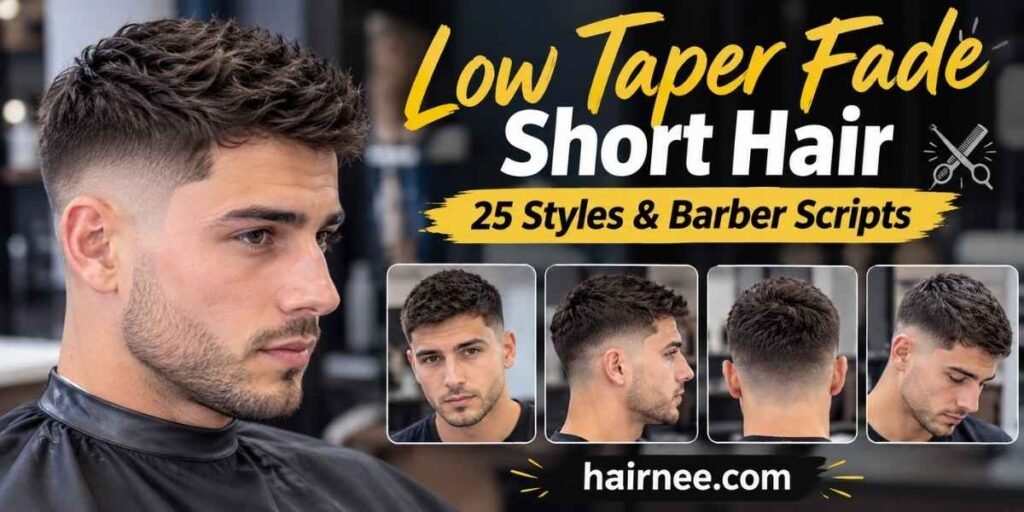
A low taper fade short hair cut keeps the top short and blends the sides down from about an inch above the ear to a clean neckline. It looks neat, grows out slowly, and fits most face shapes and hair types.
This guide gives you 25 styles, guard numbers, face shape picks, texture tips, and the exact words to say in the chair. Use the scripts, bring two photos, and you’ll leave with the exact cut you pictured.
What a low taper fade is for short hair
A low taper fade for short hair shortens the sides and neckline step by step, starting about an inch above the ear, while the top stays short. “Low” tells you where the fade starts, not how short the cut is. Most short tops sit between half an inch and an inch and a half, and the sides blend down to skin or near-skin around the ears and nape with no hard line.
At the chair, “low” means different things to different barbers, so many guys ask for it and get a mid fade. Pro tip: point to the spot above your ear and say “start it here.” One finger saves a lot of guessing.
How a low taper compares to mid and high fades
A low taper starts near the ear, a mid fade starts around the middle of the side, and a high fade starts up near the temple. The lower the fade starts, the softer the cut looks.
| Fade height | Where it starts | Look | Grow-out |
| Low taper | About 1 inch above the ear | Soft, natural | Slowest to show |
| Mid taper | Middle of the side of the head | Balanced, clear contrast | Medium |
| High fade | Near the temple and crown | Bold, sharp contrast | Fastest to show |
Pro tip: if you are unsure, start low. You can go higher at the next visit, but you can never glue hair back on. On short hair this matters even more, because a high fade can make the whole head look shaved when the top has so little length to balance it.
Low taper fade vs low fade: the difference people miss
A taper keeps a little hair even at its shortest point, while a fade goes down to skin somewhere. A low taper fade mixes both: a taper’s soft, low shape with a skin-close edge at the neckline.
| Term | Shortest point | Look |
| Low taper | Short hair stays, about #1 to #2 | Soft, no bare skin |
| Low taper fade | Skin-close at the neckline and ears | Soft shape, clean edge |
| Low fade (skin fade) | Bare skin | Sharper contrast |
Barbers use these words loosely, so the guard number matters more than the name. Pro tip: say “no skin” if you want hair left at the bottom, or “skin at the bottom” if you want the clean edge.
Low taper fade guard numbers for short hair
For a low taper fade on short hair, most barbers start with a #1 or #1.5 guard at the bottom and blend up through #2 to a #2 or #3 where the fade ends. The top then stays at the same length or longer than the top of the fade zone.
| Guard | Cut length | Where it is used |
| #0 (no guard) | Skin | Skin-close edge at the neckline |
| #0.5 | About 1.5 mm | Very tight bottom of the fade |
| #1 | About 3 mm (1/8 inch) | Standard bottom of a low taper fade |
| #1.5 | About 4.5 mm | Softer bottom, a bit more hair |
| #2 | About 6 mm (1/4 inch) | Middle of the blend or a buzz top |
| #3 | About 10 mm (3/8 inch) | Top of the fade zone or a longer buzz top |
| #4 | About 13 mm (1/2 inch) | Buzz top for fuller, softer looks |
Pro tip: give your barber two numbers, like “1.5 at the bottom, blending to 3.” A guard number is exact, while “not too short” is a guess. Sizes can vary a little between clipper brands, so treat these as a guide.
Why the low taper fade suits short hair
It suits short hair because it adds clean shape without taking away the soft, tidy look. It works at the office, on a job site, or on a night out, and it looks neat right out of the chair.
Pro tip: if your top is under an inch, ask for the fade to stay low and soft. That is where this cut works best. Short tops have very little hair to hide behind, and a low fade keeps some hair around the sides, so the cut stays rounded and relaxed, not severe.
It stays low-maintenance between cuts
Regrowth is hard to spot for the first two to three weeks, because the fade zone is small and sits low on the head.
The American Academy of Dermatology says scalp hair grows about half an inch a month. The short, faded area shows that growth sooner than the top, but a low fade still looks tidy longer than a high one. Pro tip: book your next visit before you leave the shop. It keeps you on a steady schedule.
It works across hair types
It works on thick, fine, straight, wavy, curly, and coily hair. Only the top style and the product change.
Pro tip: tell your barber your hair type before the clippers come out. It changes how they cut the top. Thick hair holds a textured crop well. Fine hair looks fuller because the eye goes to the clean edge, not the density on top. Curly and coily hair avoids the patchy look that a higher fade can cause.
Read More Related Posts Long Hair Low Taper Fade: 25 Styles, Guard Numbers & Care
Best low taper fade short hair styles
The best low taper fade short hair styles are the crew cut, textured crop, buzz cut, slick back, and curly top. Pick the one that matches how much time you want to spend on your hair each morning. Under each style below you will find extra variations with a short script you can say to your barber.
| Style | Top length | Daily time | Best for |
| Crew cut | 3/4 to 1 inch | Almost none | Neat, no-fuss look |
| Textured crop | 1 to 1.5 inches | About 2 to 3 minutes | Straight or wavy hair, a modern look |
| Buzz cut | #2 to #4 guard | None | Lowest upkeep |
| Slick back | About 2 inches | About 3 minutes | Smart, formal look |
| Curly top | 1.5 to 3 inches | 2 to 5 minutes | Natural curls and coils |
Pro tip: be honest about your morning routine. A cut you can’t style fast is a cut you will stop liking.
Crew cut with a low taper
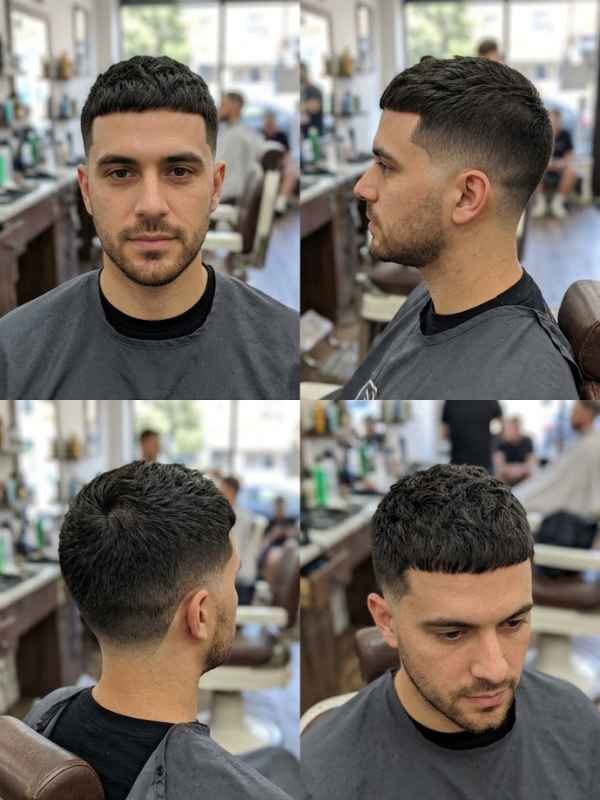
A crew cut with a low taper keeps the top at about 3/4 to 1 inch and blends the sides low. It needs only a towel dry and maybe a dab of matte paste.
- Classic crew cut. An even top, slightly longer at the front. Say: “Low taper, about an inch on top, even all over, #1.5 to #3 on the sides.”
- Ivy League cut. A little more length, enough to part to the side. Say: “Low taper, an inch and a half on top, long enough to part.”
- Flat top. The top is cut level, like a table. Say: “Low taper, flat top, keep the top level and square.”
Pro tip: ask for the top to be cut a touch longer at the front. It gives the crew cut a softer, more current look.
Textured crop with a low taper
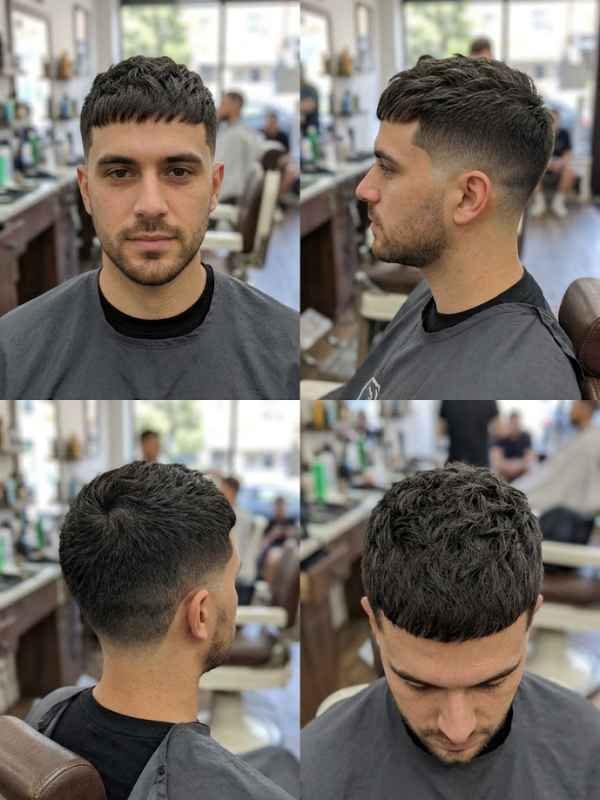
A textured crop keeps about 1 to 1.5 inches on top, cut choppy so it sits messy and matte. It feels more current than a plain crew cut.
- Classic textured crop. Choppy top, forward-brushed. Say: “Low taper, an inch and a half on top, point cut for texture.”
- French crop. A short fringe cut straight across the forehead. Say: “Low taper, French crop, short fringe cut straight across.”
- Short textured fringe. A slightly longer front that falls toward the brow. Say: “Low taper, textured fringe, keep the front soft and piecey.”
- Spiky top. Small, upward pieces set with clay. Say: “Low taper, short spiky top, point cut and lifted.”
Ask for point cutting, not thinning shears, if your hair is thick. Pro tip: thinning shears can leave thick hair frizzy, while point cutting removes weight and keeps the top smooth.
Buzz cut with a low taper
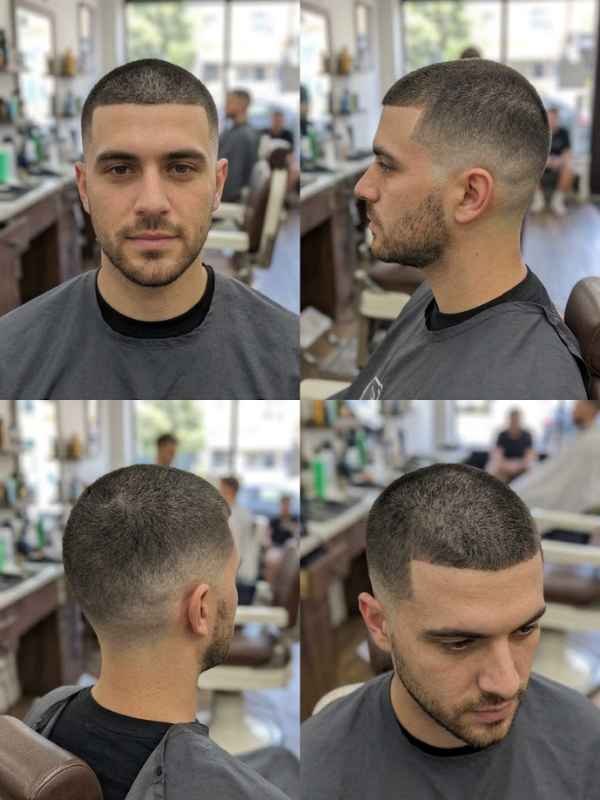
A buzz cut with a low taper uses one guard on top, usually #2 to #4, and fades low around the ears and neckline. It is the lowest-effort option here, and it can go three to four weeks between cuts.
- #2 buzz. Short and sharp. Say: “#2 on top, low taper starting just above the ear.”
- #3 to #4 buzz. Softer, with a little texture. Say: “#3 on top, low taper, #1.5 at the bottom.”
- Buzz with a line-up. A razor-sharp edge along the hairline. Say: “Buzz on top, low taper, clean line-up at the front.”
- Buzz with a beard blend. The sideburn fades into the beard. Say: “Low taper that blends into my beard, no hard line.”
The top guard should be the same length as the top of the fade zone, or longer. Pro tip: if the sides end up longer than the top, the cut looks upside down. Say your top guard out loud first.
Slick back with a low taper
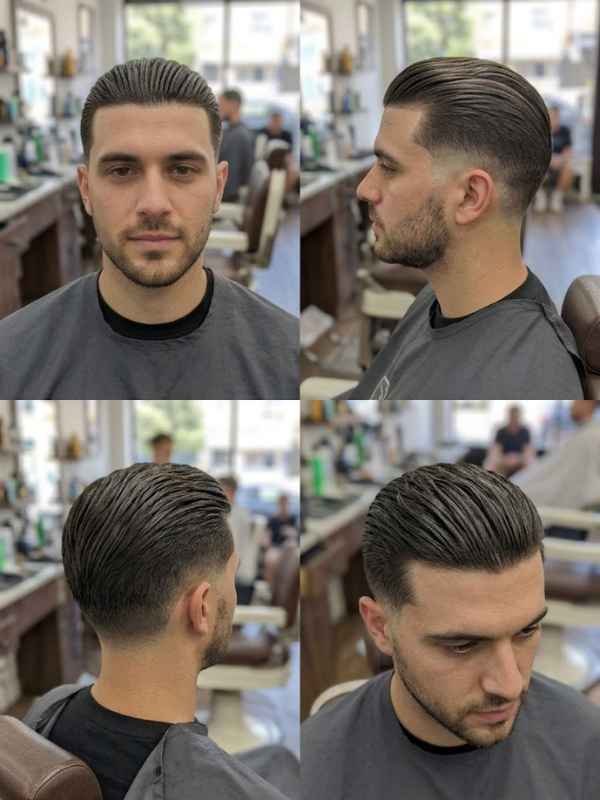
A slick back with a low taper keeps about 2 inches on top, combed back with a light pomade. The low sides keep it tidy instead of stiff.
- Short slick back. Combed straight back. Say: “Low taper, about two inches on top, to slick back.”
- Short side part. A neat, comb-over feel. Say: “Low taper, side part on the left, two inches on top.”
- Short quiff. A little lift at the front. Say: “Low taper, short quiff, extra length at the front.”
A water-based pomade combs through damp hair and washes out easily. Pro tip: use a small amount and work it from the back to the front. Too much product is the fastest way to ruin this look.
Curly top with a low taper
A curly top with a low taper keeps your curls on top, about 1.5 to 3 inches, and fades the sides low. The low start plays up the texture instead of fighting it.
- Short curly top. Defined curls, clean sides. Say: “Low taper, keep the curls on top, cut the top dry.”
- Twist sponge. Coils twisted into small tubes with a sponge. Say: “Low taper, I’ll twist the top, so leave two inches.”
- Cropped afro. A rounded, even shape. Say: “Low taper, cropped afro, shape the top round.”
- Short waves. Brushed waves on a very short top. Say: “Low taper, #2 to #3 on top, for brushed waves.”
Curls spring up when they dry, so a wet cut can end up shorter than planned. Pro tip: ask the barber to cut the top dry, or to leave extra length and check it after it dries.
Choosing a low taper fade for your face shape
Pick the top style by face shape. The low taper works on all of them, so the change happens on top and at the hairline.
| Face shape | Top style that works | Why |
| Round | Textured crop or crew cut with height | Adds length to balance the width |
| Square | Slick back or crew cut, styled slightly off-center | Softens a strong jaw |
| Oval | Almost anything, including a buzz cut | Balanced proportions suit most cuts |
| Long / oblong | Textured crop with a fringe or side volume | Adds width and breaks up the length |
| Heart | Curly top or crop with fullness at the temples | Balances a wider forehead |
| Diamond | Textured fringe | Softens the width at the cheekbones |
Pro tip: a tight buzz on a round face often looks flat, so half an inch more on top usually fixes it. You can check your shape at home: pull your hair back and compare your forehead, cheekbones, jaw, and face length in the mirror. Also tell your barber about a receding or uneven hairline, so the fade is blended there instead of cut with a hard edge.
Low taper fade for straight, wavy, curly, and coily hair
The low taper is the same on every texture. What changes is the top length, the way the barber cuts it, and the product you use.
Straight hair
Straight hair shows every line, so a clean, even blend matters most. That is a plus, because a good low taper looks very sharp here.
Pro tip: ask your barber to check the blend again once the hair is dry. Any small unevenness is easy to see on straight hair. A light matte clay or fiber paste works best, since heavy pomade makes straight hair look greasy fast.
Wavy hair
Wavy hair adds natural texture on top, so a textured crop or crew cut suits it better than a very flat style. It also hides growth well between cuts.
Work a little sea salt spray or texturizing cream into damp hair to bring out the wave without making it heavy. Pro tip: let it air dry for a few minutes before adding product. Wet hair soaks up too much.
Curly hair
Curly hair changes shape when it dries, so the fade has to leave room for that spring. A low start avoids the patchy look that tight curls can get with a higher fade.
Use a light curl cream, not clay, because paste flattens curl definition. Pro tip: tell your barber to cut the top dry, or to leave it longer than you think you need. You can always cut more, but you can’t put it back.
Coily hair
Coily hair shrinks the most, often by half or more once it dries, so a barber should check the cut both stretched and relaxed. It also dries out fast, so a leave-in or curl cream is part of upkeep, not only styling.
Pro tip: ask for a shape-up after the fade. A clean line at the forehead and temples turns a good low taper into a finished look. Your barber can also check the blend with a comb or pick to see the true length.
Read More Related Posts Long Hair Low Taper Fade: 25 Styles, Guard Numbers & Care
Low taper fade for thinning or receding hairlines
With thinning hair or a receding hairline, keep the top short and matte, start the fade low, and ask the barber to soften the blend near the temples instead of cutting a sharp edge.
Bare skin next to thin hair makes the thin spots more visible. A #1.5 or #2 at the bottom works better than skin, and a #3 or #4 buzz on top keeps the look even. Matte products help, because shine shows the scalp. Before the clippers come out, say “keep the transition gradual, no hard line near the thin spot.” It is much harder to fix after.
What to ask your barber for a clean low taper
Tell your barber three things: where the fade starts, how long the top is, and how the two should meet. Vague words like “not too short” give the barber very little to work with. Here is a script you can use as it is: “Start the fade about an inch above my ear, keep the top around an inch to an inch and a half, and blend it so there’s no visible line where they meet.”
- Bring a front photo and a side photo. The side photo shows how high the fade really goes.
- Mention a cowlick, receding hairline, or thin spots before the clippers start.
- If you liked a past cut, share the guard numbers used.
- Ask the barber to show you the guard before going shorter.
| Term | What it means |
| Taper | Hair gets shorter but never reaches bare skin |
| Fade | Hair gets shorter down to skin at some point |
| Blend | The smooth change between two lengths, with no visible line |
| Skin fade | A fade that goes all the way to the skin |
| Line-up | A sharp edge along the hairline or neckline |
| Guard number | The clipper attachment that sets how much hair is left |
Pro tip: photos can mislead, because lighting, hair density, and camera angle change how a fade looks. Pair every photo with a short description in inches or guard numbers.
How to style a low taper fade at home
Blot your hair dry, add a pea-sized amount of matte clay or paste, warm it in your palms, and work it from the roots out. A textured crop takes about three minutes.
Pro tip: for a slick back, use water-based pomade on damp hair. It holds the shape without the greasy buildup that oil-based products leave. Rubbing short hair hard with a towel roughs up the strands and makes it frizzy, so blot it instead. If you use a hair dryer, keep it on low and cool, and keep high heat off the scalp near the fade line. Curly and coily tops do better with a light curl cream or leave-in than with clay.
How often to get a low taper fade touched up
Most short low taper fades need a touch-up every 2 to 4 weeks, depending on the top style and how fast your hair grows. The short, faded area shows growth sooner than the top does.
| Style on top | Touch-up window | Why |
| Buzz cut with low taper | 3 to 4 weeks | Even short length hides regrowth longer |
| Crew cut with low taper | 2 to 3 weeks | The longer top shows unevenness sooner |
| Textured crop with low taper | 2 to 3 weeks | Texture needs regular reshaping |
| Slick back with low taper | About 3 weeks | The longer top gives some flexibility |
| Curly top with low taper | 3 to 4 weeks | Curl shrinkage hides growth |
Between visits, a trimmer with a guard can tidy the neckline, but leave the blended area to your barber, because blending it yourself can leave visible lines. Pro tip: wash with a gentle, sulfate-free shampoo two or three times a week so clay and pomade don’t build up and make short hair look dull. Booking early also means your barber maintains the shape instead of rebuilding a grown-out one.
Common low taper fade mistakes and how to avoid them
The most common mistake is describing the cut with vague words like “low” or “not too short.” Most bad haircuts start as a communication problem, not a skill problem.
| Mistake | Fix |
| Asking for “a fade” with no height | Say low, mid, or high, and point to the spot |
| Saying “not too short” | Give the guard numbers and the top length in inches |
| Showing only a front photo | Bring a front photo and a side photo |
| Not mentioning a cowlick or hairline | Tell the barber before the clippers start |
| Going too high on a short top | Keep the fade low so the cut stays soft |
| Cutting curly hair wet | Ask for a dry cut or extra length |
| Using too much product | Use a pea-sized amount and build up slowly |
| Waiting until it’s fully grown out | Rebook every 2 to 4 weeks |
Pro tip: if the cut isn’t right, tell your barber while you are still in the chair. Most fixes are quick before you leave and much harder a week later.
Low Taper Fade Short Hair on top
Beyond the five main styles, these seven short-top variations cover beards, parts, hairlines, first-timers, and the office. Each one has a short script you can use as it is.
- Caesar cut. A short top brushed forward with a straight fringe. Say: “Low taper, Caesar cut, half an inch to an inch brushed forward.”
- Short hair with a beard. The fade runs into the beard with no hard line. Say: “Low taper that blends into my beard at the sideburn.”
- Hard part. A shaved part line on a short side part. Say: “Low taper, short side part with a hard part line.”
- Thinning-hair version. A softer fade with a short, matte top. Say: “Low taper, #1.5 bottom, no skin, short matte top.”
- Receding-hairline version. The fade is blended around the temples. Say: “Low taper, blend the temples softly, no sharp edge.”
- First-fade soft version. The gentlest low taper. Say: “This is my first fade, #2 at the bottom, show me before going shorter.”
- Office-conservative. No skin showing and a gradual blend. Say: “Conservative low taper, #2 at the bottom, nothing dramatic.”
Pro tip: use the soft versions if you are unsure. A softer cut is easy to take shorter next time, and a bold one is much harder to undo.
Final Thoughts
The low taper fade works on short hair because it keeps the sides clean without making the cut look harsh. It grows out slowly, suits most faces and textures, and gives you a style that looks the same on a Monday morning as it did in the chair.
Pick the top style that fits your face and routine, give your barber guard numbers and a side photo, and book your next visit before you leave. That small routine is what gets you the same cut every time. Save this guide, copy the script that fits your style, and take two photos to your next appointment.
Frequently Asked Questions
What does a low taper fade mean for short hair?
It means the sides and neckline shorten gradually, starting about an inch above the ear, while the top stays short. The fade is soft and low, so the cut looks neat and not shaved.
How often should I get a low taper fade trimmed?
Every 2 to 4 weeks for most short styles. Buzz cuts and curly tops can stretch to 3 or 4 weeks.
Does a low taper fade suit curly hair?
Yes. The low start avoids the patchy look that tight curls get with higher fades. Ask for a dry cut.
What’s the difference between a low taper fade and a high fade?
A low taper fade starts near the ear and looks soft. A high fade starts near the temple and has sharper contrast, and it grows out faster.
Can I maintain a low taper fade at home between visits?
You can tidy the neckline with a trimmer and a guard. Leave the blended area to your barber.
Which face shapes suit a low taper fade best?
All of them. Round faces do well with height on top, square faces with a softer top, and oval faces with almost anything.
Is a low taper fade a good choice for professional workplaces?
Yes. A conservative version with a #2 at the bottom and no skin showing looks neat in any office.
Hi, I’m Jake Miller a passionate barber based in Los Angeles, California, with over 3 years of hands-on experience in the craft. I specialize in modern fades, clean cuts, precision beard grooming, and classic barbering techniques, blending sharp technical skill with a relaxed, personal touch.
Over these years, I’ve had the opportunity to work with all kinds of clients, each with their own style and personality and that’s exactly what I love about this craft. For me, it’s never just about a haircut. It’s about understanding who you are and bringing that out through precision and care.
Every client who sits in my chair gets my full attention and expertise, because I believe great barbering is where confidence meets individuality. My goal is simple: to make sure you walk out looking sharp and feeling like the best version of yourself.

1 thought on “Low Taper Fade Short Hair: 25 Styles & Barber Scripts”