

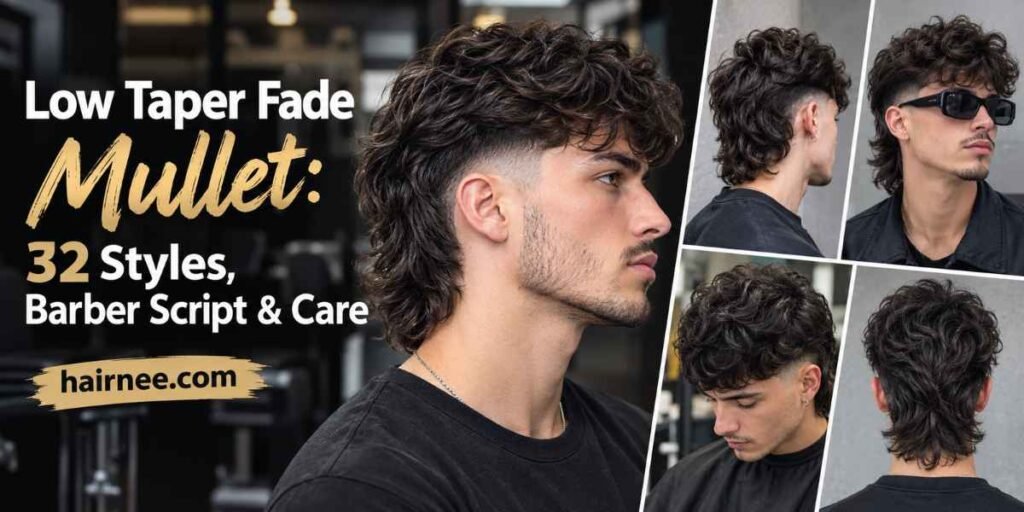
A low taper fade mullet is a haircut with short, softly faded sides and a longer back. The fade starts low, near the ears and neckline, so the cut stays neat.
This guide covers 32 styles, the exact words to tell your barber, clipper guard numbers, hair type and face shape fit, and how to keep the cut sharp.
What is a low taper fade mullet?
A low taper fade mullet is a mullet where the sides get shorter step by step near the sideburns, ears, and neckline, while the top and back stay longer. Because the fade sits low, the sides look clean instead of shaved.
A taper trims the edges and leaves more hair than a skin fade does. The “mullet” part means length kept at the back, usually 10 to 15 cm (4 to 6 in). Modern versions blend the layers, so there is no hard step from short to long like the 1980s cut had.
Pro tip: Ask for “low taper” and “keep the back long” as two separate points. The word “mullet” means different things to different barbers, and splitting the request clears up most mix-ups.
The features that define the cut
A low taper fade mullet has five features: a low fade that starts about 2.5 cm (1 in) above the ear, a top you can style, a longer back, a smooth blend, and soft layers. If one is missing, the cut looks unfinished.
Pro tip: Check the back first. In the chair, the cut usually goes wrong at the back, not at the fade.
- Fade: starts low, near the ears and neckline.
- Top: about 7 to 12 cm (3 to 5 in) so you can push it forward, back, or leave it loose.
- Back: about 10 to 18 cm (4 to 7 in), always longer than the sides.
- Blend: gradual, with no hard line between short and long.
- Layers: soft and feathered, not blunt.
The mix of a neat front and an easy back is why people ask for it. It looks like a normal taper from the front and shows its personality from behind.
Low taper vs low fade: what’s the actual difference?
A low taper trims only the edges, mostly the sideburns and neckline, and leaves most of the side length. A low fade removes more hair and can go all the way down to the skin.
Barbers use both words loosely, so the safest move is to show a photo. Here is how they usually differ.
| Feature | Low taper | Low fade |
| Hair removed | Edges only | More of the sides |
| Reaches skin | Rarely | Often |
| Look | Soft and natural | Sharper contrast |
| Touch-up | Every 3 to 4 weeks | Every 2 to 3 weeks |
| Best for | First mullet, office | Stronger contrast |
Pro tip: If you want the mullet to look “grown in”, pick the taper. If you want clear contrast between short and long, pick the fade.
Read More Related Posts Low Taper Fade Short Hair: 25 Styles & Barber Scripts
Why choose a low taper fade mullet over other mullet styles?
It looks neat from the front, hides real length at the back, and grows out better than high-contrast fades. The fade sits near the hairline, so regrowth shows slowly.
Hair grows about 1.25 cm (0.5 in) a month. That is why a high or skin fade looks soft in two weeks, while a low taper still looks fine at four. Here is how the common fade types compare.
| Fade type | Where it starts | Typical touch-up | Best for |
| Low taper fade mullet | Near the ears and neckline | Every 3 to 4 weeks | Everyday and office wear |
| Low skin fade mullet | Just above the ear | Every 2 to 3 weeks | Clean, sharper look |
| Mid fade mullet | Mid temple | Every 2 to 3 weeks | Balanced contrast |
| High fade mullet | Upper head | Every 2 weeks | Bold, loud looks |
| Burst fade mullet | Curves around the ear | About every 3 weeks | Shape and contrast |
| Drop fade mullet | Dips behind the ear | About every 3 weeks | Curved outline |
| Disconnected mullet | Sharp line, no blend | About every 3 weeks | Edgy styles |
Pro tip: Weigh the trade-offs before you book.
- Good: office-friendly, easy to grow out, works on most hair types.
- Not so good: the fade needs regular touch-ups, the tail takes months to grow, and a few dress codes still frown on it.
Best low taper fade mullet styles and variations
Pick a style by your hair texture, hair thickness, and how much time you want to spend styling, not by a photo alone. This guide covers 32 styles: five main ones first, then 27 more in quick-pick tables.
The back view matters most, so bring photos from the front, side, and back. That one habit saves a lot of “this isn’t what I wanted” moments.
The textured crop mullet
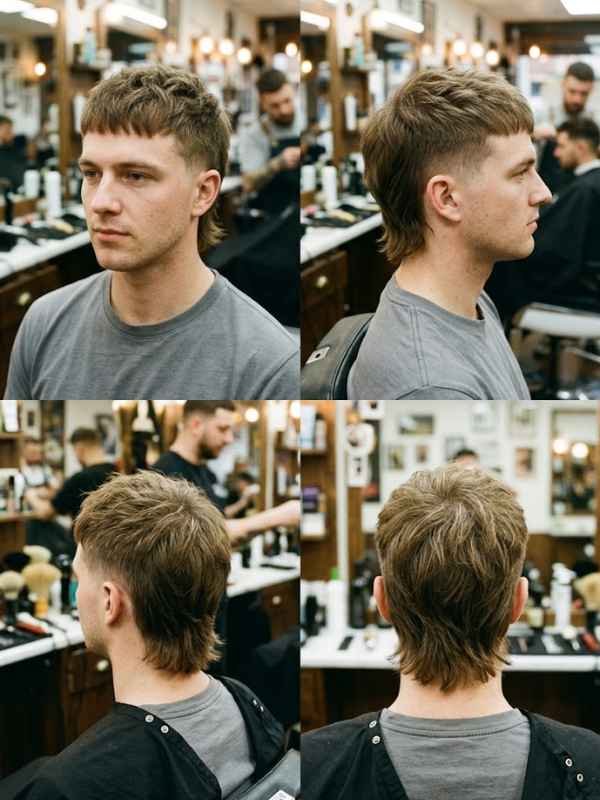
The textured crop mullet pairs a low taper with short, choppy layers on top and a small tail. It works best on thick or wavy hair.
Barbers get the choppy look with point cutting or texturising shears. Fine, straight hair can still wear it, but it needs matte paste or texture powder for grip. A good starting point is a top of 5 to 7.5 cm (2 to 3 in) and a tail that reaches the collar. Pro tip: Ask for “point-cut top, layered tail” so the back doesn’t come out blunt.
The curly mullet fade
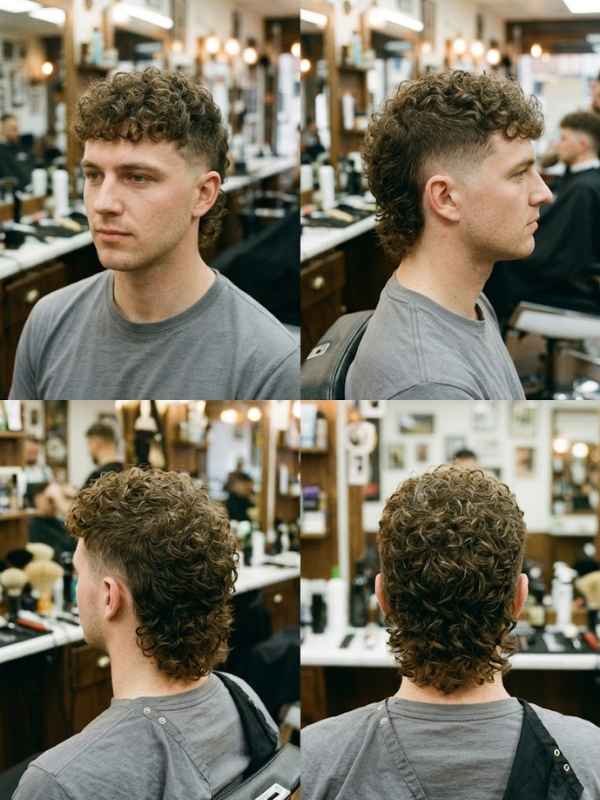
The curly mullet fade keeps natural curls on top and at the back, while the low taper keeps the sides tidy. Curls add volume on their own, so styling stays light.
Curls shrink as they dry, so hair looks shorter than it did when wet. Tell your barber, and leave a little extra length. A curl cream or light gel on damp hair keeps the pattern without the crunch.
Pro tip: Ask the barber to check your length with the curls dry, so you see the real result before they cut.
The slicked-back business mullet
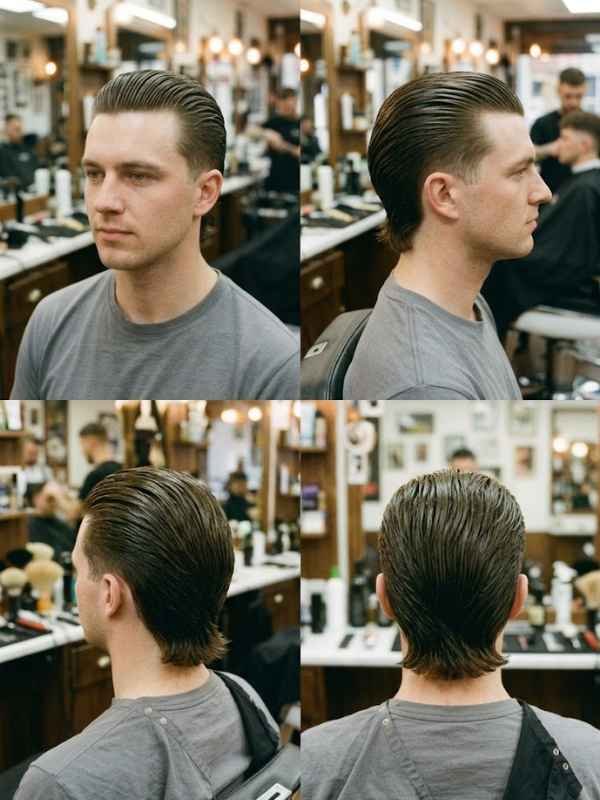
The slicked-back business mullet combs the top straight back with pomade, so the tail stays hidden until someone sees you from the side. It is the most polished version.
Pro tip: Apply a medium-hold pomade to slightly damp hair and comb it once. Too much product makes the top look flat and greasy.
You need about 10 to 12 cm (4 to 5 in) on top for this to work. It suits creatives and office workers who want a small edge without a loud look. A blow dryer on low heat sets the shape.
The shaggy surfer mullet
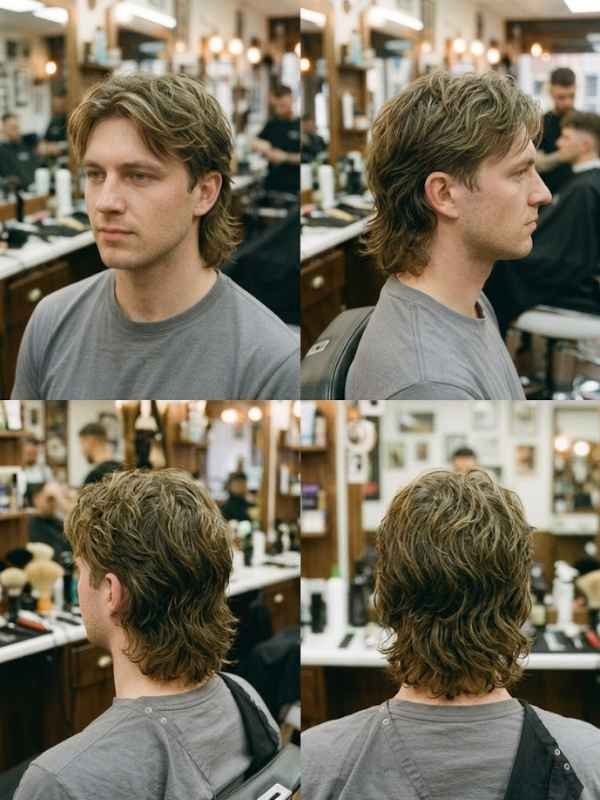
The shaggy surfer mullet keeps the top long and loose, with tousled layers instead of a sleek finish. It works best on wavy hair and gives a relaxed, lived-in look.
A sea salt spray gives it grip. Scrunch it in with your fingers and let it dry. The clean low taper underneath is what makes the messy top look planned. Pro tip: Skip the comb. Combing pulls out the waves and leaves the shape flat.
The wolf cut hybrid
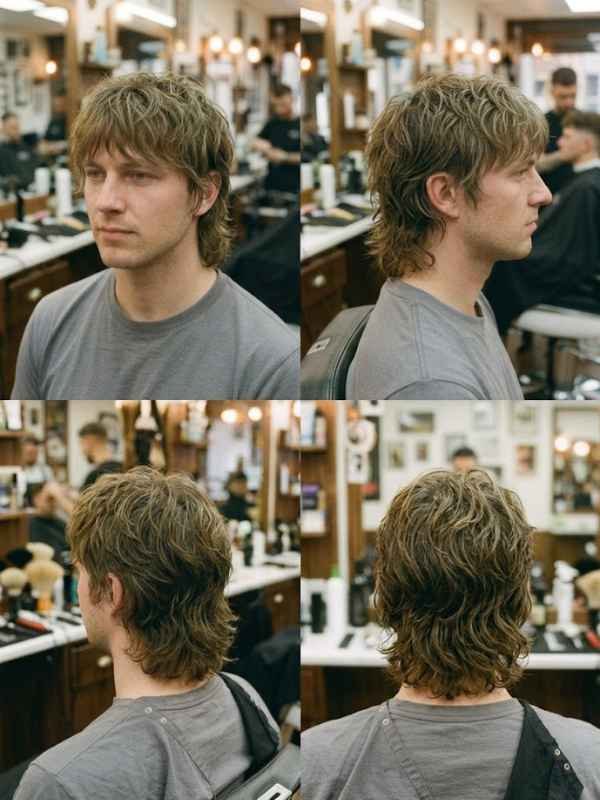
The wolf cut hybrid mixes a low taper fade mullet with a wolf cut, which is built on heavy layers. You lose the clear step at the back and get a fuller, more even flow.
Pro tip: Ask for the layers to start at the crown, not at the ears. That keeps the low taper clean while the top and back stay full.
It suits medium-length hair and sits between a classic mullet and a full shag. It also pairs well with a fringe at the front.
More low taper fade mullet variations (quick-pick list)
These are the other 27 styles, grouped by what changes: the fade shape, the top, the back length, the hair texture, the extras, and your daily life. Add the five above and you have all 32.
Pro tip: Pick one change at a time. Fade shape plus top plus length all at once is how people end up with a cut they can’t describe.
Fade shape variations (5)
These change only the fade, so the top and back stay the same. Pick the one that matches how much contrast you want.
| Variation | What it is | Ask your barber |
| Classic low taper mullet | Balanced baseline, easy first mullet | “Low taper, medium top, tail at the collar.” |
| Lower taper mullet | Taper touches only sideburns and neckline | “Keep the taper as low as possible.” |
| Low taper burst mullet | Fade curves around the ear | “Low taper burst around the ear, keep the back long.” |
| Low taper drop mullet | Fade dips behind the ear | “Low taper drop that follows the ear, long tail.” |
| Low taper to skin mullet | Taper ends at skin at the very bottom | “Low taper blending to skin at the base only.” |
Top and fringe variations (9)
These change the top and the front. The sides and back stay as they are.
| Variation | What it is | Ask your barber |
| Textured fringe mullet | Choppy fringe that falls forward | “Point-cut the fringe, low taper on the sides.” |
| French crop mullet | Short, straight-across fringe with a small tail | “French crop fringe, low taper, small tail.” |
| Middle part mullet | Centre split with a slightly retro feel | “Centre part, soft layers, low taper.” |
| Side part mullet | Neat parted top, office-friendly | “Side part, low taper, tail at the collar.” |
| Quiff mullet | Top lifted at the front | “Quiff on top, low taper, layered back.” |
| Faux hawk mullet | Top pushed up in the centre, not shaved | “Faux hawk shape, low taper, long back.” |
| Flow mullet | Medium top that sweeps back naturally | “Flow on top, low taper, blended back.” |
| Fluffy blowout mullet | Blow-dried top with soft volume | “Layered top for a blowout, low taper.” |
| Hard part mullet | Part cut into one side for a sharp line | “Hard part on the left, low taper on the sides.” |
Pro tip: A hard part softens fast. Plan to redraw the line every two weeks or so.
Back length variations (2)
The tail is the main feature of a mullet, so pick the length you can live with.
| Variation | What it is | Ask your barber |
| Short (baby) mullet | Back only slightly longer than the top | “Low taper, tail just past the nape.” |
| Long tail mullet | Tail passes the collar, toward the shoulders | “Low taper, long layered tail, only tidy the ends.” |
Hair texture variations (5)
These change how the cut is layered so it works with your hair, not against it.
| Variation | What it is | Ask your barber |
| Permed mullet | Perm adds curl and body to straight hair | “Low taper, permed top and back.” |
| Asian straight, thick hair mullet | Layers remove weight from dense, straight hair | “Low taper, thin out the weight, keep the tail.” |
| Afro or coily mullet | Full curls on top, tidy low taper on the sides | “Low taper, shape the afro, keep the back full.” |
| Fine or thin hair mullet | Shorter tail so the hair looks fuller | “Low taper, short tail, light layers.” |
| Two-block (Korean) mullet | Short sides and a longer top block | “Two-block cut with a low taper and soft fringe.” |
Color and extras variations (3)
These add something to the haircut itself, like color or a beard.
| Variation | What it is | Ask your barber |
| Blonde mullet | Lighter color makes layers easier to see | “Low taper mullet with a blonde top.” |
| Mullet with a beard | Sideburn fade blends into the beard | “Blend the fade into the beard line.” |
| Mullet with a shaved line | Small shaved line or pattern in the fade | “Low taper with one thin shaved line.” |
Pro tip: Trim the beard and the haircut in the same visit. They age at the same pace, so the whole look stays even.
Lifestyle variations (3)
These are built around where you spend your day.
| Variation | What it is | Ask your barber |
| Teen or school-safe mullet | Short tail, easy to style | “Low taper, tail above the collar, easy styling.” |
| Athletic mullet | Lighter layers that stay put during sport | “Low taper, short layers, tail off the neck.” |
| Professional mullet | Moderate top, neat tail, clean neckline | “Low taper, tidy neckline, tail at the collar.” |
Short vs. long: which length is right for you?
Medium is the safest choice for a first mullet. It looks different from a normal taper, it’s easy to cut shorter if you don’t like it, and it shows you what the longer version would feel like.
Pro tip: If you’re unsure, go medium and grow it for one more month before you decide on long.
| Length | Top | Back | Daily styling |
| Short | 7 to 10 cm (3 to 4 in) | To the collar | 2 to 3 minutes |
| Medium | 10 to 12 cm (4 to 5 in) | Just past the collar, 10 to 13 cm (4 to 5 in) | About 5 minutes |
| Long | 12 to 15 cm (5 to 6 in) | Past the collar, toward the shoulders | 8 to 10 minutes |
Short suits quick mornings and video calls. Long needs a round brush and blow dryer or a heavier pomade, and it asks for patience during the grow-out. Think about how fast your hair grows and what your workplace expects before you pick.
How long does it take to grow a low taper fade mullet?
Starting from short hair, most men see a clear tail in 3 to 6 months and reach a long tail in 8 to 12 months. Hair grows about 1.25 cm (0.5 in) a month, so there is no way to rush it. These are rough timings and they depend on your hair.
| Month | What you’ll see | What to ask your barber |
| 1 to 2 | Sides look like a normal taper, back is still short | Fade the sides only, leave the back alone |
| 3 to 4 | Back reaches the collar, the awkward stage | Trim split ends, shape the nape |
| 5 to 6 | Tail is clearly visible | Add soft layers through the back |
| 8 to 12 | Full length | Shape and remove bulk if needed |
The awkward stage is the hard part. The back is too long to ignore and too short to style. Hats and a little texture spray get most people through it.
Pro tip: During the grow-out, book fade-only visits and keep the barber’s scissors off the top and back.
Low taper fade mullet for straight, wavy, curly, and thick hair
Your hair texture decides how much layering you need, which product to use, and how long the tail looks. This table gives the quick version before the details below.
| Hair type | Layering | Product | Watch out for |
| Straight | Add layers for movement | Sea salt spray or texture powder | Looking flat or stringy |
| Wavy | Light layers | Sea salt spray or cream | Overusing clay, which flattens waves |
| Curly and coily | Cut with shrinkage in mind | Leave-in and curl cream | Dryness and frizz |
| Thick | Remove internal weight | Matte clay | Over-thinning the top |
| Fine | Keep length, shorter tail | Texture powder | Heavy pomade pulling it flat |
Straight hair
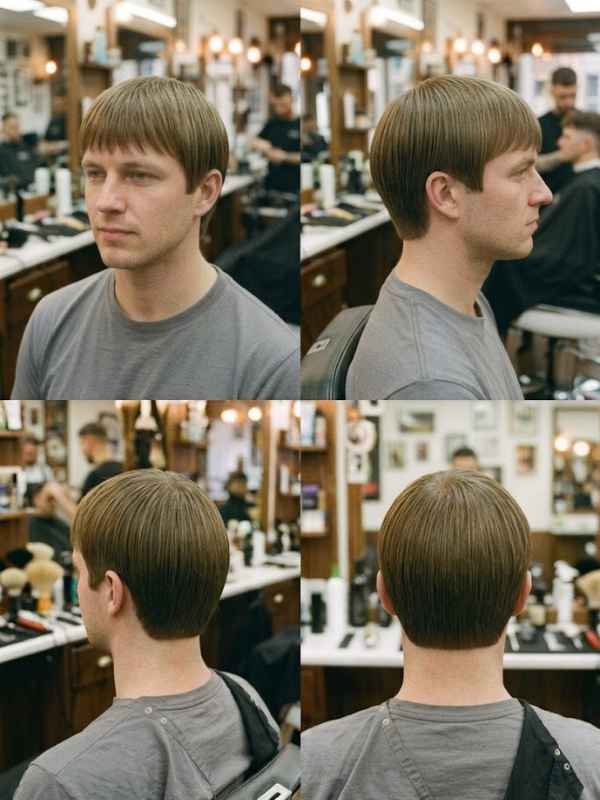
Straight hair lies flat, so it needs layers and a little texture to avoid looking stringy at the back. A sea salt spray plus low heat can build the movement it doesn’t have on its own.
Many people blame the cut when the real issue is that they skipped the texture step. Ask for point cutting through the back so the hair doesn’t hang like a curtain. Pro tip: Rough-dry with your fingers first, then add product. It gives more grip than styling wet hair.
Wavy hair
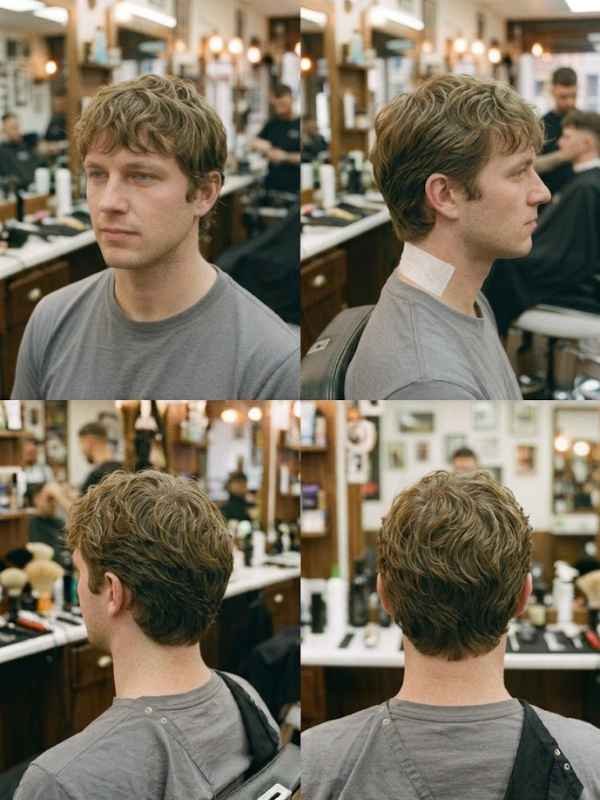
Wavy hair is the easiest to work with. The bend in each strand creates natural separation, so the layers look planned with very little product.
Pro tip: A light sea salt spray or texture cream is usually enough. Let it air dry or diffuse on low heat, and don’t brush it once it’s set.
Curly and coily hair
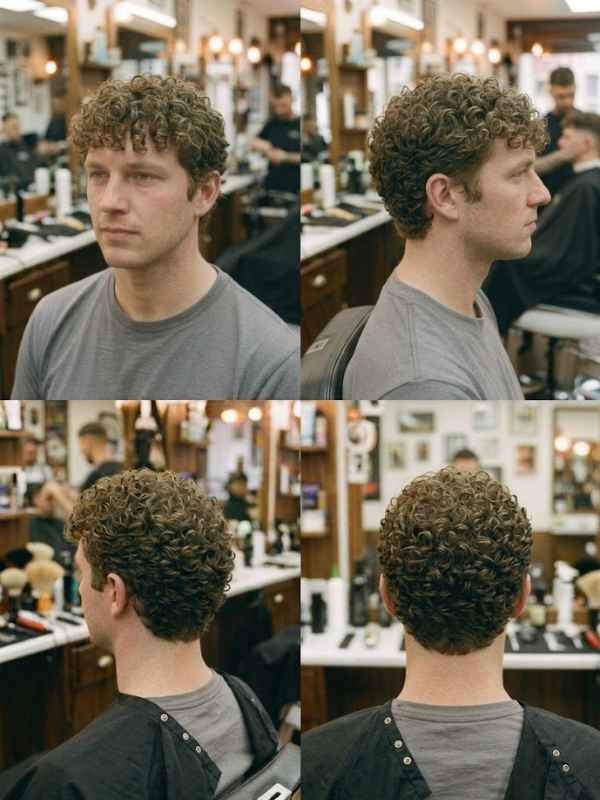
Curly and coily hair shrinks up as it dries, so the cut looks shorter than it did wet. A good barber plans for this, and it’s the detail first-timers miss most.
The upside is natural volume at the crown, so styling stays easy. Use a leave-in conditioner first, then a light curl cream, and diffuse on low heat and low speed. Pro tip: Don’t rake a brush through dry curls. Scrunch upward and leave them alone until fully dry.
Read More Related Posts Low Taper Fade Short Hair: 25 Styles & Barber Scripts
Thick and fine hair
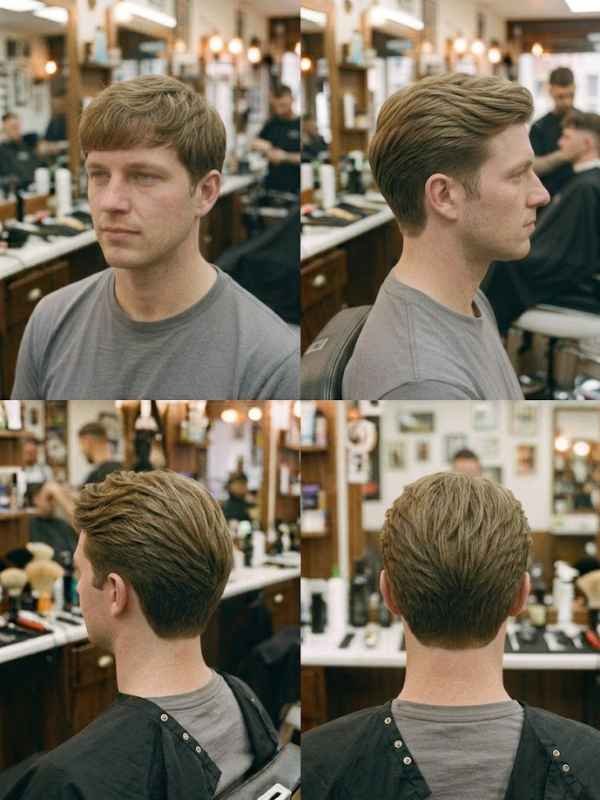
Thick hair holds the shape well but can feel heavy. Ask the barber to remove internal weight with thinning shears or point cutting instead of cutting everything shorter.
Pro tip: Fine hair wants the opposite. Keep the length, use texture powder to build density, and choose a shorter tail so it looks fuller.
Receding hairline, cowlick, or thinning crown? How to adapt it
Keep the top longer and textured for a receding hairline, cut with the direction of a cowlick, and avoid thinning the crown if it is already light. Each problem has a simple fix.
Pro tip: Tell the barber about the problem before the clippers come out. It changes where they place the fade and how they cut the top.
- Receding hairline: use a textured fringe or a side sweep, and skip the slick-back.
- Cowlick: leave extra length there and cut with its direction, instead of fighting it with short clippers.
- Thinning crown: keep the tail shorter, use texture powder, and don’t use thinning shears on the crown.
Which face shapes suit a low taper fade mullet best?
Most face shapes can wear it. The rule is to balance whatever is already dominant: add height to a round face, add width to a long face.
| Face shape | Do | Avoid |
| Round | Add height on top, keep sides tight | Extra width at the cheeks |
| Square | Textured crop or slick-back to soften the jaw | Very blunt, heavy lines |
| Oval | Almost any version | Nothing in particular |
| Long or oblong | Fuller sides, a fringe, shaggy or wolf cut hybrid | Heavy volume on top |
| Diamond | Fuller jaw area, a textured fringe | Big crown volume |
| Heart | Side-swept fringe, some fullness at the back | Very short sides with a wide forehead |
Pro tip: Name your face shape to the barber and show one reference photo. That is usually enough for them to adjust the top and the fade placement.
How to ask your barber for the perfect low taper fade mullet
Give the barber five things: fade type and height, top length, back length, texture, and whether you want a fringe. Say them as separate points, because that is where most bad mullets start.
Here are three scripts you can copy, from quiet to bold.
- Subtle: “Low taper on the sideburns and neckline only, textured top about 7 cm, tail to the collar.”
- Standard: “Low taper fade starting about an inch above my ear, textured top around 10 cm, and soft layers at the back about 13 cm.”
- Bold: “Low taper burst around the ear, long top with a fringe, and a layered tail past the collar.”
Avoid saying only “give me a mullet”. It leaves too much open. Also tell them how you style your hair and how often you’ll come back, since that changes how they cut. Pro tip: Take a photo of your head from the back after the first cut. Next visit, you can show it and say “same as this”.
Clipper guard and neckline chart
A low taper usually starts with a #2 or #3 at the top of the fade and moves down to a #1 or #0.5 near the ear and neckline. A skin finish is only for the low fade version.
| Guard | Length left | In inches |
| #0.5 | 1.5 mm | 1/16 in |
| #1 | 3 mm | 1/8 in |
| #2 | 6 mm | 1/4 in |
| #3 | 10 mm | 3/8 in |
| #4 | 13 mm | 1/2 in |
| #5 | 16 mm | 5/8 in |
You don’t need to memorise these. Just ask the barber what guards they plan to use. The neckline also matters, and there are three common finishes.
- Tapered: blends into the natural hairline and grows out best.
- Rounded: soft corners, tidy for longer.
- Blocked: square and sharp, but it looks messy fast.
Pro tip: Choose the tapered neckline if you want longer between visits.
How to style a low taper fade mullet at home, step by step
Start with towel-dried hair, add a texture product, dry on low heat, and finish with a small amount of clay or paste. The whole thing takes about five minutes once you know the order.
- Wash and towel-dry. The hair should be damp, not dripping.
- Add a base product: sea salt spray for straight or wavy hair, curl cream for curls.
- Dry on low heat with your fingers or a round brush, lifting the roots on top.
- Warm a pea-sized amount of clay or paste in your palms and work it through the top.
- Shape the fringe or front with your fingers.
- Break up the ends of the tail with your fingertips so the layers separate.
Pro tip: Use less product than you think. Too much weighs the hair down and removes the texture that makes the cut work.
How often should you trim and maintain it?
Get a fade touch-up every 3 to 4 weeks, a top and layers trim every 4 to 6 weeks, and a tail tidy every 8 to 12 weeks. You can stretch a low taper to 5 or 6 weeks if you’re happy with a softer line.
Pro tip: Ask your shop if they offer fade-only visits. They are quicker and often cheaper than a full haircut.
| Part | How often | Why |
| Fade and neckline | Every 3 to 4 weeks (2 to 3 for skin fades) | Short hair shows growth first |
| Top and layers | Every 4 to 6 weeks | Keeps the texture shaped |
| Tail | Every 8 to 12 weeks | Only split ends and shape |
Websites give different numbers because the fade type changes the answer. A softer taper hides growth longer than a skin fade. Between visits, wash two or three times a week with a gentle shampoo and condition the tail, since it’s the oldest hair and dries out first.
Common low taper fade mullet mistakes (and how to fix them)
The most common mistakes are asking for only “a mullet”, letting the fade start too high, cutting the back too short, skipping texture, skipping touch-ups, and using too much product.
| Mistake | Fix |
| Saying only “mullet” | Name the fade type, height, top length, and back length |
| Fade starts too high | Ask for “low” and point to the spot above the ear |
| Back cut too short | Say “only tidy the ends” at the back |
| No texture | Ask for point cutting on the top and back |
| Missing touch-ups | Book fade-only visits every 3 to 4 weeks |
| Too much product | Use a pea-sized amount and build up |
Pro tip: If the cut already looks off, don’t cut it again right away. Wait a week, since the layers often settle and look better than they did on day one.
Final Thoughts
The low taper fade mullet works because it keeps things neat at the sides and gives you room to play at the back. It suits most hair types and face shapes, and it grows out better than louder mullets.
Pick a version that fits your hair, say each part clearly to the barber, and be patient during the grow-out. Screenshot the barber scripts above and take them to your next appointment.
Frequently Asked Questions
How long should my hair be before getting a low taper fade mullet?
About 7 to 10 cm (3 to 4 in) on top and at the back works well. Shorter hair can start with a short version and grow the back.
What is the difference between a low taper and a low fade?
A low taper trims the edges and leaves more hair. A low fade removes more from the sides and can reach the skin.
How often should I get a touch-up?
Every 3 to 4 weeks keeps the fade clean. Skin fades need visits closer to every 2 to 3 weeks.
How long is the awkward grow-out phase?
It usually lands between month 2 and month 4, when the back is too long to ignore but too short to style.
Is a low taper fade mullet professional?
Yes, in most offices, if the fade is low, the top is neat, and the tail sits at the collar.
Can fine or thin hair pull it off?
Yes. Use a shorter tail, light layers, and texture powder to add fullness.
Does it work for curly hair?
Yes. Curls give natural volume, and the taper keeps the sides controlled.
Which face shapes suit it?
Most of them. You adjust the top and fade height to balance your face.

Hi, I’m Jake Miller a passionate barber based in Los Angeles, California, with over 3 years of hands-on experience in the craft. I specialize in modern fades, clean cuts, precision beard grooming, and classic barbering techniques, blending sharp technical skill with a relaxed, personal touch.
Over these years, I’ve had the opportunity to work with all kinds of clients, each with their own style and personality and that’s exactly what I love about this craft. For me, it’s never just about a haircut. It’s about understanding who you are and bringing that out through precision and care.
Every client who sits in my chair gets my full attention and expertise, because I believe great barbering is where confidence meets individuality. My goal is simple: to make sure you walk out looking sharp and feeling like the best version of yourself.
