

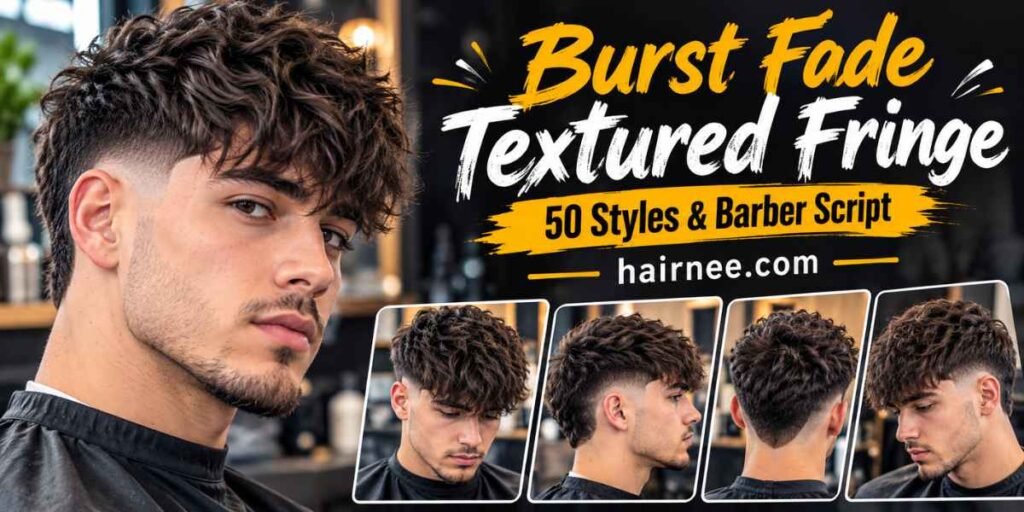
A burst fade textured fringe is a men’s haircut with a fade that curves around the ear and longer top hair pushed forward in choppy pieces. The curve is the “burst,” and the forward top is the fringe (bangs in the US). You choose the fade height, how short it goes, the back and the fringe length.
This guide gives you 50 versions, clipper guard numbers, a script you can read to your barber, and simple styling and upkeep steps. It also answers the odd questions, like whether a burst fade is haram.
Quick facts
- “Burst” tells the barber where the fade sits (a half-circle around the ear), not how short it goes.
- The back decides if the cut looks cropped or a little mullet-like.
- Tell your barber five things: burst height, shortest length, back, fringe length and texture.
- Book a fade touch-up every 2 to 3 weeks and a fringe trim every 4 to 6 weeks.
- Always judge fringe length when the hair is dry.
What is a burst fade textured fringe?
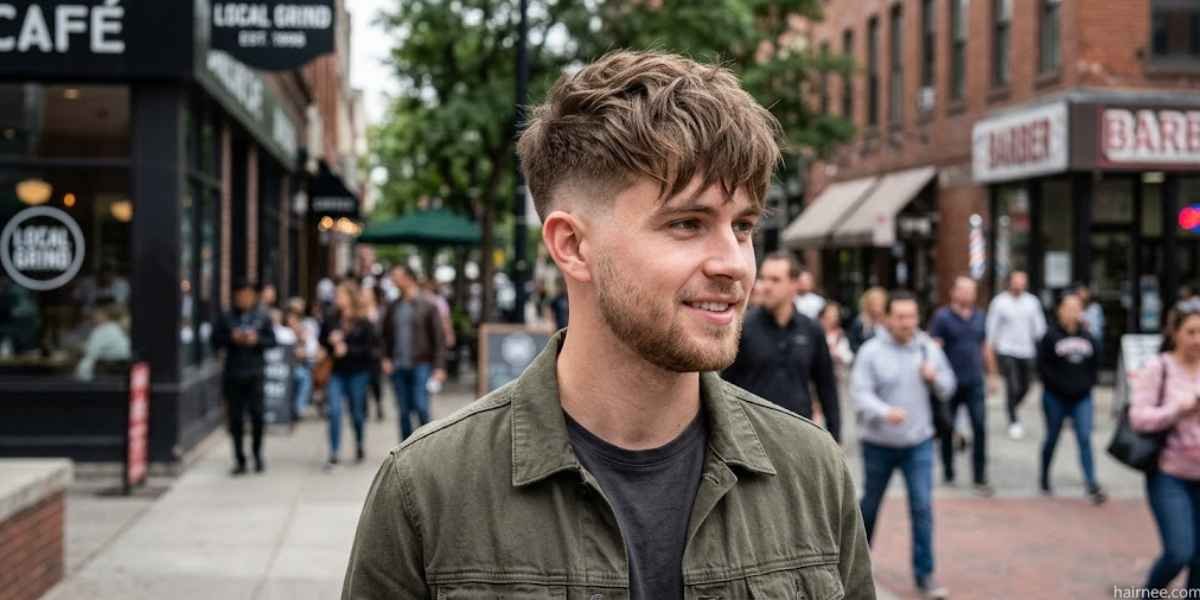
A burst fade textured fringe is a fade that curves in a half-circle around the ear, with longer top hair cut into choppy pieces and pushed toward the forehead. The sides are short, the top keeps length, and the back usually keeps more hair than a normal fade. Think of it as two parts that you set separately: the arc on the sides and the fringe on top. The name covers a whole family of haircuts, so two barbers can hear the same words and give you two different results. That is why the settings matter more than the name.
Pro tip: Say the name, then add numbers (guard sizes and inches) so nothing is left for the barber to guess.
The rounded fade around the ear
The burst fade starts near the top of the ear and curves down and back, so the shortest hair sits in a half-circle instead of a flat band. A low burst hugs the ear, a mid burst climbs toward the temple, and a high burst shows a bigger curve. Pro tip: ask for the height by pointing at your own head, because “mid” means different things in different shops.
Shape and length are two separate choices. The shortest point can be bare skin, a zero or a guarded length like a #1. Behind the arc, the back usually keeps extra weight, and that extra length is what gives some versions a rounded or mullet-like outline.
The forward textured fringe
The fringe is top hair cut long enough to fall toward the forehead, then broken up so you can see separate pieces. Barbers do this with point cutting (snipping into the ends instead of cutting one straight line) or with texturizing shears (scissors with notched blades). Texture does not mean taking off as much hair as possible. Fine hair needs its weight kept so the fringe does not look thin. Thick hair often needs bulk removed from inside so it sits closer to the head. Curly hair needs extra length because it shrinks as it dries. The fringe can stop high on the forehead for a cropped look or reach the brows for more cover.
Pro tip: Ask the barber to cut the fringe dry. Wet hair looks longer than it is.
Who does a burst fade textured fringe suit?
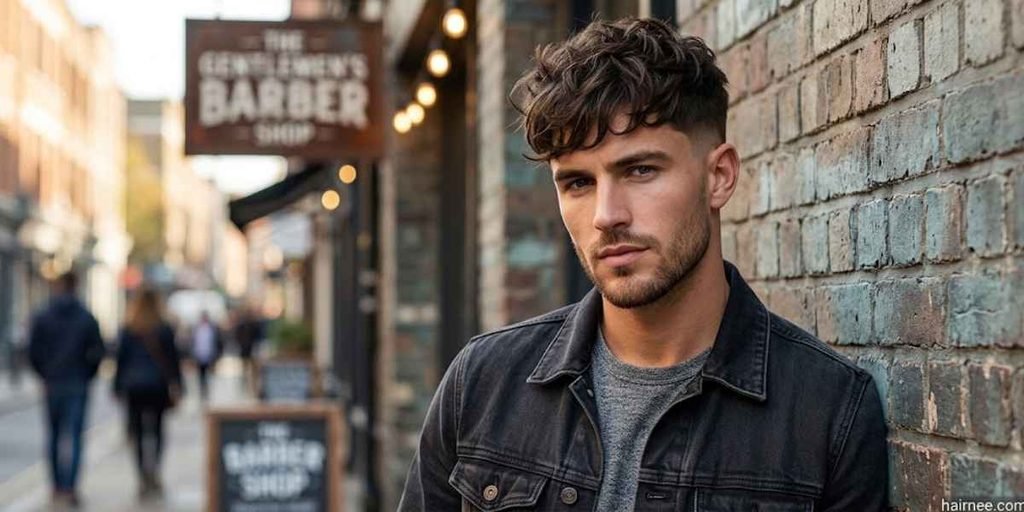
It works on straight, wavy, curly and coily hair as long as you have enough length on top to make a fringe. Hair density, growth direction and how much styling you will do matter more than face shape. Pro tip: check how your hair behaves when it is dry before you choose a fringe length.
Hair type and density
Every hair type can wear this cut. The barber just changes how much weight stays and how long the fringe is. Pro tip: bring a photo of someone with hair density close to yours, not just the same haircut.
| Hair type | What works | What can go wrong | Ask for |
| Fine or low density | Short sides make the top look fuller | Heavy thinning leaves gaps in the fringe | Light point cutting, weight kept |
| Straight, medium density | Holds a forward direction easily | Can lie flat like a helmet | Separation at the ends |
| Wavy | Natural bend gives movement | Short fringe springs up when dry | Extra length at the front |
| Curly | Curls make the texture for you | Shrinkage makes the fringe shorter | Dry cutting, curls left whole |
| Coily | Defined coils fall forward well | Too much shaping can flatten the pattern | Length checked dry, moisture first |
| Thick | Lots of hair to build a shape | Top gets wide and heavy | Bulk removed from inside |
The rule behind every row is the same. Cut for how your hair looks dry on a normal day, not how it looks wet in the chair.
Hairline, cowlicks and lifestyle fit
A fringe can soften a high forehead, but it cannot truly hide a receding hairline. A cowlick (hair that grows in a swirl or another direction) changes the plan, so tell your barber before the first cut.
Forcing a cowlick straight forward rarely lasts until lunch. An angled or uneven fringe, or a little extra weight over that spot, usually works better. Think about daily life too. A high skin burst looks bold but shows regrowth fast, while a low or shadow burst grows out gently. If your school or job has a written grooming rule, read it before you pick the bold end. Pro tip: if your hairline is receding, keep the fringe short and broken instead of long and heavy.
Face shape fit
Face shape is a starting point, not a rule, because fringe length and fade height can be changed for almost any face. Use the table to pick a first version, then adjust after you see it.
Pro tip: Hair type usually matters more than face shape. If the two disagree, follow your hair.
| Face shape | Good starting point | Watch out for |
| Round | Mid or high burst, fringe with some lift | A flat fringe that adds width |
| Square | Low to mid burst, softer broken fringe | Very blunt edges that add more angles |
| Oval | Almost any height and fringe | Nothing major, so try your favorite |
| Heart | Low to mid burst, moderate top volume | Too much volume on the forehead |
| Diamond | Fringe pushed forward to soften cheekbones | A very high burst that narrows the face |
| Long or oblong | Fringe forward, mid burst | Extra height that stretches the face |
Which burst fade textured fringe variation should you choose?
Pick a low or shadow burst for a soft look, a mid burst for balance, and a high skin burst for the strongest sides. Then decide the back separately. Pro tip: treat height, finish and back as three separate answers.
Fade placement and finish
Placement is where the curve sits (low, mid or high). Finish is how short the hair goes (skin, zero or shadow). People mix these up all the time and end up with more scalp showing than they planned, so keep them apart in your head. Pro tip: if you are unsure, start lower and softer. A gentle version is easy to take higher next time, but a high skin burst takes weeks to grow out.
| Option | Type | Look | Good for |
| Low burst | Placement | Small arc, more hair around it | Everyday, quiet look |
| Mid burst | Placement | Clear arc that does not take over the head | Most hair types |
| High burst | Placement | Big, open curve | Thick tops that can balance it |
| Skin or bald | Finish | Sharpest edge, regrowth shows first | People who book often |
| Zero | Finish | Very short with a faint shadow | Crisp look, less bare skin |
| Shadow or guarded | Finish | Soft blend, gentle grow-out | Sensitive skin, strict dress codes |
Clipper guard numbers for a burst fade textured fringe
A common burst setup uses zero or a #1 at the ear, then a #2, then a #3 as the curve climbs, then a scissor blend into the top. This is a sample, not a law. Barbers change it for your hair and the height you want.
Guard sizes below are US sizes. Brands differ a little, and some countries name guards by millimeters, so say the length out loud if you are unsure. Pro tip: write the guard order in your phone and read it to the barber, because “short on the sides” means something different to everyone.
| Guard | Hair left | Where it usually goes in a burst |
| #0 or bare blade | Skin or almost skin | Bottom of the arc for skin finish |
| #0.5 blade | Very short shadow | Bottom of the arc for a zero finish |
| #1 | About 1/8 inch (3 mm) | Ear area on a shadow finish |
| #2 | About 1/4 inch (6 mm) | Middle of the blend |
| #3 | About 3/8 inch (9 mm) | Top of the curve before the scissor blend |
| #4 | About 1/2 inch (12 mm) | Higher on the side or the back if you want weight |
Fringe length and back profile
A short fringe stops above the brows and needs little styling. A long one reaches the brows and needs more drying. The back decides if the cut looks cropped or mullet-like. Pro tip: bring a photo of the back, because it is the view most people forget and the one that causes most surprises.
A short, broken fringe with no clear direction can drift toward a French crop or an Edgar, so ask for forward direction and clear pieces. Neither back is wrong, but not saying which one you want is a mistake. You have three simple choices:
- Cropped: back kept close, like a normal fade.
- Weighted: extra length left behind the arc for a soft mullet feel.
- Full mullet: short sides, fringe up front and a couple of inches left at the neck.
50 burst fade textured fringe variations
Here are 50 versions, grouped by what each one changes: height and finish, back profile, fringe shape, hair type, top style, details and lifestyle. Each is a different mix of the same settings, so you can mix and match them. Pro tip: pick one from each group, like “mid zero burst, weighted back, brow-length fringe,” and you have a full brief.
Also Read This Mid Taper Fade With Beard: Best Styles & How to Ask 2026
Use the table as a menu. Find the closest match, then change one thing at a time until it fits your hair and your week.
| # | Group | Variation | What to ask for |
| 1 | Height and finish | Low skin burst | Small arc to skin right at the ear |
| 2 | Height and finish | Low shadow burst | Low arc ending at a #1, softest grow-out |
| 3 | Height and finish | Mid zero burst | Arc to a zero blade at the temple |
| 4 | Height and finish | Mid skin burst | Clear skin arc, strong but not huge |
| 5 | Height and finish | High skin burst | Big open curve, boldest sides |
| 6 | Height and finish | High guarded burst | High curve ending at #1 or #2, less bare skin |
| 7 | Back profile | Cropped-back burst | Back kept close, neat and office-safe |
| 8 | Back profile | Weighted-back burst | Extra length behind the arc, soft mullet feel |
| 9 | Back profile | Mullet burst with fringe | Short sides, fringe up front, long back |
| 10 | Back profile | Rounded neckline | Neck edge curves, grows out gently |
| 11 | Back profile | Blocked neckline | Square neck edge, sharp but shows regrowth sooner |
| 12 | Back profile | Natural neckline | No hard line, hair fades into the nape |
| 13 | Fringe shape | Short broken fringe | About an inch up front, above the brows |
| 14 | Fringe shape | Brow-length fringe | Lands at the brows, the standard version |
| 15 | Fringe shape | Long sweeping fringe | Falls across the brow, needs more drying |
| 16 | Fringe shape | Side-swept fringe | Pushed to one side, works with a side part |
| 17 | Fringe shape | Uneven fringe | Longer on one side, good over a cowlick |
| 18 | Fringe shape | Curtain fringe | Split in the middle, falls to both sides |
| 19 | Fringe shape | Micro fringe | Very short and choppy, high on the forehead |
| 20 | Fringe shape | Straight-edge fringe | Straighter edge softened with light point cutting |
| 21 | Hair type | Fine straight hair | Weight kept, light texture, powder for lift |
| 22 | Hair type | Thick straight hair | Bulk removed from inside the top |
| 23 | Hair type | Wavy hair | Extra length at the front so waves do not spring up |
| 24 | Hair type | Curly hair | Cut dry, curls make the texture |
| 25 | Hair type | Coily twist-out fringe | Twisted or defined coils falling forward |
| 26 | Hair type | Shaped afro fringe | Rounded top with a defined front edge |
| 27 | Hair type | Thin or low-density hair | Soft burst, weight kept, no heavy thinning |
| 28 | Hair type | Thick hair, thinned inside | Weight removed from inside so the top sits closer |
| 29 | Hair type | Permed fringe | Perm adds wave to straight hair |
| 30 | Hair type | Korean-style short fringe | Small broken pieces just above the brows |
| 31 | Top style | French crop burst | Short choppy top, fringe pressed forward |
| 32 | Top style | Messy burst fringe | Shaped with fingers, loose finish |
| 33 | Top style | Blowout fringe | Top dried up and forward for volume |
| 34 | Top style | Quiff fringe | Front lifted a little, then falls forward |
| 35 | Top style | Faux hawk fringe | Center pushed up, fringe in front |
| 36 | Top style | Mohawk burst | Long center strip, burst on both sides |
| 37 | Top style | Caesar-style textured burst | Very short top with light texture |
| 38 | Top style | Textured crop burst | Top 1.5 to 2.5 inches, broken front edge |
| 39 | Details | Hard part | Razor line for a side part with fringe |
| 40 | Details | Line-up | Sharp hairline and temples |
| 41 | Details | Beard blend | Fade runs into sideburns and beard |
| 42 | Details | Razor design | One thin razor line through the fade |
| 43 | Details | Blond fringe | Lightened top shows every piece of texture |
| 44 | Details | Color streaks | Tips or streaks that highlight the texture |
| 45 | Lifestyle | Office-safe version | Low shadow burst, tidy back, brow-length fringe |
| 46 | Lifestyle | School-safe teen version | Low or mid burst, guarded finish, neat fringe |
| 47 | Lifestyle | Boys’ version | Soft finish, shorter fringe, easy to style |
| 48 | Lifestyle | Receding-hairline version | Fringe forward, softer fade, no high skin |
| 49 | Lifestyle | Low-effort athlete version | Short fringe, low burst, air-dry friendly |
| 50 | Lifestyle | Mullet grow-out | Keep the burst, let the back grow, trim only the arc |
How does it compare with similar haircuts?
A burst fade curves around the ear, a drop fade curves down behind the ear toward the nape, and a low taper only tidies the edges. On top, a textured fringe is looser than an Edgar’s straight line or a Caesar’s even crop. Pro tip: compare cuts by where the shortest hair sits, not by their names.
Burst fade vs drop fade vs low taper and blowout taper
A burst fade keeps the short hair around the ear and often leaves the back longer. A drop fade follows the head down behind the ear, so the back is shorter all the way around. A low taper is the softest choice. Pro tip: the name “blowout taper” is used loosely online, so show a photo instead of relying on the word.
| Cut | Where the shortest hair sits | Back length | Look | Grow-out |
| Burst fade | Half-circle around the ear | Often kept longer | Medium to bold | The arc blurs first |
| Drop fade | Curves from the temple behind the ear to the nape | Shorter, more even | Medium to bold | Gradual, all around |
| Low taper | Sideburns and neckline | Close to natural length | Soft | Soft and forgiving |
| Blowout taper | Sideburns and neckline, like a low taper | Close to natural length | Soft sides, full blow-dried top | Soft and forgiving |
Textured fringe vs French crop vs Edgar vs Caesar
A textured fringe has an uneven edge made of separate pieces. A French crop is close to it, an Edgar has a blunt straight line, and a Caesar is short and even. Pro tip: if your fringe photo only shows the front, name the sides yourself.
On a burst fade, the top often looks a lot like a French crop. What makes it different is the burst on the sides and the length kept at the back, which is why photos work better than names. An Edgar is a blunt, straight-across fringe and is popular in Latino barbershops in the US.
| Top style | Front edge | Top length | Usual sides |
| Textured fringe | Uneven, separate pieces | Short to medium | Any fade, often a burst |
| French crop | Choppy, often a longer fringe | Short top, longer front | Usually a fade |
| Edgar | Blunt straight line | Short and blocky | Often high or skin fade |
| Caesar | Short, even fringe | Very short, clipper length | Short or faded |
How to ask your barber for a burst fade textured fringe
Ask for it as five choices: burst height, shortest length, back, fringe length and texture. Bring front, side and back photos, and say what you do not want. Pro tip: write your five choices in your phone before you leave home.
Five decisions to make before the appointment
Decide these five things at home, before you sit down. It is hard to think about neckline shape with a cape on and a line of people waiting.
- Fade height: low, mid or high compared to the ear.
- Shortest length: skin, zero or a guarded shadow like a #1.
- Back and neckline: cropped or weighted, and natural, rounded or sharply lined.
- Fringe length and edge: where it lands when dry, and broken or more even.
- Texture: how much separation you want, and where weight should stay.
Pro tip: Look at your own hair from the front, side and back in the mirror. It helps you pick photos that match.
Reference photos, a sample brief and a final check
Bring three photos: a front view of the fringe, a side view that shows the fade height, and a back view that shows how much length stays. The back photo is the one people forget, and it causes the most mix-ups. Add one photo of a result you do not want. Pro tip: before the clippers start, say the height, shortest length, back shape and dry fringe length out loud. A mistake takes seconds to fix in conversation and weeks to fix after the hair is gone.
Use these two scripts. The first is a fill-in version, and the second is a filled-in example.
- Fill-in: “I want a [low/mid/high] burst around the ear, down to [skin/zero/#1]. Keep the back [cropped/weighted]. Leave the fringe at [where it lands dry] with [light/medium/heavy] texture. Please avoid [what you do not want].”
- Example: “Mid burst around the ear, zero at the bottom, then a #1, #2 and #3 as it climbs. Keep the back cropped with a rounded neckline. Leave about 3 inches on top, with the fringe at the brows when dry, point cut with medium texture. Please don’t take the neckline down to skin.”
What your barber actually does, step by step
Every barber has their own order, but a burst fade textured fringe usually goes like this. Knowing the steps helps you spot trouble early. Pro tip: ask the barber to check both sides from the front before they finish. A small difference in height is easy to fix at that point.
- They check your hair dry and talk through the brief.
- They mark where the arc will start and end around each ear.
- They cut the sides with the shortest setting at the bottom of the arc.
- They blend upward with longer guards, one step at a time.
- They clean the neckline in the shape you chose.
- They cut the top with scissors, then point cut the fringe for texture.
- They add details like a line-up or a hard part if you asked for it.
- They check both sides and the fringe once more, usually while the hair is dry.
How to style a burst fade textured fringe at home

Start with damp hair, add a light pre-styler, blow-dry the top forward with some lift, then pinch the fringe into pieces with a little matte product. Pro tip: use less product than you think you need, and add more only if the fringe falls flat.
Five-step styling routine
The goal is a fringe that moves when you move, not one stiff block. Most mornings it takes about five minutes. Pro tip: do step three properly and you can use half the product.
- Wet your hair evenly so it resets, but do not soak it.
- Add a pre-styler: sea salt spray or mousse for straight and wavy hair, curl cream for curls, and a heat protectant if you use a dryer.
- Blow-dry the top forward and lift at the roots with your fingers. Curly hair does better with a diffuser (a dryer attachment that spreads the air) or lower heat.
- Warm a small amount of matte clay, paste or texture powder in your palms and work it through the middle and ends, away from the roots.
- Pinch and twist a few sections to break up the shape.
Products by hair type and common mistakes
Most styling problems come from two habits: using too much product and skipping the drying step. If your hair looks greasy by midday, use less before you switch brands. Pro tip: if a product feels heavy, try half the amount before you buy a new one.
| Hair type | Best product direction | Be careful with |
| Fine or low density | Light spray, mousse or a little powder | Heavy clay, which flattens the roots |
| Straight, medium density | Pre-styler plus light matte paste | Too much product, which makes stiff spikes |
| Thick or wavy | Small amount of paste or soft clay | Product piled at the front |
| Curly or coily | Curl cream or mousse, light finisher if needed | Brushing, which breaks up curls |
- If the top falls flat, add lift while drying instead of more hold afterward.
- Spiky texture usually means the sections you twist are too small.
- If the fringe splits into wide gaps, that is a cutting problem. Ask for more weight kept next time.
How to maintain a burst fade textured fringe
Book a fade touch-up every 2 to 3 weeks and a fringe trim every 4 to 6 weeks. The arc blurs faster than the fringe, so you can keep two schedules. Pro tip: book the next touch-up before you leave the chair.
Also Read This Mid Taper Fade With Beard: Best Styles & How to Ask 2026
Touch-up timing and grow-out
Skin versions look sharpest for about 1 to 2 weeks. Low and guarded versions can stay neat for 3 to 4 weeks or more. Hair grows about half an inch a month on average, but everyone is different, so use these numbers as a starting point and adjust after your first cycle.
| Finish | Looks sharp for | Typical touch-up |
| Skin | About 1 to 2 weeks | Every 2 weeks |
| Zero | About 2 weeks | Every 2 to 3 weeks |
| Shadow or guarded | About 3 to 4 weeks | Every 3 to 4 weeks |
A fade-only touch-up cleans the arc and neckline without touching the fringe. A full reshape resets height, length and texture together. Do not try to redo the arc at home, because it is easy to raise it or make one side uneven. Pro tip: tidying a few loose neckline hairs with a trimmer is fine. Leave the curve to your barber.
Cost, time and styling minutes
Prices change a lot between cities and shops, so ask before you sit down. A simple way to plan is to multiply the price of one visit by how often you go.
- Example: a $30 cut every 3 weeks is about $43 a month. Every 2 weeks, it is about $65. Add a tip if you tip.
- Styling time: most people need about 5 minutes. Fine straight hair can be faster, and curly hair with a diffuser can take longer.
- Time in the chair: a fade-only touch-up is usually quicker than a full cut.
Pro tip: ask if the shop has a cheaper price for a quick fade touch-up. A low or shadow finish also stretches the time between visits and saves money.
Fringe, scalp and skin problems
Most looks problems are styling or cutting problems, like oily hair, a flat top or a thin fringe after too much thinning. You can fix those at home or at your next visit. Skin problems are different. Cleveland Clinic explains that ingrown hairs (razor bumps) are more likely with frequent shaving and with thick, coarse or curly hair.
If you get bumps often, a guarded or shadow finish is gentler than taking the arc to skin. See a doctor if bumps grow, hurt more or fill with pus. Bumps or raised scars on the back of the neck and scalp can be acne keloidalis nuchae, and the American Academy of Dermatology advises seeing a board-certified dermatologist, because it tends to get worse without care. Pro tip: if the fringe is thinning in patches or fast, see a dermatologist before you change the haircut.
Should you get a burst fade textured fringe or an alternative?
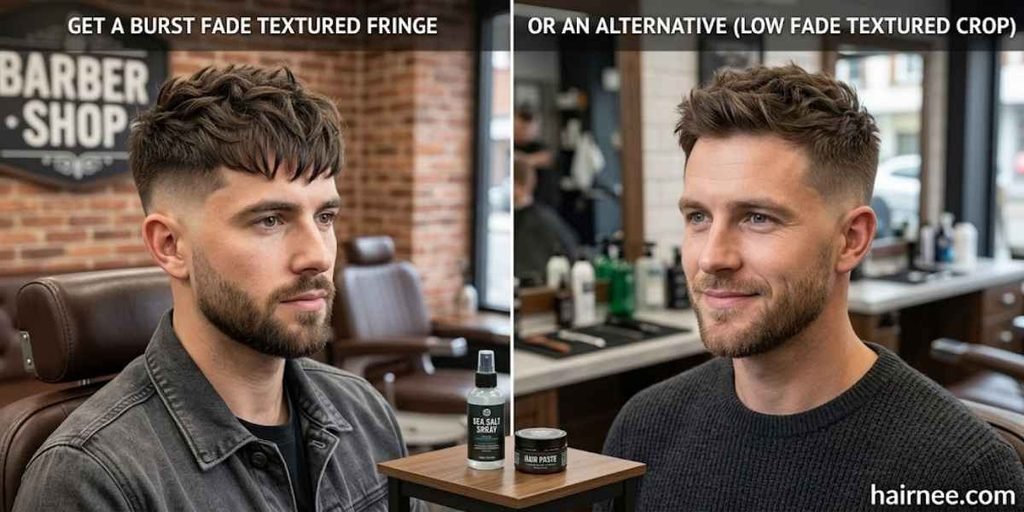
Get it if you like a clear difference between the sides and the top, a forward texture and a touch-up every few weeks. Skip it if you want a haircut you can ignore for six weeks. Pro tip: if one part bothers you, change that part and keep the rest.
Decision checklist
It is a strong fit if you:
- Want a defined curve at the side, not an all-over fade
- Have enough top length for a forward fringe, or can grow it
- Are fine with regular fade touch-ups
- Will blow-dry or use a little product most days
- Have found a barber whose work shows both burst fades and textured tops
Pro tip: Look through a barber’s recent photos before you book. If you cannot find a burst fade, ask if they are comfortable doing one.
Alternatives by objection
If one thing about the cut bothers you, you can change that one thing instead of dropping the whole idea. Pro tip: show the barber the part you like and ask them to change only the part you don’t.
| If this bothers you | Ask about |
| Exposed scalp at the sides | Low taper with a textured fringe |
| Harsh grow-out | Shadow burst or a scissor-cut taper |
| Extra length at the back | Drop fade or a cropped textured cut |
| Daily styling | Short French crop or Caesar cut |
| Not enough length at the back | Soft mullet with a burst fade |
| Clippers close to the skin | Scissor-cut textured crop with no fade |
Burst fade textured fringe for boys and teens
Yes, it works for boys and teens when the fade is low or guarded, the back is tidy and the fringe is short. Check your school rules first. Kids’ hair grows fast, so a soft finish stays neat longer. Teens usually want more styling, so show the barber what they plan to do each morning. Pro tip: take the school rule with you and show it to the barber, so the fade height and fringe length stay inside it.
Burst fade fringe
A burst fade fringe is the same arc on the sides with a cleaner, more defined bang on top. It has less choppy texture than a textured fringe.
You can wear it straight across, side-swept or as a curtain. Style it by combing the fringe forward with a little light cream or pomade instead of pinching it into pieces. It suits hair with enough density to hold a clean edge. Pro tip: if your fringe keeps splitting or sticking up, ask for a bit more texture. A little point cutting helps it sit.
Burst fade textured top
A burst fade textured top is about the length and shape of the whole top, not just the front. Most versions sit between 1.5 and 4 inches, cut with layers and point cutting. Pro tip: ask for the top length in inches, because “a bit longer” can mean a quarter inch to one barber and a full inch to another.
| Top length | Look | Good for |
| 1.5 to 2.5 inches | Textured crop with a short broken front | Low styling time |
| About 3 inches | Textured fringe to the brows | Most hair types |
| 4 inches or more | Blowout, quiff or mullet-like top | People who like to style |
These numbers are a rough guide. Curly hair shrinks as it dries, so it needs more length than the table suggests.
Summary
A burst fade textured fringe is a curved fade around the ear with a choppy, forward top. Decide five things (burst height, shortest length, back, fringe length and texture), bring three photos and ask for the fringe to be cut dry. Plan a fade touch-up every 2 to 3 weeks.
Pro tip: When you get a cut you love, take photos from the front, side and back. Those photos are the best brief you will ever give a barber.
Frequently Asked Questions
What fade suits a textured fringe?
A low or mid burst suits most people, a low taper is softer, and a high burst or skin fade is bolder. Pick based on how bold you want it and how much upkeep you can handle. A low taper keeps the fringe as the main feature. A mid burst adds shape without looking heavy. A high burst works best on thick tops that can balance it.
Is a burst fade haram?
Scholars have different views. Many call a fade makruh (disliked) because of the hadith that forbids qaza’, which means shaving part of the head and leaving part. Some say a gentle blend is not forbidden in itself, and that it becomes a problem if you copy something impermissible.
The hadith is in Sahih Muslim, narrated by Ibn Umar. Views differ between schools and scholars, and some are stricter on sharp skin fades than on gradual blends. This article is not a religious ruling.
Should I get a burst, fade, or taper?
Pick a burst for a curved, bold side with more length at the back, a fade for the sharpest short sides, and a taper for a soft, low-effort look. A burst is a type of fade, and a taper only shortens the edges.
What does a 3:2:1 fade look like?
A 3:2:1 fade is a guard order: a #3 on the upper sides, a #2 around the ears and a #1 at the temples and neckline. It looks like a soft shadow, not a skin fade. Some barbers use 3:2:1 differently, with a #3 on top, a #2 on the sides and a #1 at the edges, so confirm which one they mean.
For a burst, the #1 hugs the ear, the #2 and #3 follow as the curve climbs, and you can add a zero blade at the bottom for a sharper look.
Hi, I’m Jake Miller a passionate barber based in Los Angeles, California, with over 3 years of hands-on experience in the craft. I specialize in modern fades, clean cuts, precision beard grooming, and classic barbering techniques, blending sharp technical skill with a relaxed, personal touch.
Over these years, I’ve had the opportunity to work with all kinds of clients, each with their own style and personality and that’s exactly what I love about this craft. For me, it’s never just about a haircut. It’s about understanding who you are and bringing that out through precision and care.
Every client who sits in my chair gets my full attention and expertise, because I believe great barbering is where confidence meets individuality. My goal is simple: to make sure you walk out looking sharp and feeling like the best version of yourself.

1 thought on “Burst Fade Textured Fringe: 50 Styles & Barber Script”