

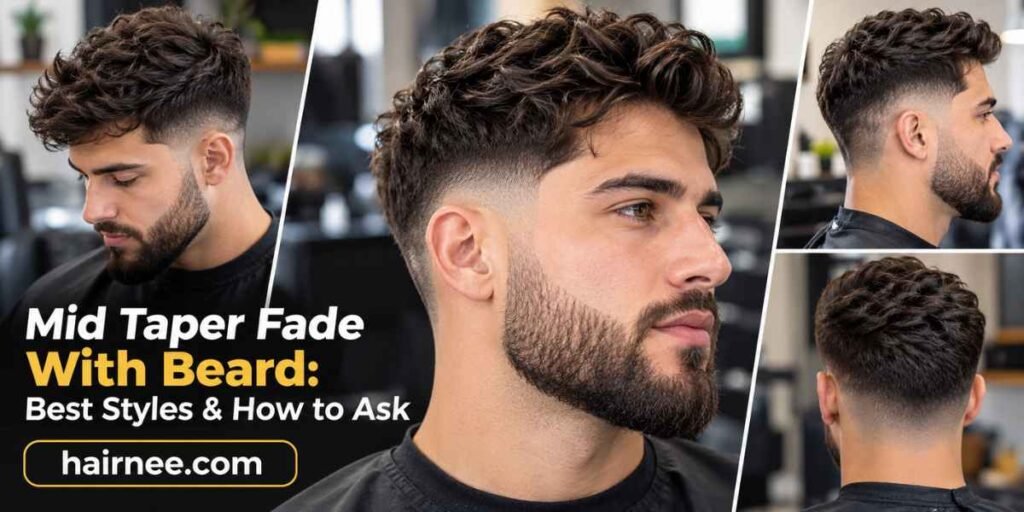
A mid taper fade with beard starts shortening your hair around the mid-temple and carries that line through the sideburn into your beard. Done well, it looks like one clean shape from hairline to jaw.
This guide shows the best styles, the exact words to use in the barber chair, and how to keep the blend neat at home. It works for straight, curly and coily hair, and for beards from light stubble to full.
Quick answer: mid taper fade with beard in 5 points
A mid taper fade with beard shortens hair from the mid-temple down the sideburn, then blends into a beard that is shorter on the cheek and fuller at the jaw.
- The sideburn is the bridge between your haircut and your beard.
- “Mid” is where the fade starts, not how short it ends. Those are two different choices.
- A fuller beard blends more smoothly. A patchy beard looks better short or disconnected.
- A disconnected beard (a small gap between hair and beard) is a real style choice, and it is the easiest to maintain.
- Book the haircut and the beard trim together, at least the first time.
Pro tip: say all five points out loud in the chair, even if you bring a photo. A photo shows the look, but it does not tell the barber your beard length or how sharp you want the edges.
What is a mid taper fade with beard?
A mid taper fade with beard is a short-sides haircut that starts at the mid-temple and blends through the sideburn into the beard, with no visible gap.
Barbers use “taper” and “fade” a little differently from shop to shop. A taper usually changes length gently around the edges, while a fade can cover more of the side and go down to skin (that is the whole taper vs fade debate). Barbers often hear “just give me a fade” and then have to guess the rest, so describe where the blend starts, how short it ends and how it meets the beard. Pro tip: describe the finish you want instead of only naming the cut.
Where does the “mid taper” sit?
The mid taper starts around the temple, about halfway between your hairline and crown, then runs round the ear to the neckline.
Pro tip: bring a side-profile photo. A front photo hides the taper height and the beard link, and those two things decide the whole look. The mid taper does not run across the back of the head like a full fade, so the top keeps its length. Once a beard is added, the curve of the sideburn becomes the bridge of the style.
How does the fade connect into the beard?
The sideburn is the bridge. Hair gets shorter going up the side and a little longer going down into the beard, so no hard line shows.
Some barbers build this in small steps, dropping the guard size about every inch until the sideburn meets the haircut. Others keep the sideburn as its own shape and soften the join by hand with a trimmer or scissors. Pro tip: ask which method your barber uses before the clippers come out, so you both picture the same result.
Is a mid taper fade with beard right for you?
Yes, for most men. It suits straight to coily hair, light to full beards and most face shapes, because height, top length and beard shape are separate choices.
What changes from person to person is how wide the blend is and how smooth the sideburn-to-beard step can look. Pro tip: if you are nervous, ask the barber to show the taper height on your own head with the clippers off before any cutting starts.
Which hair textures and top lengths work?
Straight, wavy, curly and coily hair can all wear it. Texture changes the blend width and the styling, not whether the cut works.
Straight hair shows the blend line clearly, so the barber has to be precise. Curly and coily hair, including afro-textured hair, hides a wider blend and holds more volume, so it often looks better with a little extra bulk left on the sides. Pro tip: if your curls shrink a lot when dry, ask the barber to check the length on dry hair, not wet.
What beard density and length blend best?
A fuller beard blends most smoothly. Light or patchy growth looks better kept short with a softer connection point.
A fade needs a difference in length to look like a fade. A full beard gives the barber an inch or more to step through, and thin growth gives them less. Pro tip: if your cheeks are thin but your chin is strong, keep the cheek short and let the length live on the chin.
| Beard type | Best blend | Simple tip |
| Light stubble | Soft, shadow-like blend | Keep the sideburn slightly shorter than the stubble |
| Patchy beard | Short beard or disconnected | Do not chase a tight line the growth cannot hold |
| Medium beard | Clear step-down over about half an inch | Keep the neckline clean |
| Full beard | Step-down over an inch or more | Keep the sideburn trimmed close |
How much beard do you need before the blend works?
You need about a quarter inch (6 mm) to see any blend, and half an inch (13 mm) or more for a clear, smooth one.
Most beards grow roughly a quarter to half an inch a month, so a little patience gives the barber much more to shape. Below a quarter inch, the blend looks like a soft shadow, which is fine if that is the look you want. Pro tip: grow it for three to four weeks before your first appointment, and do not trim it yourself first.
How should face shape affect the cut?
Treat face shape as a guide, not a rule. A lower taper with more side bulk adds width, and a higher, tighter blend makes the face look narrower.
Beard length works the same way. It can fill out a short jaw or slim down a heavy one. Most of this is a chat with your barber, not a chart. Pro tip: ask the barber to hold the clippers against your temple in the mirror, so you can see where the taper would start before it is cut.
| Face shape | Taper idea | Beard idea |
| Oval | Almost any height works | Most beard lengths suit it |
| Round | Mid taper with tight sides | Slightly longer chin, shorter cheeks |
| Square | Mid or low taper for balance | Softer, rounded cheekline |
| Long or rectangular | Lower taper, keep side bulk | Shorter chin, fuller cheeks |
| Diamond or heart | Mid taper with some top volume | Fuller chin to balance the cheekbones |
Mid taper fade with beard vs similar cuts
A mid taper starts at the mid-temple and stays local. A low taper starts near the ear, a mid fade covers more of the side, and a high taper starts near the crown.
Names change from shop to shop, so the table below describes what you would actually see. Pro tip: whatever name you use, confirm the starting point and the finish with your barber before the cut begins.
| Cut | Where it starts | Side bulk kept | Contrast | Upkeep | Beard blend |
| Low taper | Near the ear | Most | Low | Easy | Soft and slow |
| Mid taper | Mid-temple | Medium | Balanced | Medium | Through the sideburn |
| Mid fade | Mid-level, wide | Least | Strong | High | Through the fade |
| High taper | Near the crown | Varies | Strongest | High | Needs planning |
Mid taper vs mid fade with a beard
A mid taper blends mainly at the sideburn and neckline. A mid fade is one smooth step-down across the whole side and back.
The taper keeps more bulk on the sides and grows out softly. The fade looks sharper but shows regrowth sooner, and the beard has to look sharp too, or the pair looks uneven. Pro tip: if you are not sure, start with the taper. It is easier to go shorter next time than to wait for it to grow back.
Best mid taper fade with beard styles
The best looks come from mixing three choices: taper height, beard length, and whether the beard connects or stays separate.
Below are six core combinations, then 20 more ideas you can show your barber. Pro tip: pick the beard first, because beard length limits which blend is possible.
Mid taper fade with stubble
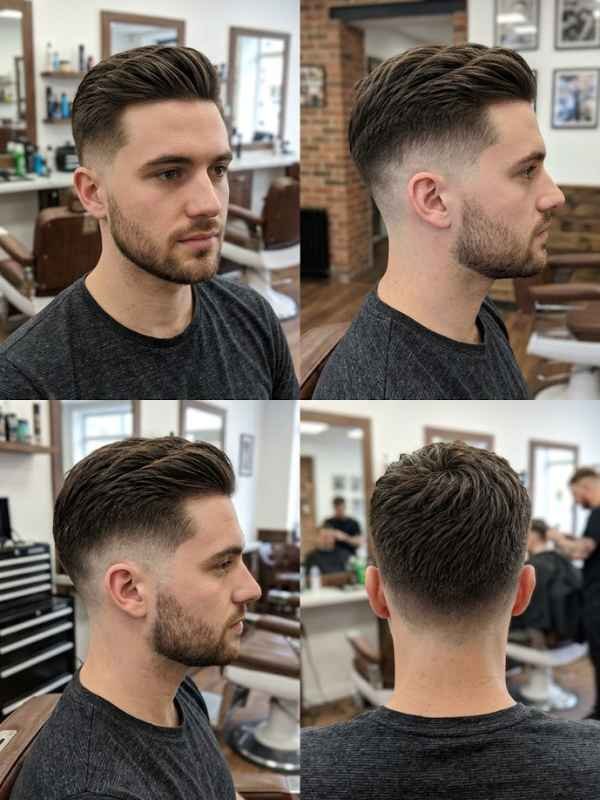
Stubble gives the softest and easiest blend, because the length gap is small.
The sideburn fades into a few days of growth, so the join is forgiving even when it is not perfect. It suits a shadow finish better than a skin-close one, and it fits a low-effort routine. Pro tip: keep the stubble at one even length with a guard, and let the barber handle the sideburn.
Mid taper fade with a short boxed beard
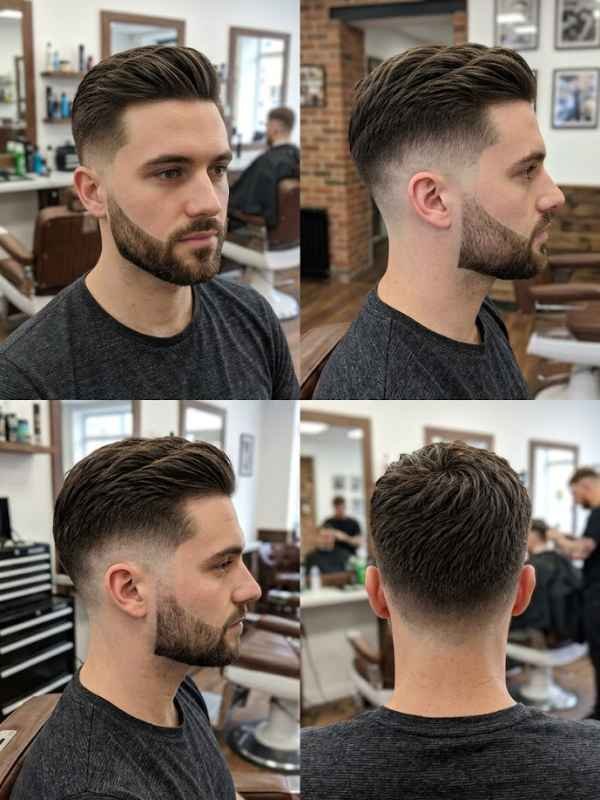
A short boxed beard gives the sharpest, most office-ready version of this style.
The beard has a clear cheekline and neckline, so the barber has a firm edge to blend the sideburn into. The trade-off is upkeep: both the haircut and the beard rely on crisp lines, so they need trimming about as often. Pro tip: ask for a natural cheekline, not a razored one, if you want it to look softer.
Also Read This Mid Taper Edgar Cut: 40 Styles & Barber Script (2026)
Mid taper fade with a full beard
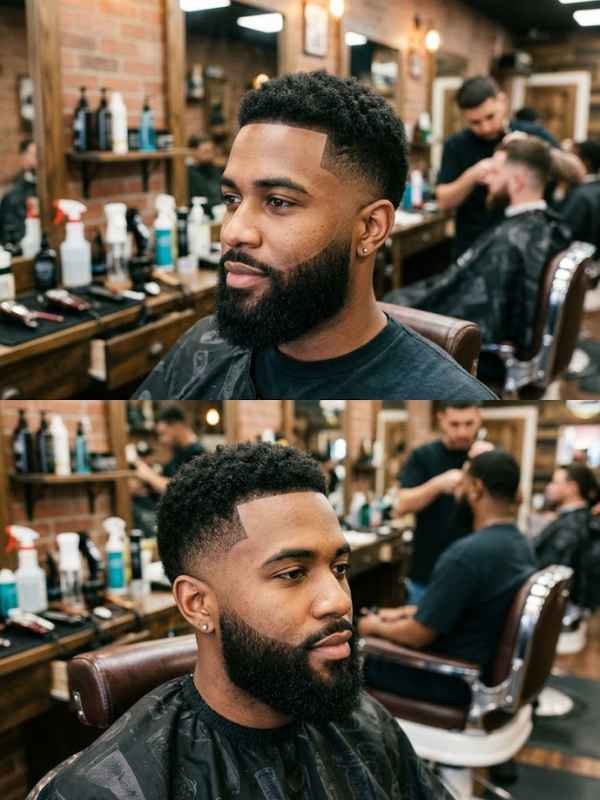
A full beard needs a step-down near the sideburn, so the sides do not look stuck onto the beard.
The barber can drop the length over an inch or more, instead of jumping from a short taper straight to long cheek hair. Keeping the sideburn trimmed close, even when the rest is long, is what stops it looking like two separate parts. Pro tip: ask for the cheek hair to be shaped so it follows the jaw instead of growing out sideways.
Mid taper fade with a disconnected beard
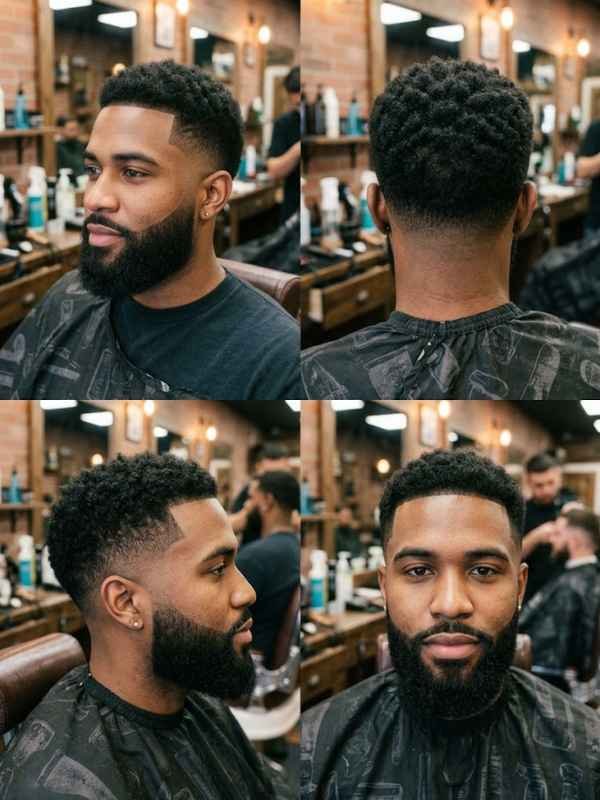
A disconnected beard leaves a small, planned gap between the taper and the beard. It is a style choice, not a failed blend.
It looks higher in contrast and it is easier to maintain, because the two areas never need blending together again. It works well when your hair and beard have different texture or color. Pro tip: keep the gap even on both sides, because an uneven gap is the one thing that makes this style look wrong.
Curly or coily mid taper fade with a shaped beard
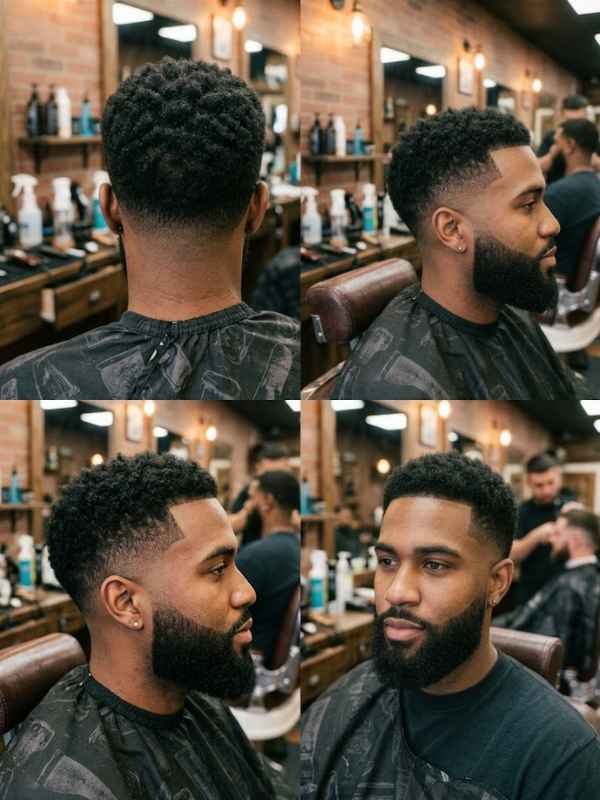
On curly or coily hair, ask for a slightly wider blend so the taper does not look sudden next to the volume on top.
The beard gets the same treatment: shaped around the edges, with the length inside kept natural. Neither area needs a razor-sharp line, so this look handles longer gaps between visits. Pro tip: shape the beard when it is dry, because curls and coils pull up as they dry and can change the line.
Textured or longer top with a beard fade
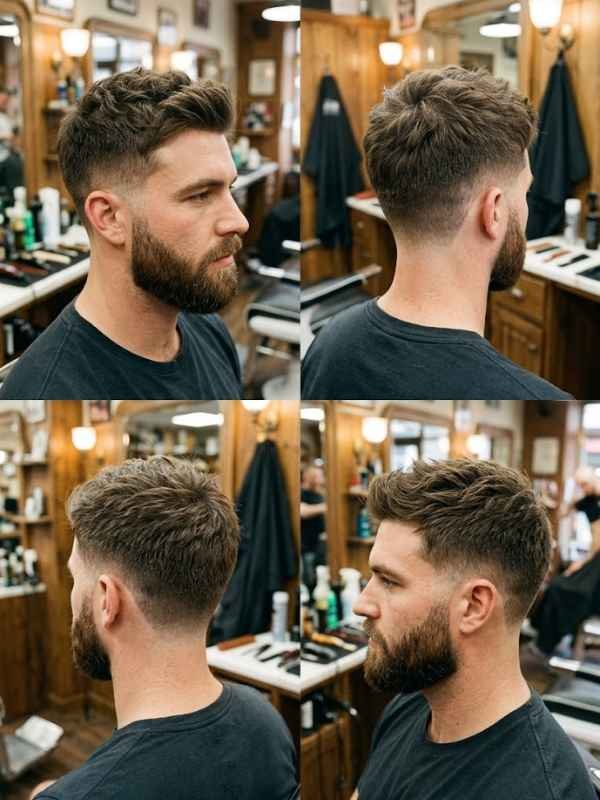
A mid taper is not only for short tops. A textured crop, a brushed-back top or a longer styled top all sit well over the same sideburn-to-beard blend.
The blend stays the same while the top does the stylBest tools and products for home upkeeping work. More length on top usually needs a little more bulk left on the sides, so the head does not look bottom-heavy. Pro tip: bring a photo of the top style you want, since the barber will plan the side bulk around it.
More mid taper fade with beard ideas
Here are 20 more mid taper fade with beard combos. Each one differs in top style, beard type or hair texture.
| # | Style | Top | Beard | Works best for |
| 1 | Pompadour | High, swept-up volume | Short full beard | Thick, straight hair |
| 2 | Quiff | Short, textured quiff | Heavy stubble | Medium hair, casual look |
| 3 | Slick back | Combed back with pomade | Medium, groomed beard | Office and formal events |
| 4 | Hard part | Shaved part line | Sharp line-up beard | Straight hair, clean look |
| 5 | Comb over | Neat side part | Short beard | Work and daily wear |
| 6 | Buzz cut | Even buzz, #2 or #3 guard | Full beard | Very low upkeep |
| 7 | Crew cut | Short, tapered top | Chin strap beard | Strong jawline |
| 8 | French crop | Short, forward fringe | Short beard | Fine or thinning hair |
| 9 | Messy fringe | Loose and forward | Light stubble | Wavy hair |
| 10 | Curly top | Natural curls, two to three inches | Medium beard | Curly hair |
| 11 | Afro | Full, round shape | Shaped full beard | Coily, afro-textured hair |
| 12 | Waves | Brushed waves | Full beard, sharp edge | Coily hair, wave routine |
| 13 | Sponge twists | Short twists | Short beard | Coily hair |
| 14 | Faux hawk | Raised centre | Short beard | Thick hair |
| 15 | Mohawk strip | Long centre strip | Full beard | Bold, high-contrast look |
| 16 | Long top | Chin or shoulder length | Long beard | Straight or wavy hair |
| 17 | Mullet | Short top, longer back | Stubble | Trend-focused style |
| 18 | Undercut-style top | Long top, clear contrast | Long beard | Strong contrast |
| 19 | Wolf cut | Layered, textured | Short beard | Thick, wavy hair |
| 20 | Salt-and-pepper | Natural grey top | Short grey beard | Mature, low-fuss look |
Pro tip: pick two or three from the table, not one. A barber can quickly tell you which one your hair density and beard growth can really support. Add the six core styles above and you have 26 combinations in this guide.
How do you ask a barber for a mid taper fade with beard?
Tell the barber five things: taper height, finish, top length, beard link and edges. Naming the style is the easy part.
Pro tip: bring a side-profile photo, because it shows both the taper height and the beard connection.
Build a five-point barber brief
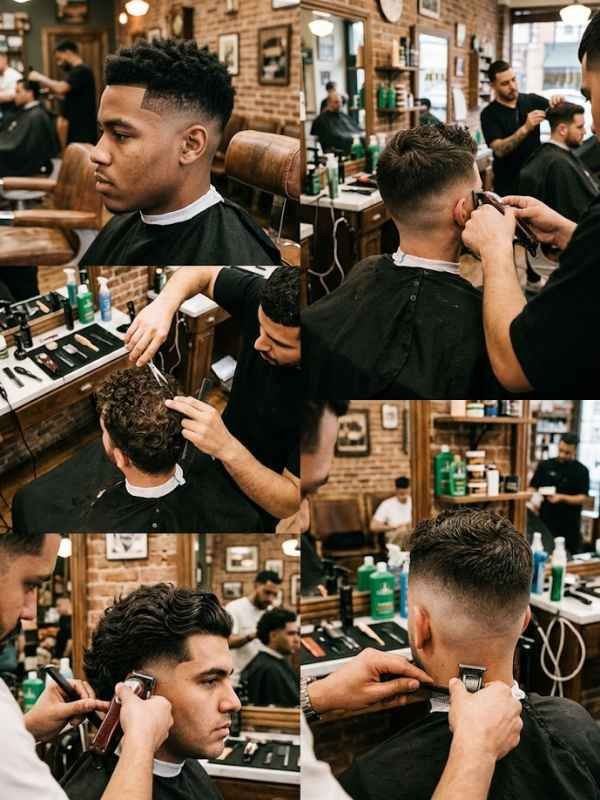
Say five points out loud, even with a photo. They let the barber treat the haircut and beard as one job.
Here is a script you can copy: “Start the taper around the mid-temple, finish it at a shadow, leave the top as it is, blend the sideburn into the beard, and keep the cheekline natural.” Change the words to fit your own cut. Pro tip: say the script before you sit down, not while the cape is going on.
1. Set the taper height
Say where the fade should start. For this style, it is around the mid-temple.
This stops the barber from choosing between a low and a high start for you. Pro tip: point at your own head, or at your photo.
2. Choose a shadow or skin-close finish
Decide if the shortest point leaves a soft shadow of hair or goes down to bare skin. It is a separate choice from where the taper starts.
A skin-close finish looks sharper but grows out faster, so it drives most of your future upkeep. Pro tip: if you have never had a skin finish, try a shadow first.
3. State the top length and texture you want to keep
Tell the barber how you want to wear the top: natural, brushed back or textured. That tells them how much length and bulk to leave.
Pro tip: say how long you plan to keep it. A trim for a wedding next week is a different plan from growing it out for three months.
4. Specify connected or disconnected beard
Say clearly if the sideburn should flow into the beard or stay apart with a gap. A barber cannot guess this from a haircut request.
Pro tip: if you are unsure, ask for connected with a soft join. It is easier to cut a gap later than to bring a blend back.
5. Confirm cheekline, neckline, and line-up
Agree if the beard edges and the haircut edges should look natural or sharp. A line-up or shape-up on the hairline should match the beard lines.
A soft, natural sideburn next to a razored cheekline tends to look mismatched. Pro tip: say “natural” or “sharp” for all edges together, so the whole head looks planned.
Should you ask for specific guard numbers?
A guard number helps only if you already know one that worked for you. Describing the finish you want is more reliable.
The standard Wahl guard set runs from a #1/2 at 1/16 of an inch up to a #8 at one inch, and those sizes stay the same across the set. The result can still change, because the taper lever on a clipper adjusts closeness between guard sizes. Pro tip: use guard numbers as a rough guide, then add the look in plain words too.
| Guard | Length (inch) | Length (mm) | Common use here |
| #1/2 | 1/16 | 1.5 | Very close finish |
| #1 | 1/8 | 3 | Close shadow finish |
| #2 | 1/4 | 6 | Short beard or soft taper |
| #3 | 3/8 | 10 | Short beard |
| #4 | 1/2 | 13 | Medium beard |
| #5 | 5/8 | 16 | Fuller beard |
| #6 | 3/4 | 19 | Long beard step |
| #8 | 1 | 25 | Longest standard guard |
How to blend a mid taper into a beard, guard by guard
Start with the whole beard at one even length. Then step down with shorter guards as you move up the cheek toward the sideburn.
The table is an example for a medium beard, so change it to fit your own growth. Use a light flicking motion as you move the trimmer away from the skin, and comb as you go so no hard line is left. Pro tip: if this is your first time, do the beard at home only up to the cheek and let a barber shape the sideburn, since that is the part most easily overdone.
| Zone | Example guard | Length |
| Chin and jawline | #5 | 5/8 inch |
| Lower cheek | #4 | 1/2 inch |
| Mid cheek | #3 | 3/8 inch |
| Upper cheek | #2 | 1/4 inch |
| Sideburn | #1 or shadow | Matches the taper |
How do you style a mid taper fade and beard at home?
Two short routines: style the top while it is slightly damp, and brush and tidy the beard.
The faded sides need almost no daily work once they are cut. Pro tip: do both routines in the same order each morning, and the whole thing takes under five minutes.
Style the hair on top for its natural texture
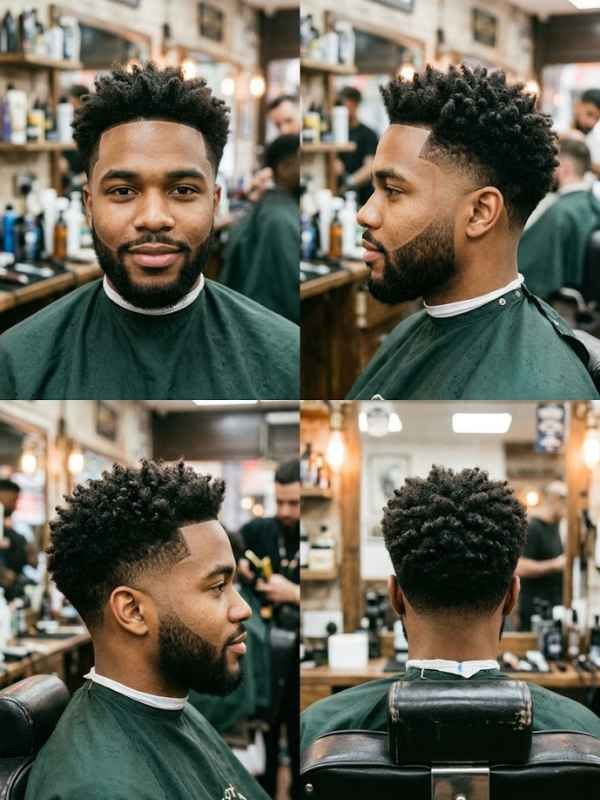
For straight or wavy hair, work a light cream or matte paste through damp hair. For curly hair, use a leave-in conditioner or curl cream.
Pro tip: stop adding product as soon as the hair looks shaped. Too much flattens the texture the cut was built around. Style while the hair is still slightly damp and it will hold better as it dries.
Also Read This Mid Taper Edgar Cut: 40 Styles & Barber Script (2026)
Keep the beard and perimeter groomed
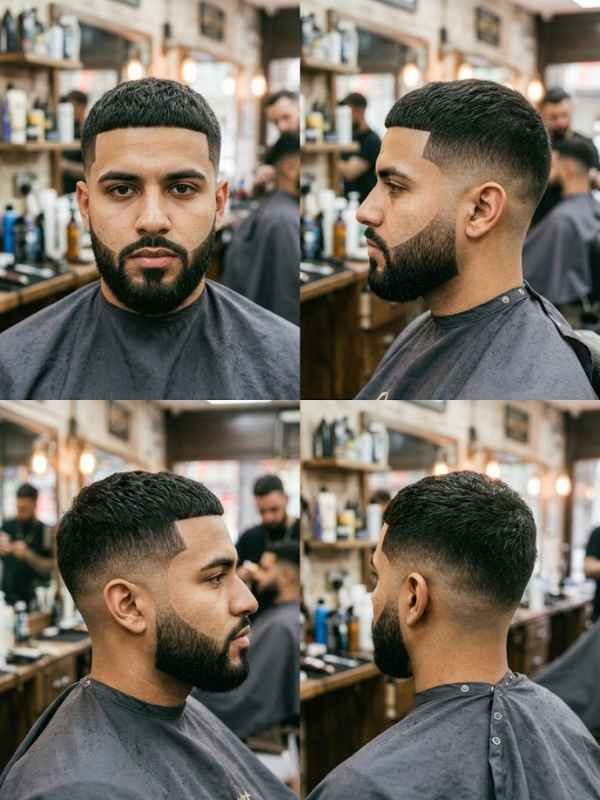
Wash the beard and the skin under it, brush it the way you want it to lie, and moisturize after trimming.
The American Academy of Dermatology suggests gentle brushing, and a conditioner that will not clog pores if you break out under your beard. Between visits, only trim strays at the neckline and cheekline. Pro tip: do not reshape the sideburn-to-beard link yourself, because that is how lines creep higher than your barber planned.
Best tools and products for home upkeep
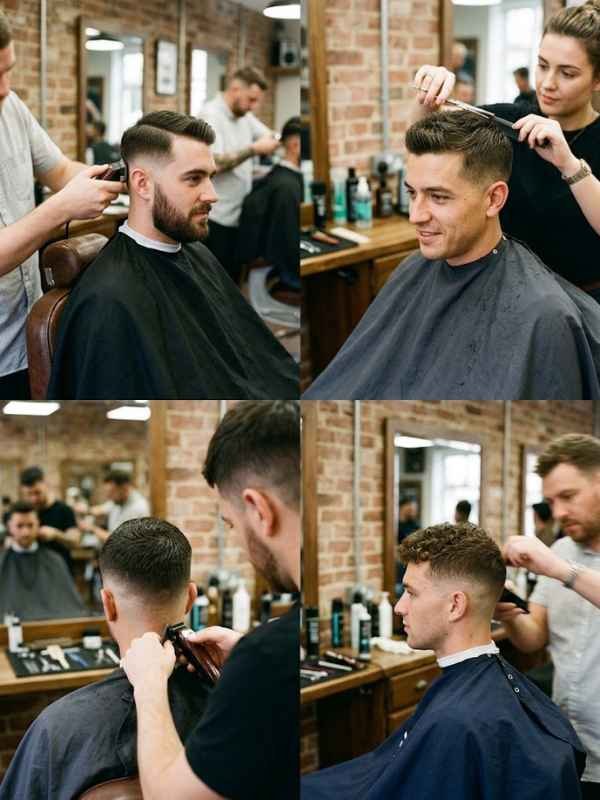
A trimmer with guards, a small detail trimmer, a beard brush or comb and a light styling product cover almost everything.
Pro tip: buy for your beard type, not a big kit. A good trimmer and a brush do more than a bag of products you will not use. Add a little beard oil or beard balm only if your beard feels dry.
| Tool or product | What it does |
| Trimmer with guards | Keeps beard length even |
| Small detail trimmer | Cleans the neckline and cheekline |
| Beard brush or comb | Lays hairs in one direction before trimming |
| Mirror (hand or wall) | Lets you check the sideburn from the side |
| Matte paste or curl cream | Styles the top without weight |
| Beard oil or balm | Softens the beard and the skin under it |
How often should you maintain a mid taper fade with beard?
Most men rebook every two to four weeks. Skin-close finishes and sharp beards need it sooner, and shadow finishes can stretch longer.
Your own growth rate matters more than any published number. Pro tip: book your next visit before you leave the chair, so you do not wait until the blend has already faded.
| Style | Typical rebooking |
| Skin-close finish | About 2 weeks |
| Shadow finish | 3 to 4 weeks |
| Short boxed beard | 2 to 3 weeks |
| Disconnected beard | 3 to 4 weeks |
| Stubble | 3 to 4 weeks (trim the beard sooner if it grows fast) |
Barber touch-ups vs home maintenance
Fix stray hairs at home. Leave the blend to your barber.
Rebuilding the taper or the sideburn-to-beard link is easy to overshoot, and a visible step is harder to fix than a slightly overgrown edge. Use clean, sharp tools and stop if your skin looks irritated. Pro tip: if you do want to try a home fix, only ever cut less than you think you need.
- Safe at home: neckline strays, stray cheek hairs, light brushing, moisturizing.
- Leave to the barber: the sideburn blend, taper height, beard shape changes.
What does the grow-out look like?
The sideburn fills in and the neckline blurs first. Then the beard blend loses its smooth step-down.
A skin-close finish shows this in a couple of weeks, and a shadow finish holds a bit longer. Because hair and beard grow at different speeds, the two can drift apart, which is another reason to book them together. Pro tip: rebook when the sideburn line starts to look soft, not when it already looks messy.
Common mistakes when pairing a mid taper with a beard
The biggest mistakes are skipping the beard when you book, choosing the wrong beard length, and fixing the sideburn blend yourself.
Pro tip: if you only fix one of these, fix the booking. Telling the barber about the beard before the cut starts solves most of the others.
- Booking only a haircut, then asking for a beard trim at the end.
- Letting the beard grow for months and expecting a clean blend in one visit.
- Going too short on the cheek and leaving the chin long, which looks unbalanced.
- Using a razor on the cheekline when the sideburn is soft and natural.
- Cutting the sideburn at home to “fix” it, and making the line too high.
- Choosing a skin finish without checking how easily your skin gets irritated.
Common problems, risks, and fixes
Most problems here are cosmetic. But close trimming can irritate skin, and some bumps on the neck need a doctor, not a new barber.
Pro tip: if the same spot gets sore every time you trim, change the technique or the tool before changing the haircut.
Razor bumps, irritation, and ingrown hairs
Trim or shave in the direction your hair grows, use a sharp blade, and do not press hard.
Close trimming at the sideburn and neckline can cause razor bumps (the medical name is pseudofolliculitis barbae) and ingrown hairs, especially on curly or coarse hair. The American Academy of Dermatology advises shaving with the hair growth and changing the blade, or a disposable razor, after about five to seven shaves. It also suggests shaving after a shower, when hair is softer. Pro tip: if bumps keep coming back at the back of the neck, they may be acne keloidalis nuchae, which is seen more often in Black men and is worth a dermatologist visit.
Patchy beard, uneven density, or a broken sideburn blend
Keep the beard shorter, soften the sideburn join, or leave a clean gap. This usually looks better than forcing a tight line.
Thin patches are mostly down to genes, so the fix is in the shape. If you are thinking about minoxidil for your face, talk to a dermatologist first. It is approved for hair loss on the scalp, and face irritation is a common side effect. Pro tip: choose a beard shape that lets you trim or tidy the thin areas, instead of working around them.
Alternatives if a mid taper fade with beard is not the best fit
If a mid taper is not right, choose a low taper for a softer look, a mid fade for more contrast, or a high taper or disconnected beard for the most contrast.
Pro tip: decide by how much upkeep you want, not by the name. The lower the contrast, the more forgiving it is when you miss a visit.
| Option | What you gain | What you give up |
| Low taper with beard | Softer blend, most side bulk | Least contrast |
| Mid fade with beard | Wider, stronger fade | Regrowth shows sooner |
| High taper or disconnected beard | Maximum contrast or easiest upkeep | The beard link must be planned |
Low taper with beard
A low taper starts near the ear, keeps more side bulk and gives the softest blend into the beard.
It is also the most forgiving if you miss an appointment, since there is less length change to blend. Pro tip: choose this one if you want the beard to be the main feature.
Mid fade with beard
A mid fade gives a wider, stronger fade, but you lose some side bulk and it needs more frequent upkeep.
Pro tip: if you pick this one, book your barber for both the cut and the beard every time. A sharp fade next to a messy beard looks like two different haircuts.
High taper or intentionally disconnected beard
A high taper gives the most contrast, and a disconnected beard is the simplest to maintain.
With a high taper, plan the beard link carefully instead of letting it happen at the sideburn. With a disconnected beard, the two areas grow out on their own and never need blending again. Pro tip: if you like strong contrast but not the upkeep, a disconnected beard under a mid taper is a good middle path.
Mid taper fade with beard curly hair
A mid taper fade with beard works very well on curly hair. The taper keeps the sides neat while the curls stay full on top.
Curl pattern matters. Looser curls (around 2C to 3A) show the taper line more clearly, while tight curls and coils (3C to 4C) hide a wider blend and shrink when dry. This also suits Black men with afro-textured hair, as long as the blend is a little wider and the sides keep some bulk. Pro tip: use curl cream on the top and a light balm on the beard, and skip heavy products that weigh the curls down.
Mid taper fade with beard for thick, coarse, fast-growing beards
Thick beards need more length steps, more frequent trims and a tidy cheekline to keep the blend neat.
Dense, dark beards grow fast and often grow outward on the cheeks, so the blend can look puffy within a week or two. Coarse hair also bumps more easily after close trimming, so use a sharp blade and shave with the hair growth. A disconnected look can be easier to keep if your beard grows fast and unevenly. Pro tip: plan a quick cheekline and neckline tidy every one to two weeks, and a full shape every three to four.
Summary
A mid taper fade with beard works best when the haircut and beard are planned together. Pick the taper height, decide if the beard connects or stays apart, and choose a beard length your growth can hold.
Take that plan to the chair instead of a single photo, rebook before the sideburn and neckline lose their shape, and leave the blend to your barber. If you want the blend to curve round the ear, ask about a burst fade, and a drop fade dips down behind the ear. Pro tip: save the five-point barber brief on your phone and use it every visit.
Frequently Asked Questions
What fade looks best with a beard?
A taper fade or a low-to-mid fade usually looks best, because it blends easily into the sideburn. A mid taper is the balanced choice.
Is mid-fade haram in Islam?
There is no single agreed ruling. Many scholars say a blended fade is allowed, while some call fades that show bare skin disliked.
Is a mid-fade attractive?
Yes, most people find it neat and flattering. It keeps the sides tidy, frames the face and gives the head a balanced shape.
Can I get a mid-taper fade haircut with a beard?
Yes. A mid taper works with any beard, from light stubble to a full beard. Ask the barber to blend the sideburn into the beard.
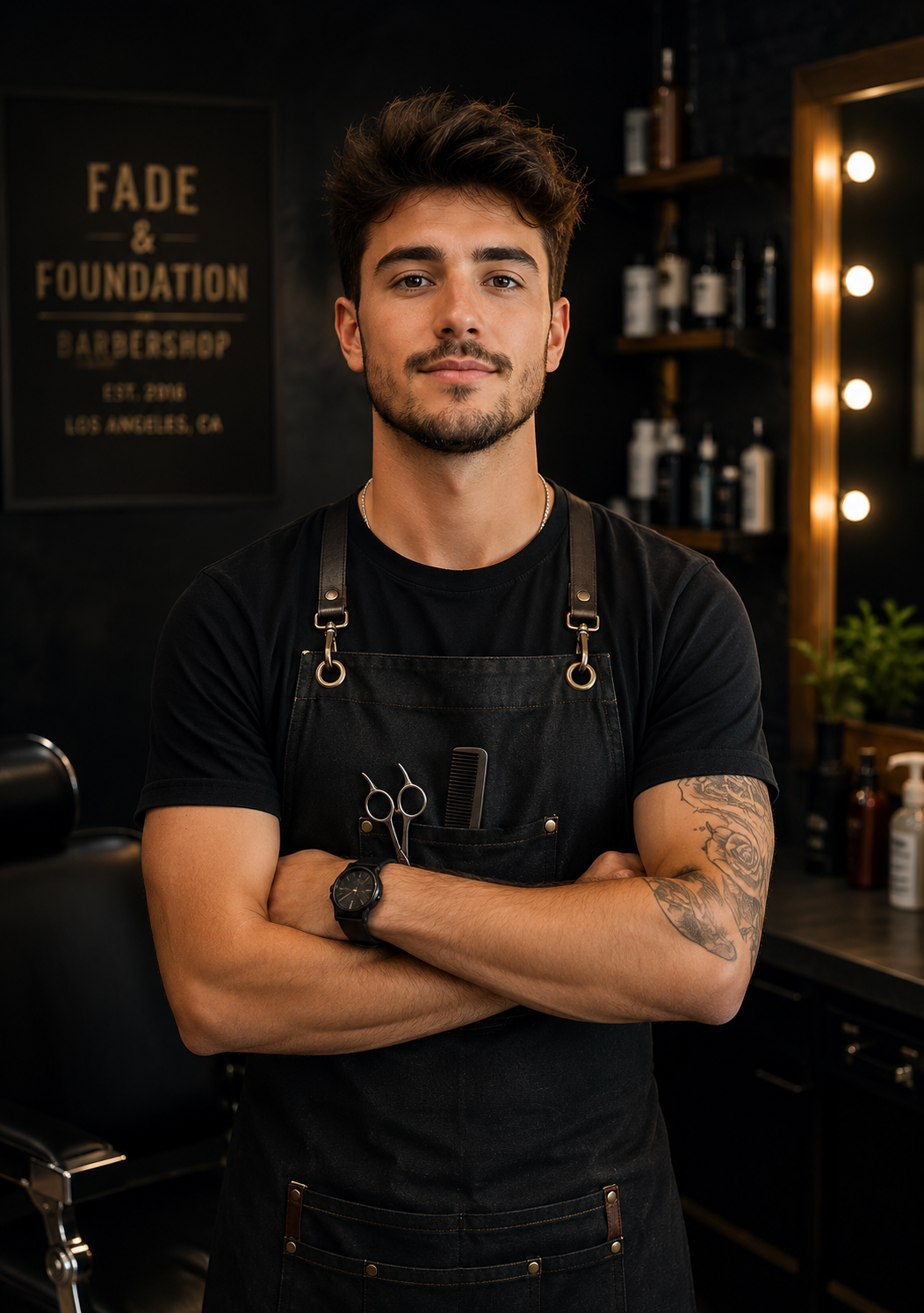
Hi, I’m Jake Miller a passionate barber based in Los Angeles, California, with over 3 years of hands-on experience in the craft. I specialize in modern fades, clean cuts, precision beard grooming, and classic barbering techniques, blending sharp technical skill with a relaxed, personal touch.
Over these years, I’ve had the opportunity to work with all kinds of clients, each with their own style and personality and that’s exactly what I love about this craft. For me, it’s never just about a haircut. It’s about understanding who you are and bringing that out through precision and care.
Every client who sits in my chair gets my full attention and expertise, because I believe great barbering is where confidence meets individuality. My goal is simple: to make sure you walk out looking sharp and feeling like the best version of yourself.

1 thought on “Mid Taper Fade With Beard: Best Styles & How to Ask 2026”