

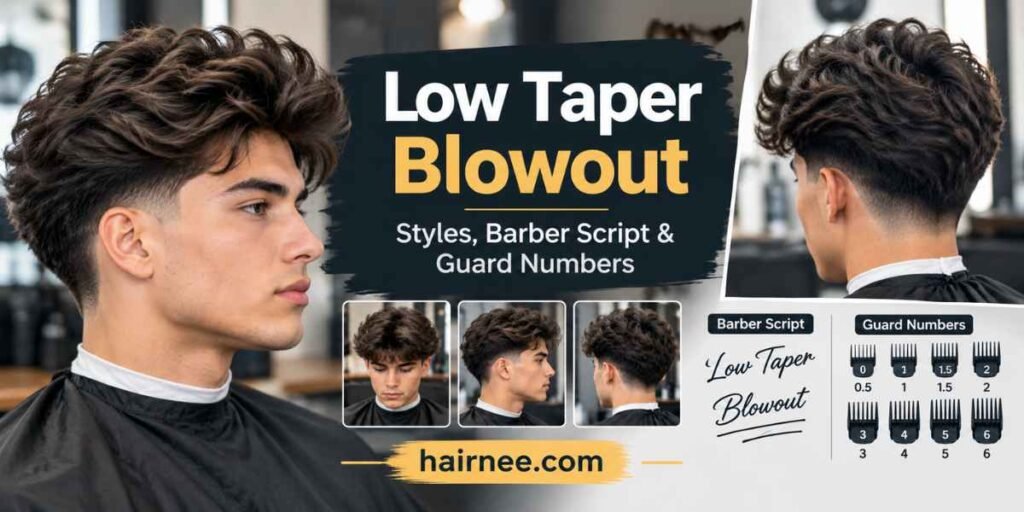
A low taper blowout keeps the sides short and soft near the ears, then lets the top sit tall and full. You get volume without the sharp contrast of a high fade, so the hairstyle looks neat at work, at school and on the weekend.
The name trips people up, because barbers don’t always use it the same way. Getting the details right, like the guard number and the top length, is what separates the cut you wanted from the one you got.
Key Points
- A low taper blowout is a short, soft taper around the ears and neckline with a 3 to 6 inch top that’s blow-dried for lift.
- Compared with a low taper fade, the sides stop at a short guard length instead of going down to bare skin.
- It suits straight, wavy, curly and coily hair, but each texture needs a different cut and drying method.
- Tell your barber the taper height, the shortest length on the sides and the top length, and show a photo.
- Book a full haircut every 3 to 4 weeks, with a quick neckline cleanup around week 2.
What is a low taper blowout?
A low taper blowout is a men’s haircut with short, tapered sides near the ears and neckline and a longer top that’s blow-dried up and back for volume.
It’s really two choices in one. The sides get a low taper, and the top gets a blowout.
What Is a Low Taper Blowout?
A low taper blowout combines a low taper on the sides and back with a top that’s left long enough to blow-dry into full, lifted volume.
The word “low” tells the barber where the shortening starts. That’s around the sideburns, just above the ear and along the nape, which is the back hairline. It stays below the temple line, so the sides keep most of their length.
“Taper” means the hair gets shorter little by little instead of stopping at a hard line. A taper usually keeps some hair at its shortest point, while a fade goes down to bare skin.
“Blowout” describes the top. You dry the hair with a blow dryer and a brush or your fingers so it lifts at the roots. Most tops are between 3 and 6 inches long.
You may also hear this cut called a low blowout taper or a low taper fade blowout. The names overlap, so a photo helps.
One more catch. In some barbershops, “blowout” is an old nickname for the temple fade, which is a different haircut.
Pro Tip: Say “blow-dried volume on top” when you book. That phrase separates your cut from the temple fade some barbers call a blowout.
What Does a Low Taper Blowout Look Like?
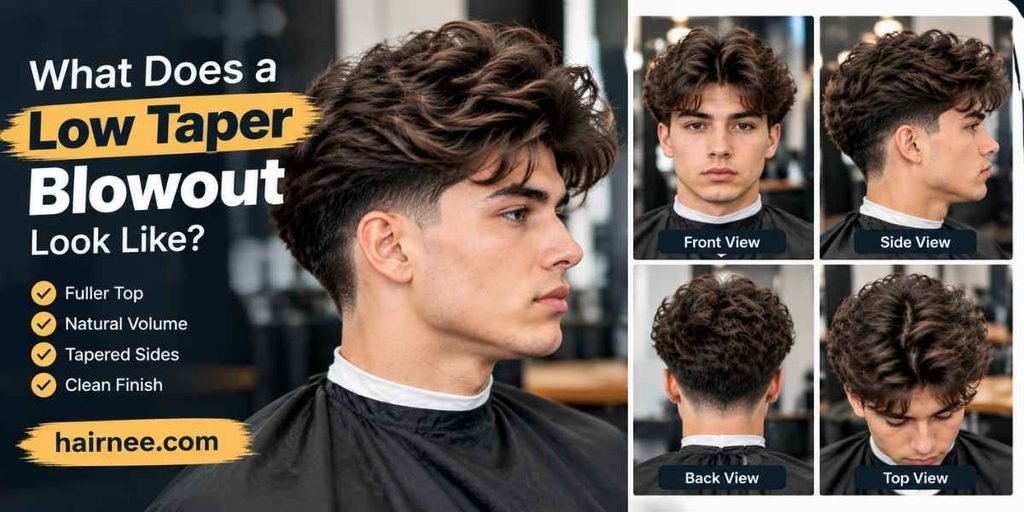
A low taper blowout looks like a rounded, lifted top over short, soft sides that stay full at the temples and only fade near the ears and neckline.
From the front, you see height at the crown and either a natural part or a swept-back finish. The sides look full and clean, not shaved.
From the side, the taper is a narrow band that curves around the ear and meets the nape. Above the ear, the hair gets longer step by step until it joins the top.
From the back, the neckline is short and tidy, and the hair gets thicker toward the crown.
Texture changes the finish. Straight hair looks smooth and sleek. Wavy hair has more movement. Curly and coily hair make the fullest, roundest shape.
Pro Tip: Save photos from the front, side and back. The side view shows exactly where the taper starts.
Low Taper Blowout vs. Low Taper Fade: What Is the Real Difference?
In a low taper blowout, the sides stop at a short guard length, while a low taper fade goes all the way down to bare skin.
Height isn’t the difference. Both start low, near the ear and the nape. What matters is how short the barber goes at the very bottom. That changes how sharp the cut looks and how fast it grows out.
Also remember that “blowout” only describes the top. A fade can carry the same blow-dried top, and many shops use one name for both. The easiest way to order is to describe the sides and the top separately.
| Feature | Low taper blowout | Low taper fade |
| Shortest point on the sides | A short guard length, often #1 or #2, with no bare skin | Bare skin or a zero-guard finish (often called a skin fade) |
| Contrast | Soft and gradual | Crisp and clear |
| Top styling | Blow-dried for volume | Any style: slick, textured, curly or blow-dried |
| Regrowth | Softens slowly | Shows quickly once the skin line fills in |
| Typical trim window | 3 to 4 weeks | 2 to 3 weeks |
| Best for | Neat, low-maintenance looks | Sharper, higher-impact looks |
Pro Tip: Ask which guard the barber plans to start with at the sideburn before the clippers come out. It takes five seconds and can save you a bad haircut.
Is a Low Taper Blowout the Same as a Low Taper Fade?
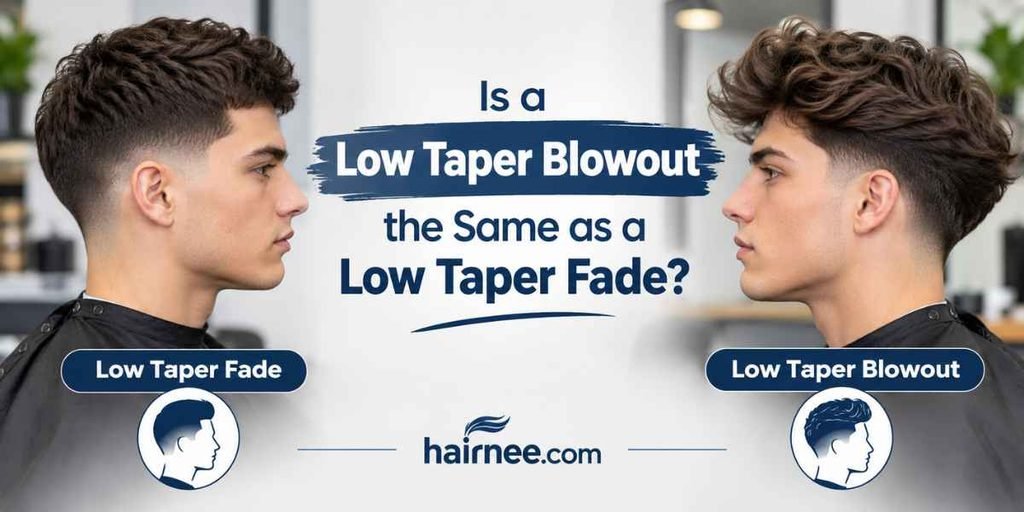
No. Both cuts start low, but a taper keeps short hair at the base, a fade reaches skin, and “blowout” adds a volume-styled top.
People mix them up for good reasons. The photos look alike, social captions use the names loosely, and some barbers treat them as the same thing.
You can check in the mirror. Look at three spots:
- Sideburn: hair still there means a taper, and smooth skin means a fade.
- Nape: a soft, fuzzy edge points to a taper, while a bare-skin gradient points to a fade.
- Touch test: a taper feels like short stubble all the way down, and a fade feels smooth at the very bottom.
To be safe, say it plainly. For a taper: “Low taper, no bare skin, blow-dried volume on top.” For a fade: “Low taper fade, skin at the sideburns and nape.”
Low vs. Mid vs. High Blowout Taper: Which Height Should You Choose?
A low blowout taper starts just above the ear and stays below the temple, a mid taper starts at the temple, and a high taper starts above it.
| Height | Where the taper starts | Contrast | Regrowth softens | Best for |
| Low | Just above the ear and along the nape, below the temple | Subtle | Roughly 3 to 4 weeks | First-timers, offices, longer gaps between visits |
| Mid | At temple level | Medium | Roughly 2 to 3 weeks | A clear shape with fair upkeep |
| High | Above the temple, high on the sides | Strong | Roughly 1 to 2 weeks | Bold contrast and frequent barber visits |
Go low if you want the softest grow-out and the most side length left. It also suits rounder faces, since fuller sides plus height on top make the face look longer.
Think about mid if your side hair is very thick. A low taper leaves more hair to grow, so the sides can look bulky by week three. A mid taper removes more.
Pick high only when strong contrast is the goal. A low version won’t give you that look, however you style it.
Pro Tip: Not sure? Start low. Going one level higher next visit is easy. Growing out a taper that’s too high takes weeks.
Does a Low Taper Blowout Work With Your Hair Type?
Yes, a low taper blowout works on straight, wavy, curly and coily hair. The difference is how the top is cut and how you dry it.
Three things affect the result, and people often mix them up. Texture is the curl pattern. Density is how many hairs grow in one area. Strand width is whether each hair is fine, medium or coarse. Volume from a low taper blowout depends on all three.
Hair is usually grouped as straight (Type 1), wavy (2A to 2C), curly (3A to 3C) and coily (4A to 4C). Plenty of people have a mix, so use the table as a rough guide.
| Hair type | Where the volume comes from | Best tool | Product that helps | Most common mistake |
| Straight | Root lift and a layered top | Round brush and a narrow nozzle | Volumizing mousse, light clay | Leaving heavy bulk above the taper |
| Wavy | The natural bend in each strand | Diffuser or fingers | Sea salt or texturizing spray | Brushing dry waves into frizz |
| Curly | Curls stacking into a round shape | Diffuser and curl cream | Curl cream | Touching curls before they’re dry |
| Coily | Natural density and shrinkage | Pick, or a comb attachment on low heat | Leave-in conditioner, light oil | Styling dry, under-moisturized hair |
Straight Hair: How to Get Real Volume Without the Mushroom Effect
Straight hair gets real volume when the barber removes weight from the lower sides and you dry the roots upward instead of only puffing out the length.
The mushroom effect happens when extra bulk sits right above the taper line. As you blow-dry, that weight pushes outward, and the top flares over the sides like a cap.
The fix starts in the chair. Ask for weight to be taken out above the taper and for layers through the top, so the hair lifts instead of hanging.
At home, try this:
- Dry the hair until it’s damp, then add heat protectant and mousse at the roots.
- Aim the dryer at the roots and pull the hair up and back with a round brush.
- Keep the dryer moving, about 4 to 6 inches away, on medium heat.
- Finish with a few seconds of cool air to set the lift.
Script: “I have straight hair, so please remove some weight from the lower sides and add layers on top so it lifts instead of flaring out.”
Pro Tip: Do your final lift in the last minute of drying. Hair sets as it cools, so the last direction you give it is the one that stays.
Wavy Hair: The Path of Least Resistance
Wavy hair is the easiest texture for this cut because the natural bends already lift the roots. Your main job is to control frizz.
Spray a light texturizing or sea salt spray on damp hair. Then finger-dry, or use a diffuser on low to medium heat. Scrunch upward instead of brushing, so the waves stay grouped together.
Finish with a little light paste. Wavy hair usually holds its shape well, so heavy product does more harm than good.
Script: “I have wavy hair. Leave enough length for the waves to show, taper low at the ears and neckline, and add light texture through the top.”
Pro Tip: If your waves puff out at the sides by midday, the sides are carrying too much weight. Ask the barber to lighten them next time.
Curly Hair: The Most Visual Payoff of Any Texture
Curly hair gets the biggest visual payoff because the curls stack into a round top that holds its own height, and the low taper frames it cleanly.
Start with very damp hair. Work curl cream through from roots to ends. Dry with a diffuser on low airflow and medium heat, and cup the curls up toward your scalp.
Then leave it alone until it’s fully dry. Fluff the roots lightly with your fingers. If you touch it too early, the curls break apart and turn frizzy.
Script: “I have curly hair. Keep the taper low, leave enough length for my curls to stack on top, and shape it so it looks round from every side.”
Pro Tip: Curls spring up as they dry, so a length that looks long when wet can look short when dry. Tell your barber how much yours shrinks.
Coily / Afro Hair: Volume Built In, Shape Is the Job
Coily hair already has plenty of volume, so the low taper’s job is to frame and shape that fullness with clean edges, not to add height.
The taper sits at the sideburns, behind the ear and along the nape. It gives the rounded top a clear border, and that contrast makes the shape look planned.
For styling, moisture matters more than heat. Use a leave-in conditioner, define the hair with a comb or sponge, and lift it from the roots with a pick. If you blow-dry to stretch the hair, use a comb attachment on low heat with a heat protectant.
Script: “Keep all my length on top and shape it round. Taper tight at the sideburns and nape, and don’t go above the ear.”
Pro Tip: Ask to see the barber’s recent work on 4A to 4C hair before you book. Shaping a coily top well takes skill, and photos tell you more than reviews.
What Face Shapes and Lifestyles Does It Suit?
A low taper blowout suits most face shapes, because the taper is subtle and you can raise or lower the volume on top to balance your features.
Use the table as a starting point, not a rule. Your hairline, jaw, hair density and personal taste all change the result.
| Face shape | What tends to work | A small change to consider |
| Oval | Almost any top length and direction | Choose by lifestyle, not shape |
| Round | Extra height on top, tidy sides | Avoid heavy volume at the sides |
| Square | A softer, textured top | A little fringe softens a strong jaw |
| Oblong or long | Medium volume and forward texture | Don’t make the top too tall |
| Diamond | Some fullness at the forehead | A textured fringe balances wide cheekbones |
| Heart | A fringe or length across the forehead | The low taper keeps the sides full, which balances a narrow chin |
Lifestyle matters too. The soft sides of a low taper blowout look neat in offices and schools, and a medium-height top keeps things formal when you need it.
If you sweat a lot or wear a cap or helmet, go for a textured top over a smooth one. Texture bounces back after a hat. Smooth volume flattens.
Pro Tip: Check your face shape with a front-facing photo and your hair pulled back. Then decide how much volume to ask for.
Also Read This High Taper Fade for Curly Hair: 30 Styles, Face-Shape & Barber Guide
How Do You Ask Your Barber for a Low Taper Blowout?
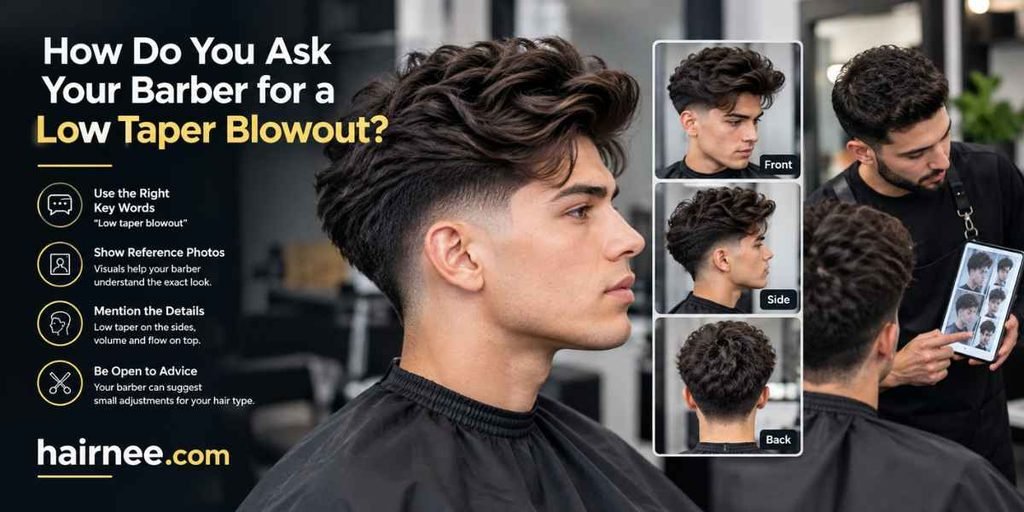
To ask for a low taper blowout, name the taper height, the shortest length on the sides and the top length, then show a photo.
Barbers read the same words in different ways, so details do most of the work. Four things cover almost everything: where the taper starts, how short it ends, what happens on top, and how your hair behaves.
You can copy this script:
“I’d like a low taper blowout. Start the taper just above my ears and at the neckline, keep the shortest length at a #2 with no bare skin, and leave the sides full above that. Keep 4 inches on top with texture so I can blow-dry it up and back.”
A few extras are worth adding:
- Sideburns: say “taper them naturally” for a soft finish, or “square them off” for a sharper one.
- Neckline: a tapered neckline grows out gently. A blocked one looks crisp at first but grows out with a hard line.
- Weight: “remove some bulk from the lower sides” helps straight and thick hair.
- Hair type: mention it, because the same top length behaves differently on each texture.
Vague requests cause most bad haircuts. “Just a taper” could mean a skin fade, and “short on the sides” could mean anything from a #1 to a #4.
Quick save: Screenshot the script and swap in your own numbers. It takes ten seconds and keeps the chair talk short.
Pro Tip: If your photo shows a different hair type from yours, tell the barber which parts to copy, like the taper height and top length. Don’t expect the same volume.
Guard Numbers for a Low Taper Blowout: What Do They Mean?
For a low taper blowout, the sides usually blend from a #1 or #2 guard at the sideburns and nape up into your natural length.
A guard number tells the barber how much hair to leave. It doesn’t say where on your head to leave it. So give a location with every number, like “a #2 at the sideburn, blending up into my length above the ear.”
| Guard | Length (inches) | Length (mm) | Typical role in this cut |
| #1 | 1/8 | 3 | Shortest point at the sideburn and nape for a tighter taper |
| #2 | 1/4 | 6 | The most common starting point, a little softer than a #1 |
| #3 | 3/8 | 10 | The middle of the blend |
| #4 | 1/2 | 13 | The upper blend, into your natural length above the ear |
| #6 | 3/4 | 19 | The last step on thick or curly sides |
Sizes can differ a little between clipper brands. Many barbers also build a low taper blowout with adjustable levers or scissor-over-comb instead of plastic guards. Asking for “a quarter inch at the shortest point” is safer than giving only a number.
If you don’t want any skin showing, say “nothing shorter than a #1.” Some barbers finish with a bare blade at the very bottom unless you tell them not to.
Pro Tip: Start at a #2 for a softer look. A #1 makes the taper easier to see from the front, and you can go tighter next time.
What Happens During a Low Taper Blowout Haircut?
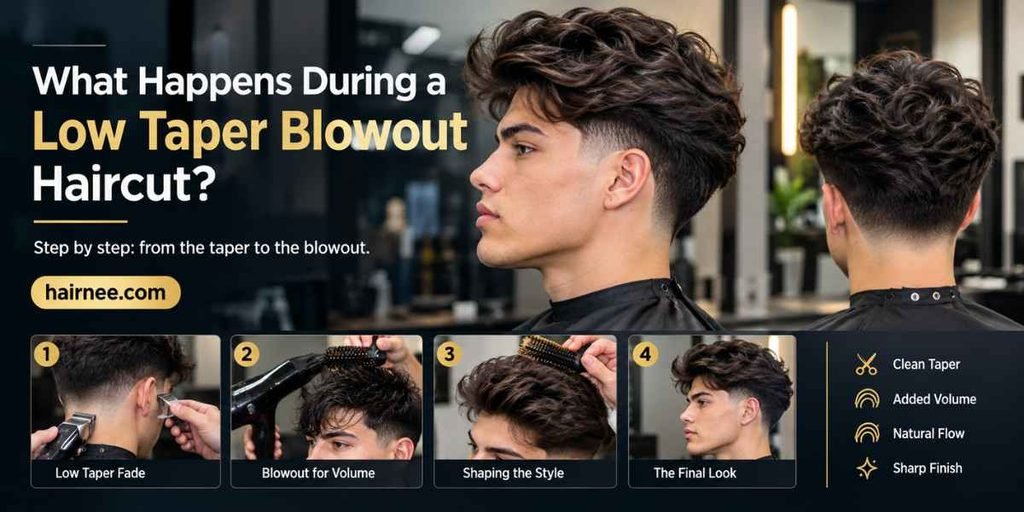
A barber usually sets the neckline and sideburn edges first, blends the sides upward with longer guards, then cuts and blow-dries the top.
The order changes from shop to shop, but most appointments go like this:
- Talk: the barber looks at your photo, your hair type, your natural part and any cowlicks. A cowlick is a spot where the hair grows in a different direction.
- Guidelines: the lowest points at the neckline and sideburns are set with the shortest guard.
- Blending: the barber steps up through longer guards, from the bottom up, and softens each step.
- Weight check: they feel the sides and take out bulk above the taper if it looks heavy.
- Top: the top is cut with point-cutting or texturizing, which means snipping into the ends so the hair lifts instead of hanging.
- Blow-dry check: the top is dried to see how it falls, and stray lengths get trimmed.
- Finish: the edges are cleaned up and a light product goes in.
A low taper blowout appointment usually takes 30 to 60 minutes, and a bit longer if the barber shows you how to style it.
Pro Tip: Ask the barber to show you the drying direction near the end, and film it. Copying the same airflow at home matters more than any product.
How Do You Style a Low Taper Blowout at Home?
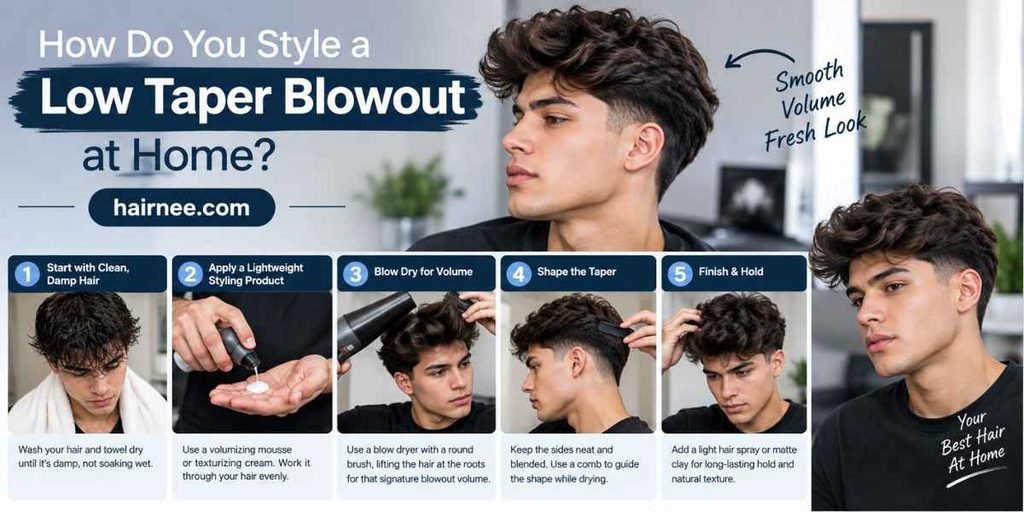
To style a low taper blowout, blow-dry damp hair upward and back from the roots on medium heat, then set it with cool air and a light product.
Give yourself five to eight minutes. Here’s the routine:
- Towel-dry until the hair is damp, not dripping. Very wet hair takes too long to dry and goes flat.
- Apply heat protectant, then a volumizing mousse or spray at the roots.
- Dry the roots first with the narrow nozzle that comes with most dryers. Hold the dryer 4 to 6 inches away.
- Lift the front up and back, then the crown up. Brush the sides lightly inward toward the taper.
- Press the cool-air button for a few seconds to set the shape.
- Warm a pea-sized amount of light clay or paste in your palms and work it in from the back to the front.
Leave the clipper work to your barber. Between visits you can tidy the neckline with a trimmer, but stay away from the sides.
Pro Tip: Make sure the hair is completely dry before you add product. Damp hair slumps within an hour, even with a strong-hold product.
Best Products and Tools for a Low Taper Blowout
A low taper blowout needs just three products: a heat protectant, a volumizing spray or mousse for the roots, and a light styler to hold the shape.
Choose by hair type and finish, not by brand.
| Product | What it does | Best for |
| Heat protectant spray | Shields hair from dryer heat | Anyone using a blow dryer |
| Volumizing mousse or root spray | Lifts hair at the roots | Straight and fine hair |
| Sea salt or texturizing spray | Adds grip and separation | Wavy and medium-density hair |
| Curl cream | Defines curls and reduces frizz | Curly hair |
| Leave-in conditioner and light oil | Adds moisture and softness | Coily hair |
| Matte clay or paste | Gives light hold with no shine | Textured and fringe styles |
| Texture powder | Adds instant lift at the roots | Fine hair |
| Flexible hairspray | Locks the finish in place | Any type |
The tools are simple too: a blow dryer with a narrow nozzle and a diffuser, a medium round brush, a wide-tooth comb, a pick for coily hair, and a small trimmer for the neckline.
Skip heavy pomades and strong gels. They weigh the hair down and undo the lift you just built.
Pro Tip: Start with a pea-sized amount. Adding more is easy, but taking product out means washing your hair again.
How Often Does a Low Taper Blowout Need a Trim?
A low taper blowout needs a full haircut every 3 to 4 weeks, with an optional neckline and sideburn cleanup around week 2.
Hair grows about half an inch a month, so the taper lines shift a little each week. The edges blur first, then the top gets heavier.
| Week | What you’ll notice | What to do |
| Week 1 | Crisp edges and full lift | Style as usual |
| Week 2 | Neckline and sideburns start to soften | Optional quick cleanup |
| Week 3 | Taper edges blur and the top feels heavier | Book your next cut |
| Week 4 | The shape looks fuller and volume slumps | Full haircut is due |
| Week 5 and beyond | The taper is mostly gone | The cut is overdue |
Thick hair and fast growers show the blur sooner. Curly hair hides it better. Since there’s no bare-skin line to grow out, a low taper blowout ages more gently than a fade.
Pro Tip: Book your next appointment before you leave the chair, about three weeks out. Good slots with a good barber fill up fast.
Common Low Taper Blowout Mistakes (and How to Fix Them)
The most common low taper blowout mistakes are cutting the top too short, leaving bulk above the taper, being vague about height and using too much product.
| Mistake | What goes wrong | The fix |
| Top cut too short | There’s nothing left to lift | Keep at least 3 inches, and trim slowly |
| Heavy sides | The outline flares like a mushroom | Ask for weight to be taken out above the taper |
| Vague height | The taper drifts up to a mid taper | Say “starts above the ear, under the temple” |
| Stopping the blow-dry early | Volume collapses within an hour | Dry fully, then use cool air |
| Too much product | The hair gets weighed down | Use a pea-sized amount, from back to front |
| Brushing dry curls | Frizz and lost definition | Use your fingers or a diffuser instead |
| A blocked neckline | A hard edge that grows out badly | Ask for a tapered neckline |
Pro Tip: If your low taper blowout looks wide by midday, the cause is usually side weight, not styling. Mention it at your next visit.
Low Taper Blowout Variations: Which Style Fits You?
Low taper blowout variations differ mostly in how the top is cut and finished, while the low taper underneath stays the same.
Five versions come up most often in barbershops. Each one changes the shape on top and leaves the taper alone.
Textured Fringe Low Taper Blowout
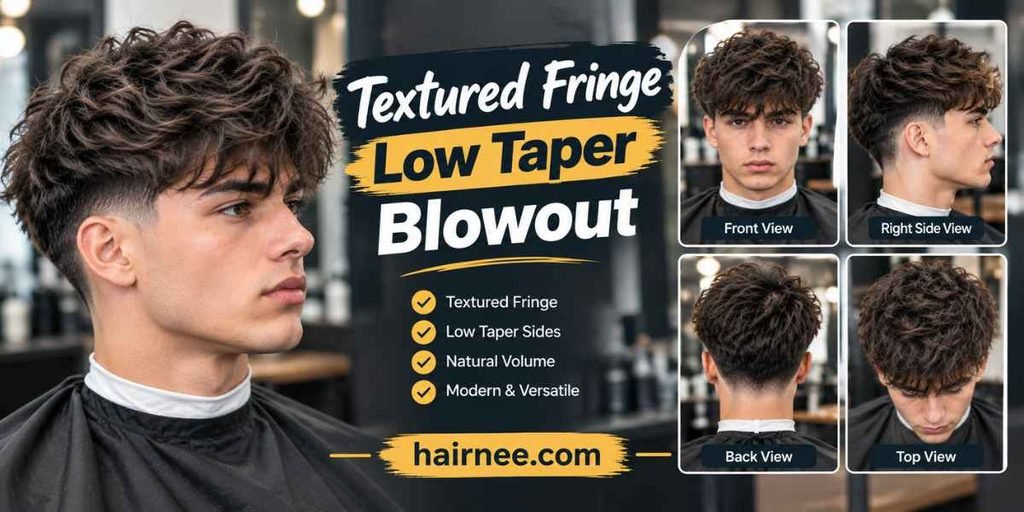
A textured fringe low taper blowout has a soft, choppy fringe that falls forward over the forehead while the crown is blow-dried for lift.
The barber snips into the ends of the fringe, which is called point-cutting, so it looks broken up instead of straight. It usually sits around eyebrow level and blends into the sides with no hard line.
It suits oval, square and longer faces. The fringe softens a strong jaw and shortens a long forehead. To style it, dry the fringe forward and a little down, lift the crown, and finish with matte paste.
Script: “Textured fringe, point-cut, brow length, blended into the sides.”
Edgar / Blunt Fringe Low Taper Blowout
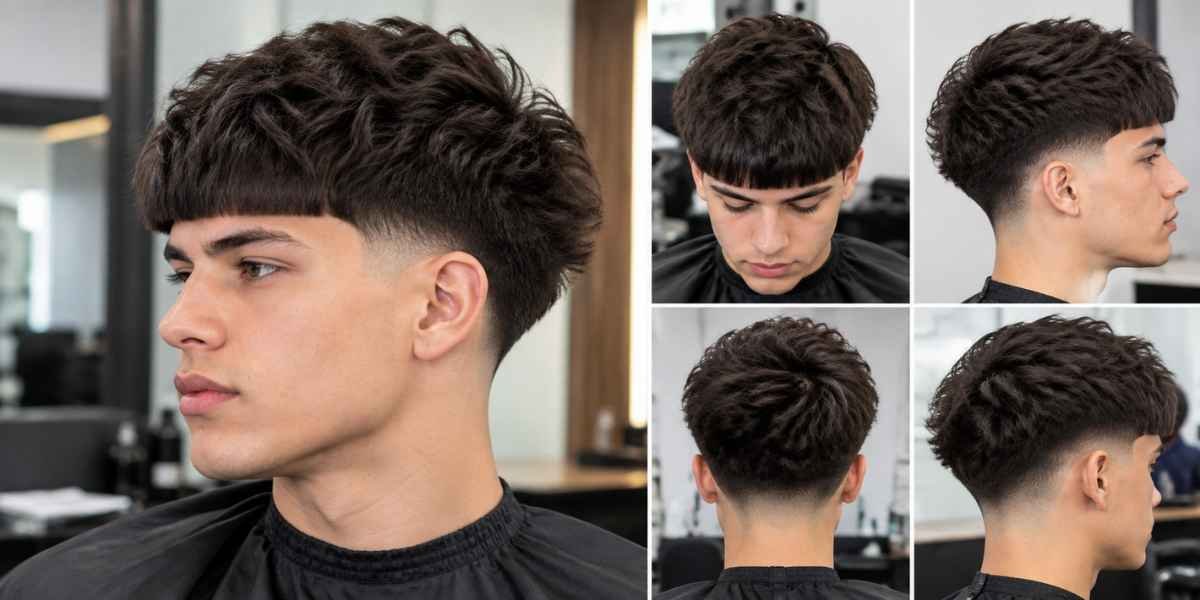
An Edgar or blunt fringe low taper blowout has a straight, one-length fringe cut across the forehead at about eyebrow height.
That hard line against the soft taper is what makes the style stand out. It works best on thick, straight or slightly wavy hair, because that hair can dry flat and hold the edge.
Plan on a fringe trim every two to three weeks. The straight line is the whole look. A French crop keeps its fringe short and choppy, while the Edgar keeps it clean and even.
Script: “Blunt fringe at eyebrow height, cut straight across, low taper on the sides.”
Also Read This High Taper Fade for Curly Hair: 30 Styles, Face-Shape & Barber Guide
Grown-Out / Longer Top Low Taper Blowout
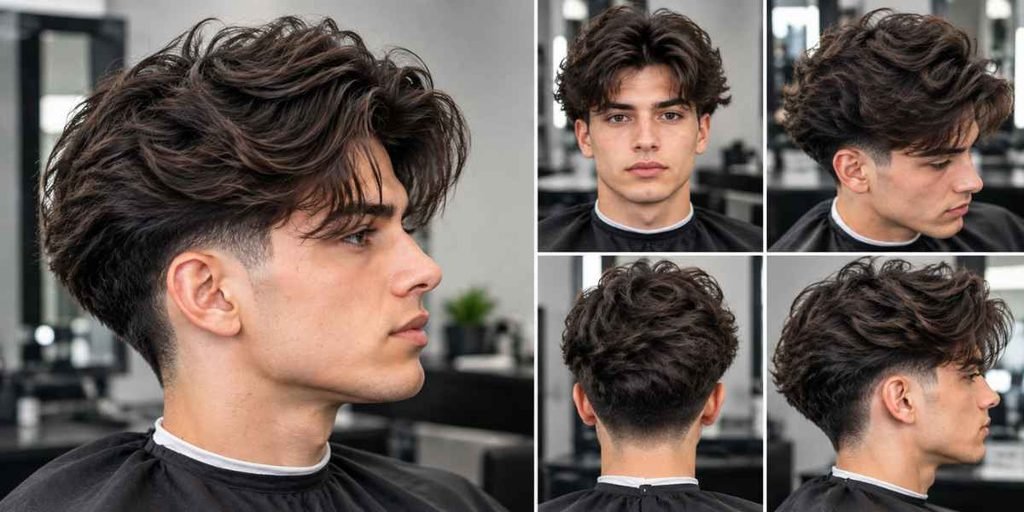
A grown-out low taper blowout keeps the top past 6 inches while the taper stays neat underneath, so the extra length adds volume and flow.
More length means more weight. The barber needs to take out bulk and add light layers, or the extra hair drags the shape down instead of lifting it.
Keep the taper fresh every three to four weeks and trim the top ends every second visit. Dry the hair backward or to the side with a round brush for a full, relaxed finish.
Script: “Keep my length on top, add light layers to control the weight, and keep the taper low and neat.”
Curly Afro Low Taper Blowout
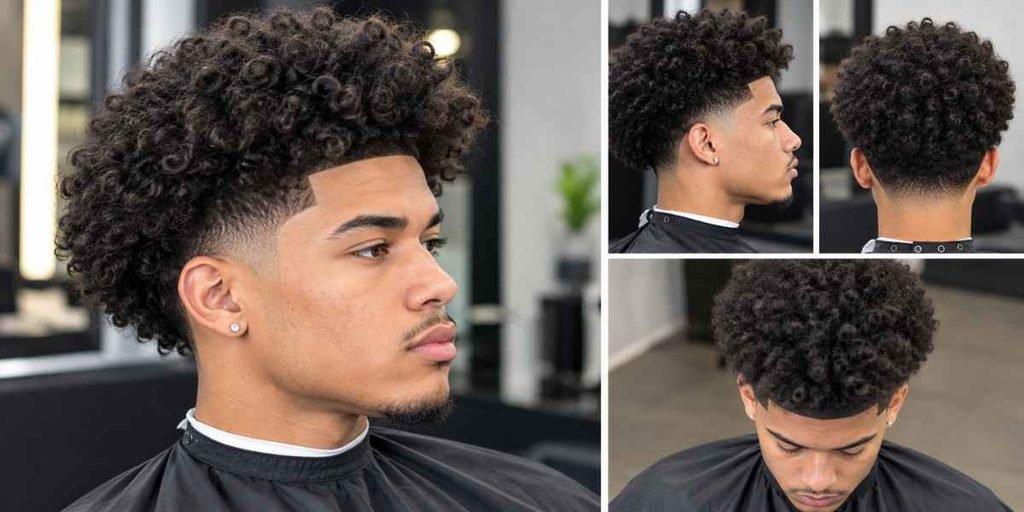
A curly afro low taper blowout has a full, round curl shape on top and a tight taper that starts below the ear.
The taper stays low so the afro keeps its full outline. The clear border between tight sides and a soft top gives the shape its structure.
Ask the barber to round the top with a pick while they cut, and moisturize your curls before styling. Aim for about 3 to 5 inches of natural, unstretched length, so the shape has room to build.
Script: “Tight taper below the ear, keep my curls full on top, and shape it round.”
Perm Low Taper Blowout
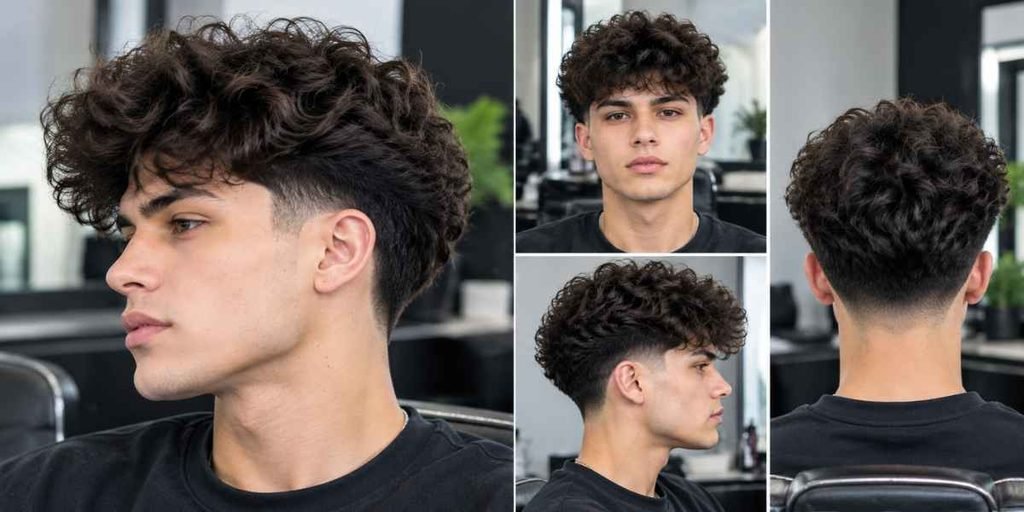
A perm low taper blowout adds a chemical wave or curl to straight or loosely wavy hair, so the top holds volume with far less heat styling.
The sides get a low taper, and only the top is permed. The texture lasts several months and grows out slowly, so talk it over with your stylist before you commit.
Mention your hair condition first, especially if it’s bleached or heat-damaged. Ask how long to wait before washing, which is often a day or two. Then style with a diffuser and curl cream.
Script: “I’d like a perm on top for curls and volume, with a low taper on the sides.”
30 More Low Taper Blowout Variations for Every Style and Finish
Beyond the five main styles, 30 more low taper blowout variations change the top shape, length, taper technique, finish, color or texture.
Each row is a different version of the low taper blowout, not a rename, and the last column gives you a line to copy. Start with the top shape, since it changes the overall look the most.
| Variation | What makes it different | Best suited to | Ask your barber |
| Middle part / curtain | A center split, with the top falling to both sides and lifted a little at the roots | Straight or wavy hair, 4 to 6 inches on top | “Low taper, middle part, keep the front long enough to fall to both sides.” |
| Slick-back | The top brushed straight back, with height at the front and crown | Thick straight or wavy hair | “Low taper, keep the top long enough to comb straight back with lift at the front.” |
| Side part / side-swept | A clear part that sweeps the top across to one side | Any texture, and easy to dress up | “Low taper, natural side part, top long enough to sweep across.” |
| Quiff / soft pompadour | The front lifted higher than the crown and swept up and back | Medium to thick hair with 4 to 6 inches at the front | “Low taper, longer front for a soft quiff, shorter toward the crown.” |
| Faux-hawk-lite | A soft center ridge, with the top shaped in toward the middle | Thick or wavy hair, 3 to 4 inches | “Low taper, top styled up toward the center with no hard sides.” |
| French crop | A shorter, cropped top brushed forward with a short, choppy fringe | Thick hair and low-effort routines | “Low taper, about 2 to 3 inches on top, short forward fringe.” |
| Comma hair | The fringe curls inward into a comma shape over the forehead | Straight to wavy hair with 4 to 5 inches at the front | “Low taper, longer fringe I can curl into a comma, lighter layers on top.” |
| Layered shag top | A choppy, layered top with movement around the crown | Wavy or thick hair | “Low taper, add layers through the top for a shaggy, moving shape.” |
Length and volume change the feel of the cut, even when the shape stays the same.
| Variation | What makes it different | Best suited to | Ask your barber |
| Short top | About 3 inches on top for close, tidy lift | Fine hair, or low-effort routines | “Low taper, keep about 3 inches on top with light layers.” |
| Medium length | Around 4 to 5 inches, a good balance of volume and control | Most textures | “Low taper, 4 to 5 inches on top, textured.” |
| Fluffy / cloud top | Soft, feathered volume that looks airy, not styled | Straight to wavy hair | “Low taper, layers through the top so I can blow it up soft and fluffy.” |
The taper itself can change too, and this is where the barber’s skill shows.
| Variation | What makes it different | Best suited to | Ask your barber |
| Low burst | The taper curves around the ear in a half circle instead of running straight down (a burst fade shape) | Wavy or curly hair | “Low burst taper around the ear, blowout on top.” |
| Drop taper | The taper line curves down behind the ear | Anyone who wants more shape from the side | “Low drop taper, curve it down behind my ears.” |
| Ice pick | A narrow, pointed sideburn, with a taper that starts below the ear and rises quickly | Guys who like sharp sideburn detail | “Low taper with ice-pick sideburns.” |
| Disconnected | The taper stays low, and the sides and top meet at a clear step instead of blending | Curly hair and bold looks | “Low taper only at the edges, leave a clear step up to the top.” |
| Skin finish | A guard-based taper with bare skin only at the sideburn and behind the ear | A little more sharpness while staying soft | “Low taper, skin only at the sideburns and behind the ears.” |
| Heavy crown | Extra length and density kept at the crown for a rounder shape | Round or oval faces | “Low taper, keep extra length at the crown so I can lift it.” |
| Extended sideburn | Sideburns kept fuller, down to mid-ear, with the taper starting behind them | A retro look that frames the jaw | “Low taper, keep my sideburns full to mid-ear and taper behind them.” |
Finishing touches and facial hair are the next layer of choice.
| Variation | What makes it different | Best suited to | Ask your barber |
| Sharp line-up | A crisp edge along the hairline and temples | Extra definition on any texture | “Clean line-up, keep my natural hairline, don’t push it back.” |
| Stubble or short beard | A short beard blended into the sideburn taper | Guys who keep a light beard | “Blend the taper into my short beard at the sideburn.” |
| Full beard | A beard faded into the taper so the hairline and jaw connect | Full beards on round or oval faces | “Low taper into my beard, keep the length, blend the connection.” |
| Razor design | A thin part line or small pattern cut in with a razor | Personal style on short sides | “Add a thin razor part line on the left side.” |
Color is its own choice, and it can change how the top looks and how gently you need to dry it.
| Variation | What makes it different | Best suited to | Ask your barber |
| Blonde or bleached top | A lightened top over natural or darker sides | Healthy hair that can handle gentle drying | “Low taper, bleached top, keep the layers soft.” |
| Highlights or color pop | Subtle highlights or a bold color on the top only | Textured, layered tops | “Low taper, highlights through the top only.” |
| Silver / salt-and-pepper | A gray top left natural over a clean taper | Mature guys, since gray hair can feel coarser and drier | “Low taper, keep the silver on top, add moisture and texture.” |
Some cuts are shaped by texture or a specific need.
| Variation | What makes it different | Best suited to | Ask your barber |
| Sponge-twist top | Small coils made with a curl sponge, sitting over a low taper | Coily hair, types 4A to 4C | “Low taper, keep my top length for sponge twists.” |
| Short locs top | Short or starter locs on top, with a clean taper around the ears | Locs, or growing them out | “Low taper on the sides, keep my locs on top, clean around the ears and nape.” |
| Taper mullet | The sides taper around the ears while length stays at the back | Wavy or curly hair | “Low taper around the ears only, keep length at the nape, blowout on top.” |
| Temple-friendly | Side hair kept full at the temples, with the top pushed forward or lightly across | Receding temples | “Low taper, don’t cut high at the temples, leave enough top to sweep forward.” |
| Fine-hair volume | Shorter layers and a mousse-led blow-dry to build fullness | Fine or thin strands | “Low taper, layers through the top to build volume on fine hair.” |
Pro Tip: Change one thing at a time, either the top shape or the finish. Then you’ll know exactly what’s working when you see the result.
What You Need Before Getting a Low Taper Blowout
Before you book a low taper blowout, you need about 3 inches of hair on top, a reference photo, a barber who blow-dries, and roughly 45 minutes.
- Enough length: around 3 inches gives you real lift. Hair grows about half an inch a month, so growing out a buzz cut usually takes 4 to 6 months.
- A reference photo: two or three angles, ideally on hair that looks like yours.
- The right barber: check their feed for soft tapers and blow-dried tops, and ask if the blow-dry is included in the price.
- A realistic budget: prices vary a lot by city and shop, and a blow-dry finish can add time and cost.
- A five-minute routine: a dryer, a brush and a light product are enough to keep a low taper blowout looking fresh.
- Patience with your hair’s habits: a cowlick or crown swirl changes how the top lifts, but a good barber can work with it.
Pro Tip: Show your barber your cowlick or crown swirl before they start cutting. It decides which direction your top will cooperate with.
Low taper blowout straight hair
A low taper blowout on straight hair works when the top has layers, the sides carry little bulk and you dry the roots upward.
Density decides how much work you’ll need. Fine, straight hair lifts easily but goes flat by lunchtime. Thick, coarse straight hair is heavy and needs thinning so the outline doesn’t get wide.
If your style sags before the day is over, try these fixes:
- Add mousse or root spray to damp roots, not the ends.
- Spend the last 30 seconds lifting straight up, then cool the shape.
- Use a little texture powder at the roots instead of a heavy pomade.
- Check your top length. Under 3 inches, straight hair rarely lifts.
Thick, coarse hair needs a different plan. Ask for thinning at the sides of your low taper blowout and use less product, since it already has plenty of bulk.
Low taper blowout curly hair
A low taper blowout on curly hair works best when the barber shapes the top dry and allows for how much your curls spring up.
A dry cut lets the barber see how each curl falls, so ask for it if your barber is comfortable with that method. Loose spirals (3A), defined ringlets (3B) and tight corkscrews (3C) shrink by different amounts, so the barber needs to see your real pattern.
For a midday refresh, mist the top lightly with water, work in a little curl cream, and re-diffuse for two or three minutes. This brings the shape back without a full wash.
At night, a satin pillowcase or a loose satin bonnet cuts friction and keeps the top of your low taper blowout from flattening. When frizz shows up, the cause is usually too much touching or too little moisture, not the cut.
Frequently Asked Questions
A low taper blowout is a low-maintenance cut that needs about 3 inches of top hair, a trim every 3 to 4 weeks and a few minutes with a blow dryer.
How long does hair need to be for a low taper blowout?
You need at least 3 inches on top for a low taper blowout to hold real lift, and 4 to 6 inches gives you more shape to work with.
Curly and coily hair shrink as they dry, so a barber may leave more length than the measurement suggests. From a buzz cut, expect around 4 to 6 months of growth.
What guard number should I ask for?
Ask for a #1 or #2 at the sideburns and neckline, then let the barber blend up through longer guards into your natural length.
Say “no bare skin” if you don’t want skin showing, since some barbers finish a low taper blowout with a bare blade.
Does a low taper blowout work on thin or fine hair?
Yes, a low taper blowout suits thin or fine hair because the fuller sides keep attention on top, where mousse and shorter layers can build fullness.
It won’t add density, but the right layers and a root-lifting product make the hair look thicker.
Is this cut appropriate for the office or school?
Yes, the soft, gradual sides of a low taper look neat in most offices and schools, especially with medium volume and a smooth or lightly textured top.
Can you wear a low taper blowout with a beard?
Yes, the taper blends naturally into a short or full beard when the barber connects the sideburn to the beard line.
Ask for the beard to be faded into the taper, and keep the beard length in balance with the volume on top.
Can you get the look without a blow dryer?
You can get close by air-drying with a texturizing product on wavy or curly hair, but straight hair usually needs a dryer to stand up.
Without a dryer, put mousse at the roots and push the hair upward as it dries.
Final Thoughts
A low taper blowout works because it splits the job in two. A soft taper keeps the sides neat, and the blown-out top gives the cut its shape. Get the height, the shortest length and the top length right, and the rest is easy.
Bring a photo, ask for the details in plain numbers, and book your next trim early. A few minutes with the dryer each morning keeps your low taper blowout looking sharp between visits.
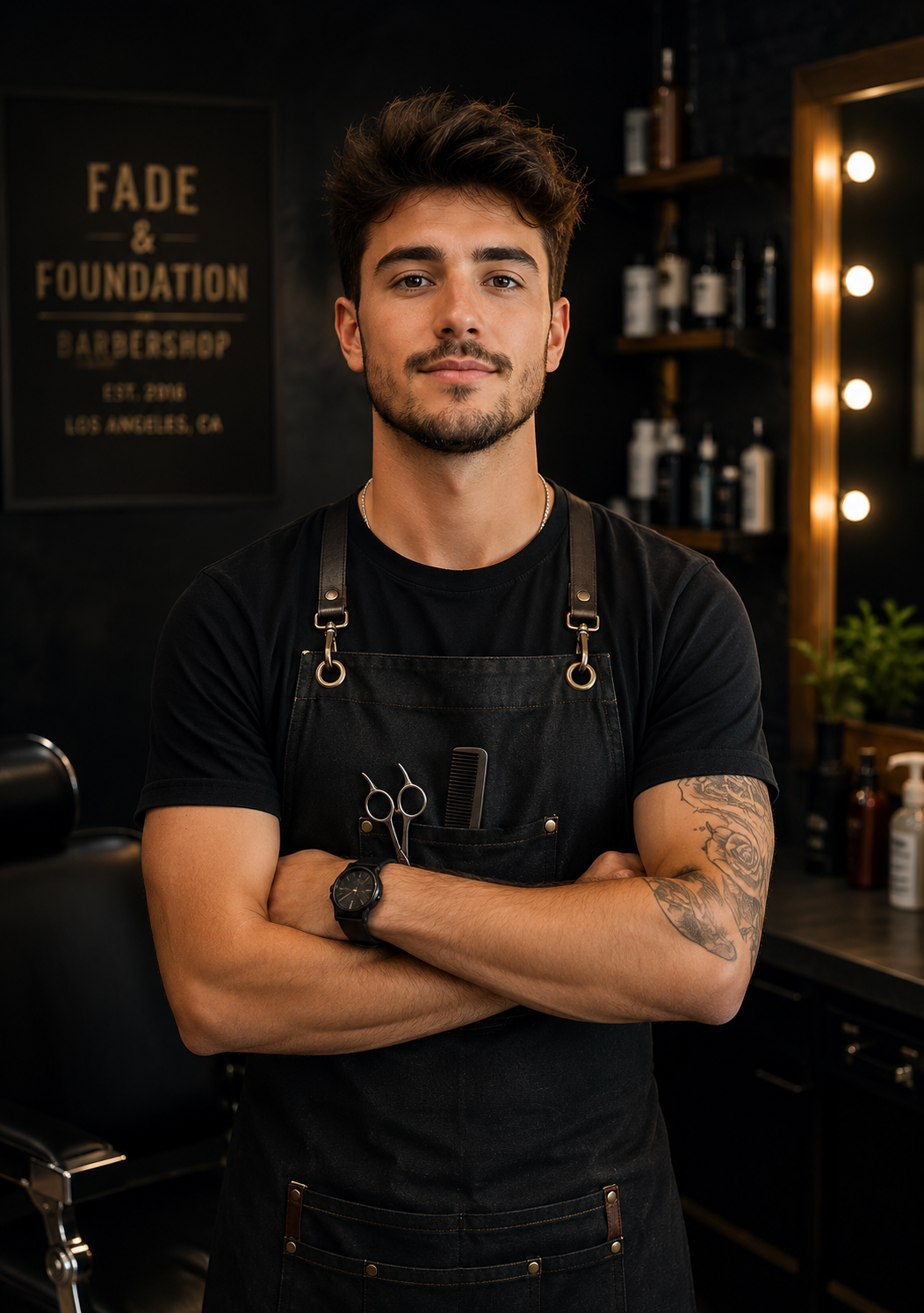
Hi, I’m Jake Miller a passionate barber based in Los Angeles, California, with over 3 years of hands-on experience in the craft. I specialize in modern fades, clean cuts, precision beard grooming, and classic barbering techniques, blending sharp technical skill with a relaxed, personal touch.
Over these years, I’ve had the opportunity to work with all kinds of clients, each with their own style and personality and that’s exactly what I love about this craft. For me, it’s never just about a haircut. It’s about understanding who you are and bringing that out through precision and care.
Every client who sits in my chair gets my full attention and expertise, because I believe great barbering is where confidence meets individuality. My goal is simple: to make sure you walk out looking sharp and feeling like the best version of yourself.

1 thought on “Low Taper Blowout: Styles, Barber Script & Guard Numbers”