

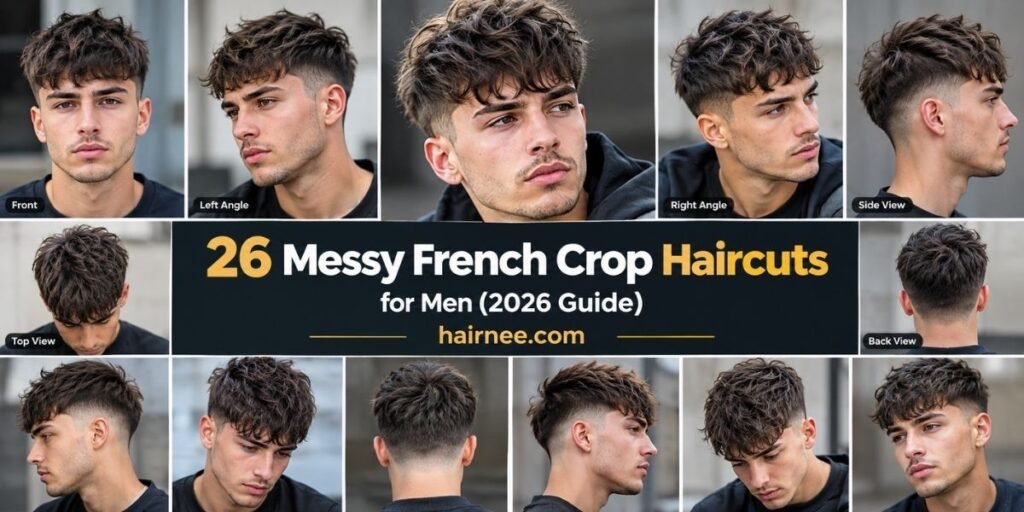
The messy French crop is a short, textured haircut with a forward fringe and faded or tapered sides. It looks effortless, yet it keeps its shape from the morning commute to a late dinner.
This guide covers 26 genuinely different versions, plus fade types, guard numbers, face-shape matches and hair-type techniques. You’ll also get word-for-word barber scripts you can copy straight into your notes app.
Key Points
- A messy French crop is a textured top of roughly 1–3 inches (2.5–7.5 cm), a broken forward fringe, and faded or tapered sides.
- Low fades and tapers are the safest picks. Skin and high fades give the most contrast but need a trim every 2–3 weeks.
- A typical trim interval is 3–5 weeks, and clipper guard numbers only apply to the sides, since the top is usually scissor-cut.
- Matte clay, texture powder or light cream works better than gel or shiny pomade.
- Face shape only nudges fringe length and fade height. Hair type and density matter more.
- Tell your barber the fade height, top length in inches, fringe style and texture method. A reference photo does the rest.
What Is a Messy French Crop?
A messy French crop is a short haircut with a textured, forward-styled top, a broken fringe at the brow line and faded or tapered sides.
A classic French crop cuts that fringe straight across and keeps the top neat. The messy version breaks the line with point cutting, leaves a little more length and finishes dry, so the hair falls in loose pieces rather than one clean sheet.
It’s a cousin of the Caesar cut, not a twin. Both push hair forward, but the Caesar keeps a short, even top while this one welcomes movement. If you’ve ever wondered whether a “messy French crop haircut” and a French crop are the same thing, the difference is the finish: the messy one is deliberately undone.
💡 Pro Tip: Air-dry your hair once before your appointment and note where the crown swirls. Your barber can then cut the fringe with that direction instead of fighting it.
Key Features
The defining features are a top of about 1–3 inches, a forward-falling broken fringe, faded or tapered sides and a dry, matte finish.
| Feature | Typical spec |
| Top length | 1–3 in (2.5–7.5 cm) for most versions |
| Fringe | Forward, broken or choppy, at or just above the eyebrows |
| Sides and back | Low, mid or high fade, or a taper |
| Texture method | Point cutting, slide cutting or razor work |
| Finish | Matte, dry, tousled |
| Daily styling | 2–5 minutes |
| Trim interval | 3–5 weeks |
| Suits | Straight, wavy and curly hair, from fine to thick |
Why Messy French Crop Is So Popular?
It’s popular because your barber does the hard work once and the style takes only a couple of minutes at home.
The messy top is also forgiving. An uneven fringe or a few extra weeks of growth just reads as texture, not as a bad haircut.
It travels well between settings, too. Keep the fade low and the product light for the office, then push the fringe forward and go rougher for the weekend.
Add the fact that straight, wavy and curly hair can all wear it with small tweaks, and you can see why it keeps showing up on social feeds and in barbershop chairs.
Also Read This 22+ Best Kids Mullet Haircuts for Boys & Girls (2026)
Best Messy French Crop Hairstyles
The 26 hairstyles below all share a textured, forward top, and they differ in fade height, top length, hair type, fringe shape and finishing details.
Each entry ends with a quick “Ask for” script and a “Best for” note. Use the table first if you’d rather narrow things down by goal.
| If you want… | Start with |
| The lowest maintenance | Low Taper Fade (4), Short Crop (6) |
| A workplace-friendly look | Low Fade (2), Middle-Aged Men (10) |
| The boldest contrast | Skin Fade (5), High Fade (11), Disconnected (23) |
| Curly hair | Curly (7), Modern Curly (17) |
| Straight hair | Straight (13), Modern Straight (18) |
| Thinning or receding hair | Receding Hairline (24), Middle-Aged Men (10) |
| A grow-out path | Long Crop (16), Quiff (25) |
| Extra detail on the sides or colour | Burst Fade (21), Drop Fade (22), Highlights (26) |
1. Messy French Crop Fade
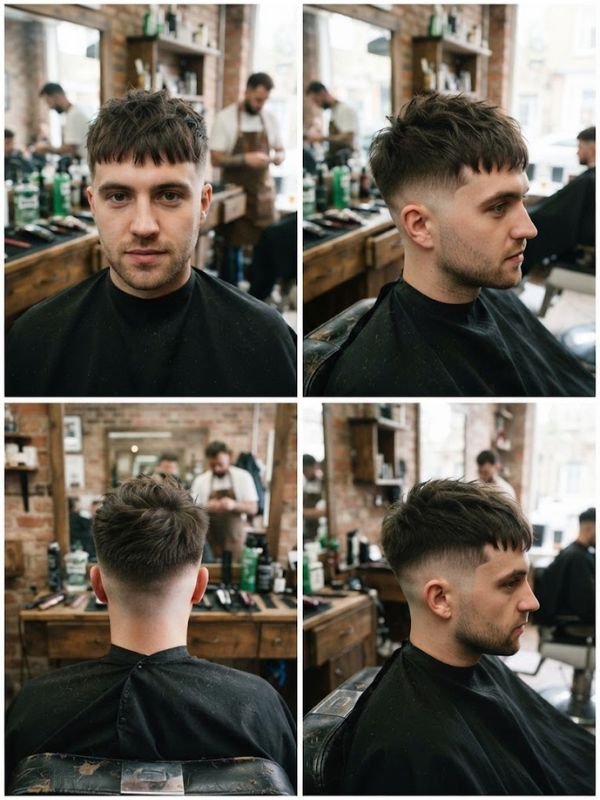
The messy French crop fade is the baseline version: sides blended down from longer to very short, with a broken, forward top.
Think of it as the default order when you haven’t picked a fade height yet. The top sits around 1.5–2.5 inches and gets broken up so the fringe falls in pieces. The next few entries show how low, mid, skin and taper variations change the mood.
- Ask for: “A messy French crop with a fade on the sides, about two inches on top, and a textured fringe brought forward.”
- Best for: First-timers and most hair types.
2. Messy French Crop Low Fade
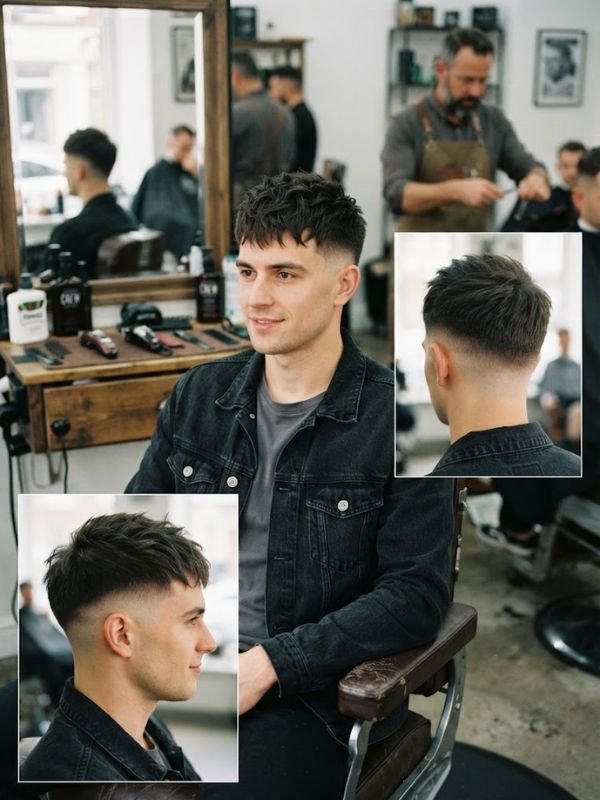
A low fade starts just above the ear and neckline, so the sides stay subtle and the messy top does the talking.
It hides regrowth better than higher fades and looks polished in strict workplaces. This is also where a messy modern low fade French crop lives: a low, clean perimeter with a textured, slightly disconnected fringe. Barbers usually run the blend from a #0.5 or #1 guard up to about a #2.
- Ask for: “Low fade with a soft blend above the ear, top about two inches, textured fringe that stays above my eyebrows.”
- Best for: Dress-code offices and men who visit every 4–5 weeks.
💡 Pro Tip: A low fade goes wrong when it creeps upward. Book your next visit before the line reaches the middle of your ear.
3. Messy French Crop Mid Fade
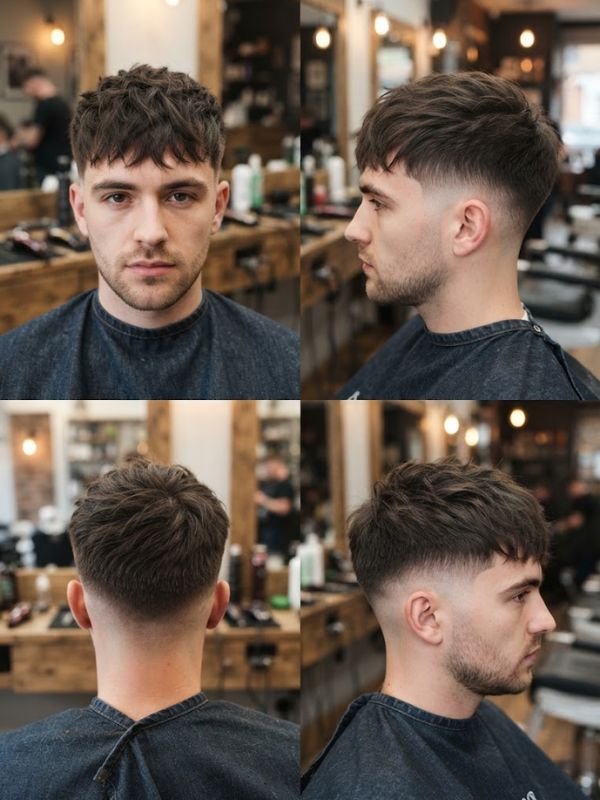
A mid fade begins around the temple, giving clear contrast without exposing as much scalp as a high fade.
This version suits thick, dense hair. Taking bulk off the sides stops a full top from looking mushroom-shaped, while the fringe stays soft and broken. It’s the balanced middle: bolder than a low fade, calmer than a skin fade.
- Ask for: “Mid fade starting at a #1, blended up into the top, about two inches on top, thinned out so it doesn’t look heavy.”
- Best for: Thick or coarse hair and visible but not extreme contrast.
4. Messy Crop Low Taper Fade
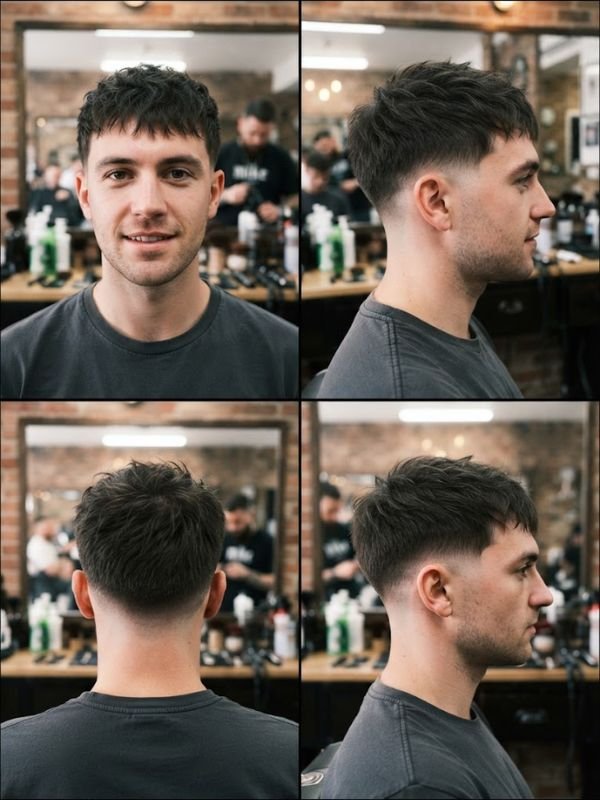
A low taper fade only shortens the hair around the sideburns, ears and neckline, so it leaves more length on the sides than a true fade.
That makes it the softest, most natural-looking option. It also grows out gracefully, which suits guys who can’t book every three weeks. Pair it with a rough, tousled top and the contrast between neat edges and loose hair does the work.
- Ask for: “Low taper on the sideburns and neckline, natural length left above it, messy textured top.”
- Best for: Grow-out phases, professional settings and longer gaps between cuts.
5. Messy French Crop Skin Fade
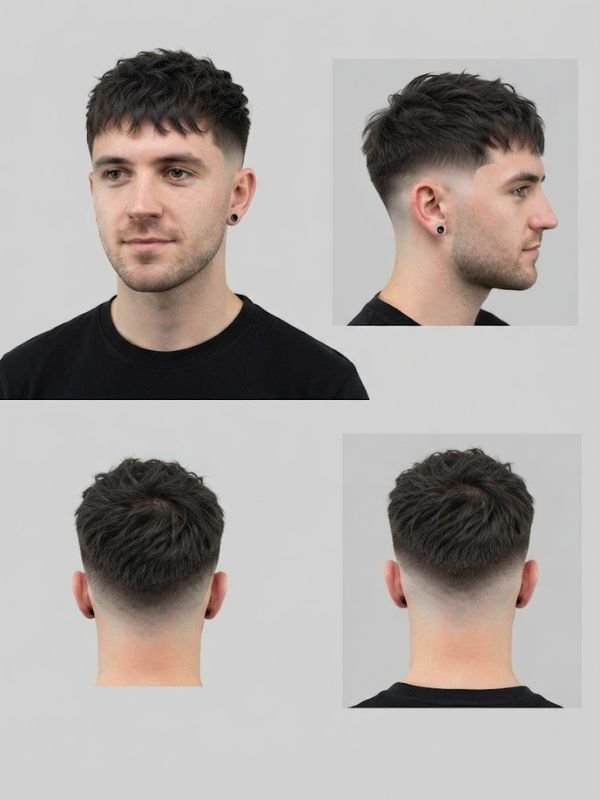
A skin fade, also called a bald fade, shaves the bottom of the sides to bare skin before blending upward for the sharpest contrast.
Barbers finish the lowest section with a foil shaver or trimmer. The look is crisp, but it shows regrowth quickly, so plan a tidy-up every 2–3 weeks.
- Ask for: “Skin fade starting low, blended up through a #1 and #2 into the top, textured top about two inches.”
- Best for: Men who want strong contrast and don’t mind frequent visits.
💡 Pro Tip: A fresh skin fade can look red for a day. A light, fragrance-free moisturiser on the faded area calms it down before you go out.
6. Short Messy French Crop
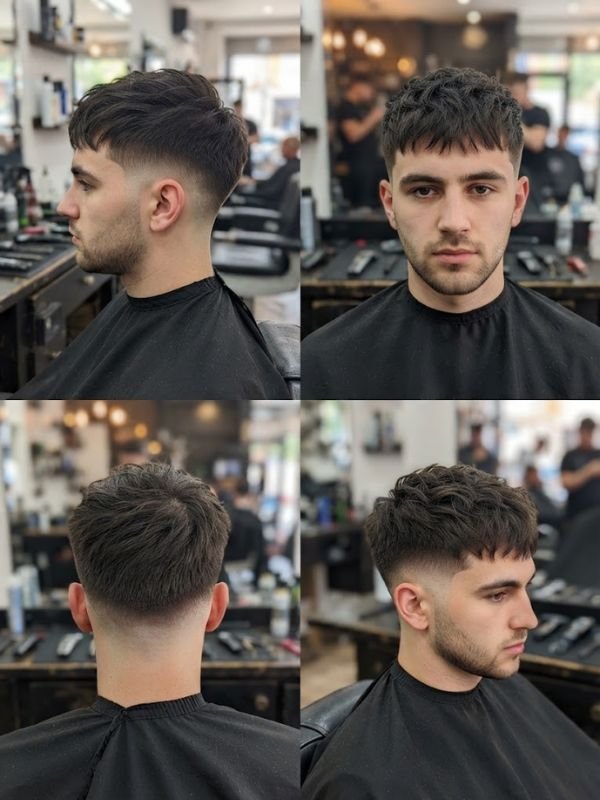
A short messy French crop keeps the top around 1–1.5 inches, which makes it the lowest-effort version and a natural fit for gym-goers.
Shorter hair moves less, so the messiness comes from cut-in texture and a dry product like powder or clay. The fringe just skims the brows. It stays tidy under a hat or helmet and dries in minutes.
- Ask for: “Short crop, about an inch on top, point-cut for texture, fringe just above the eyebrows, low taper.”
- Best for: Athletes, hot climates and anyone who wears a hat often.
7. Curly Messy French Crop
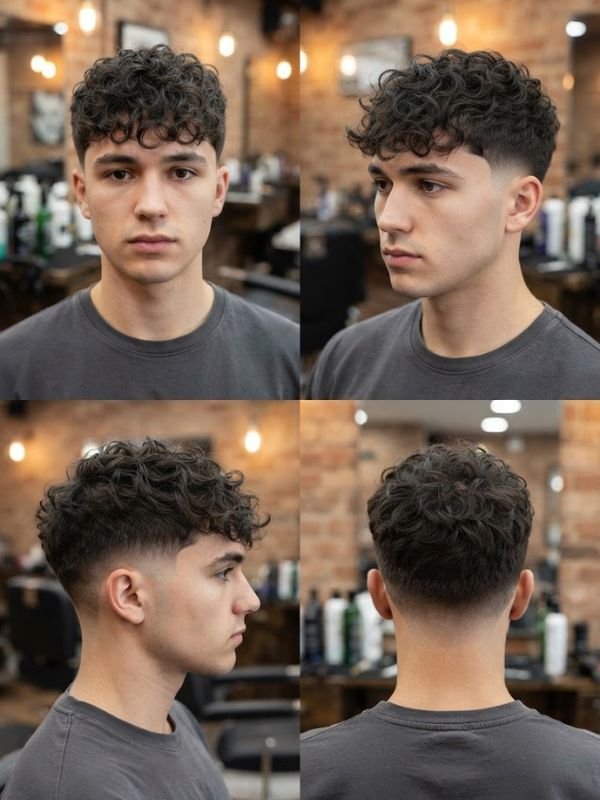
On curly hair, the crop works by shaping a compact top of natural curls and fading the sides so the curls stay in charge.
Ask your barber to cut it dry so they can see how your curls spring. Leave roughly 2–3 inches on top, because curls look much shorter once they dry. Define them with a curl cream and let them air-dry or diffuse on low heat.
- Ask for: “Cut my curls dry, keep two to three inches, shape the fringe softly, mid fade on the sides.”
- Best for: Wavy-to-curly patterns that need shape more than length.
8. Textured Messy French Crop
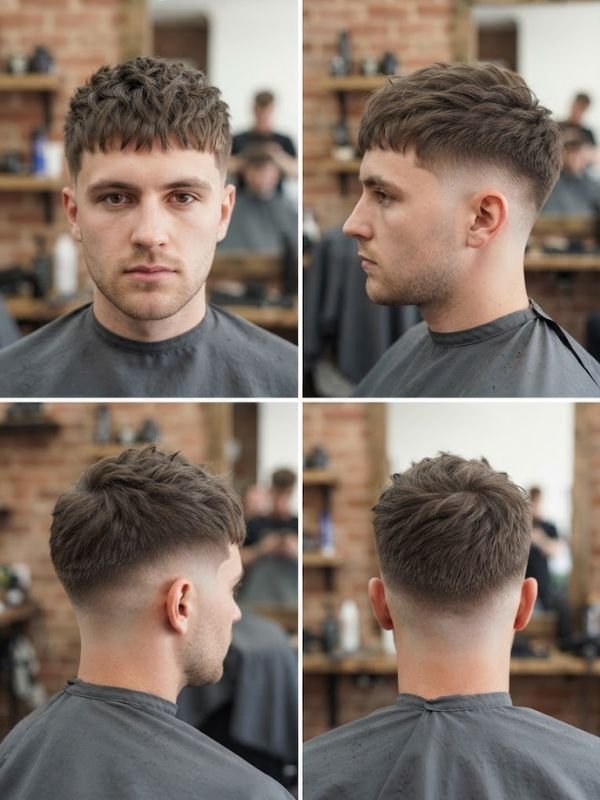
A textured messy French crop gets its messiness from the cut itself, using point cutting, slide cutting or a razor to create visible separation.
Because the texture is built in, the hair still looks undone on day two without much product. It’s especially helpful for straight or coarse hair that would otherwise fall in a solid sheet.
- Ask for: “Textured crop, point-cut the top and fringe for separation, no blunt lines, tapered sides.”
- Best for: Straight, coarse or thick hair, and men who want a low-product routine.
9. Messy Fringe French Crop
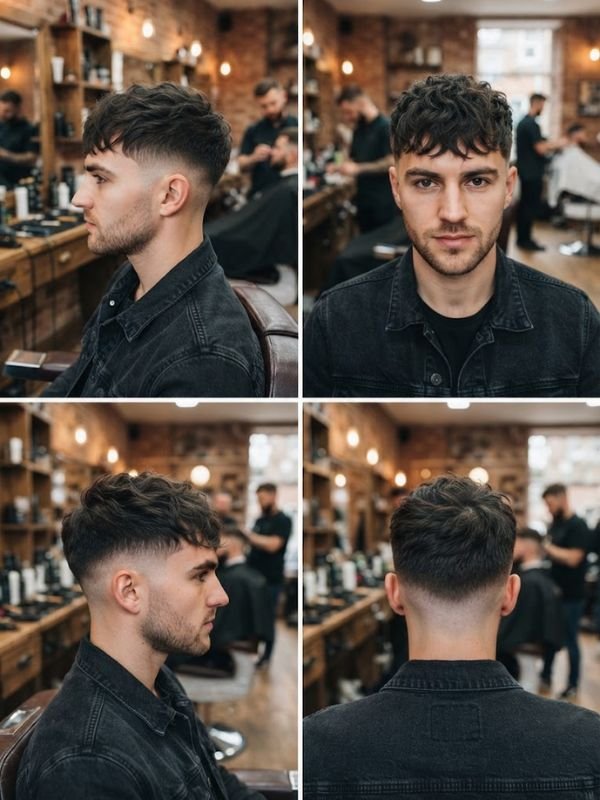
A messy fringe French crop puts the spotlight on the front, with a broken, uneven fringe that sits at or just above the eyebrows.
Fringes come in a few shapes here: a short micro fringe, a choppy piecey one, or a longer forward fringe that breaks into strands. A higher forehead usually gets more from a longer fringe, while a short forehead looks better with a shorter one so the hair doesn’t crowd it.
- Ask for: “Break up the fringe with point cutting, keep it at my brow line, slightly uneven ends.”
- Best for: Men with a strong, even hairline who want the fringe to be the feature.
💡 Pro Tip: Ask your barber to cut the fringe dry. Wet hair stretches, and a fringe cut wet often ends up shorter than you planned.
10. Messy Crop Haircut for Middle-Aged Men
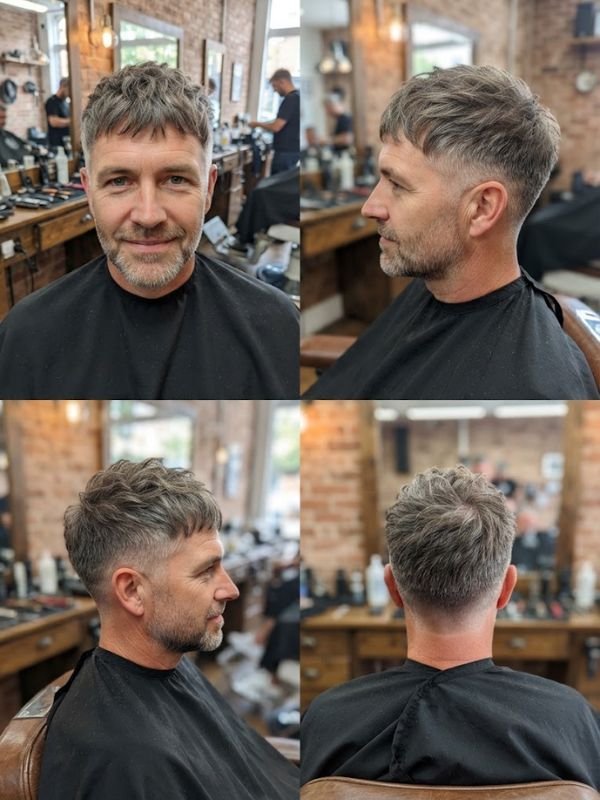
For middle-aged men, a messy crop works best when kept tidy: a softer taper, a controlled 1.5–2 inch top and relaxed texture.
Grey strands add natural dimension to a textured top, and slightly thinner areas are easier to disguise when the hair is broken up. Skip extreme skin fades and heavy spikes, which can look like they’re trying too hard.
- Ask for: “Low taper, top about two inches, textured but tidy, fringe kept off my eyebrows.”
- Best for: Men in their 40s and beyond, greying hair and early thinning.
💡 Pro Tip: Grey hair is often drier and wirier. A pea-sized amount of cream usually behaves better than a stiff clay.
11. Messy Crop High Fade
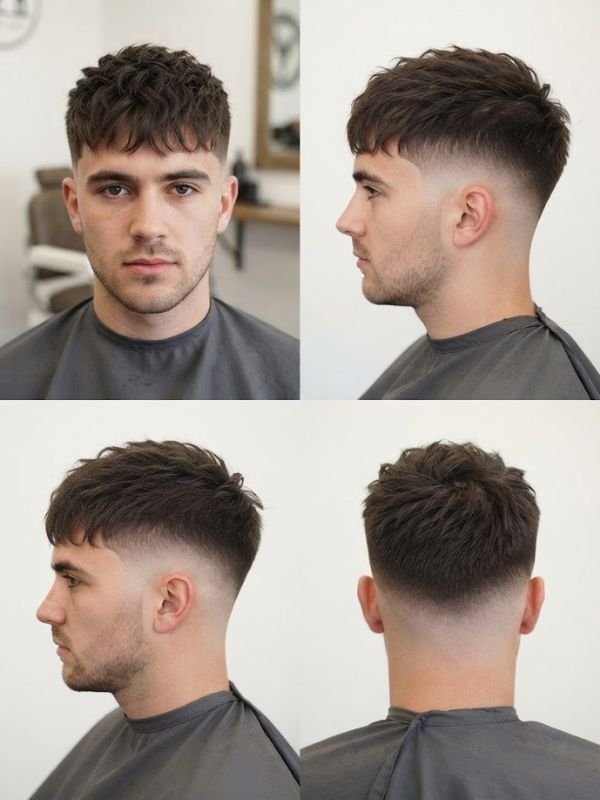
A high fade starts at or above the temples, leaving only the top with real length and creating the strongest contrast of any messy crop.
It narrows the sides visually and adds height, which is why it flatters rounder faces. It also puts all the attention on the texture up top. The trade-off is upkeep: the line loosens within two to three weeks, and on some men it can look severe.
- Ask for: “High fade blended from skin up to about a #2 near the temple, textured top around two inches.”
- Best for: Round faces, thick hair and an athletic, clean-sided look.
12. Modern Messy French Crop
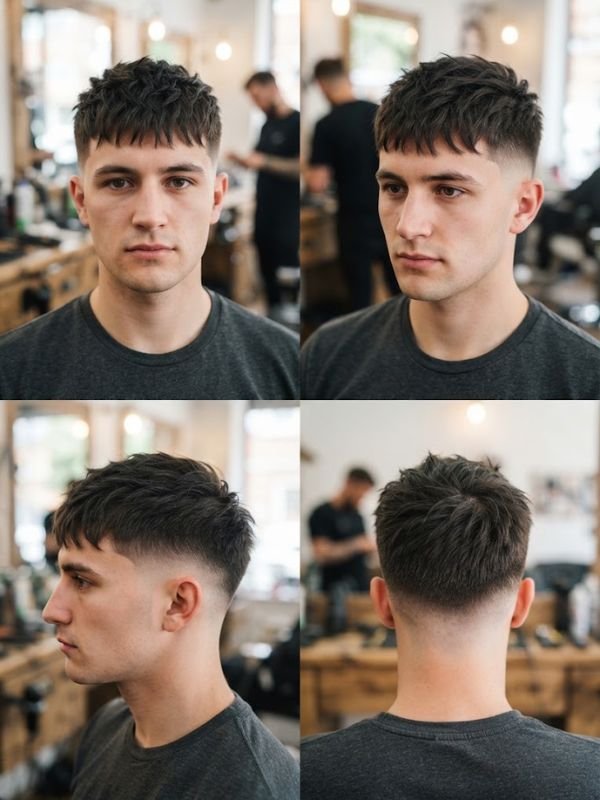
The modern messy French crop treats mess as design: a slightly disconnected fringe, sharper texturizing and usually a skin or low fade underneath.
It’s less symmetrical and more editorial than the everyday version. The sides stay cleaner than the top, which gives that controlled-chaos effect. A matte clay with a light mist of sea salt spray builds the finish.
- Ask for: “Modern messy crop with a low skin fade, choppy asymmetrical fringe, and about two inches of heavy texture on top.”
- Best for: Style-conscious men who bring a reference photo.
💡 Pro Tip: “Modern” means different things to different barbers, so a photo beats any adjective.
13. Messy French Crop for Straight Hair
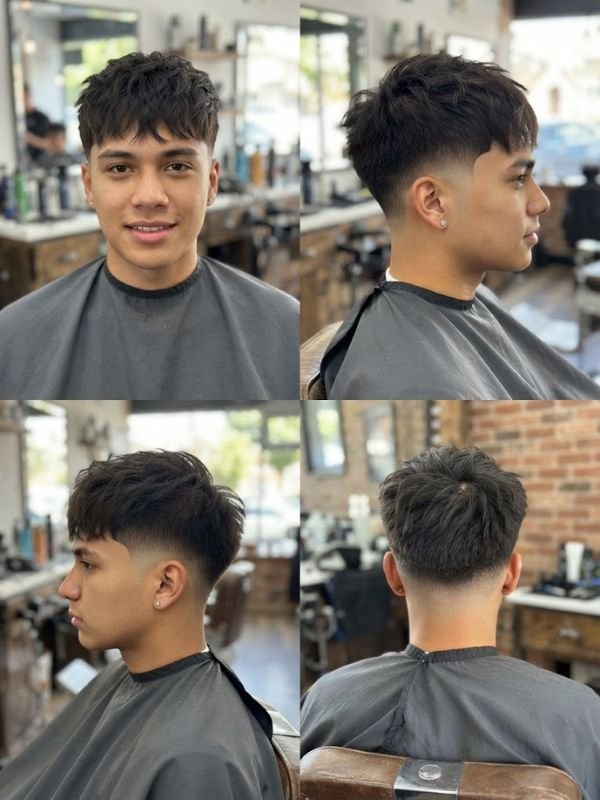
Straight hair needs cut-in texture to look messy, so ask for point cutting on the fringe and top instead of one flat, blunt length.
Straight strands reflect light and tend to fall in a sheet. A barber can layer the top so pieces separate on their own. At home, lift the roots with a blow dryer, then use texture powder or matte clay to keep the pieces apart. A top of 1.5–2.5 inches works well.
- Ask for: “Point-cut the top and fringe, don’t cut it blunt, tapered sides. I want it to separate, not lie flat.”
- Best for: Straight, medium-density hair that needs volume and grip.
14. Messy French Crop With Beard
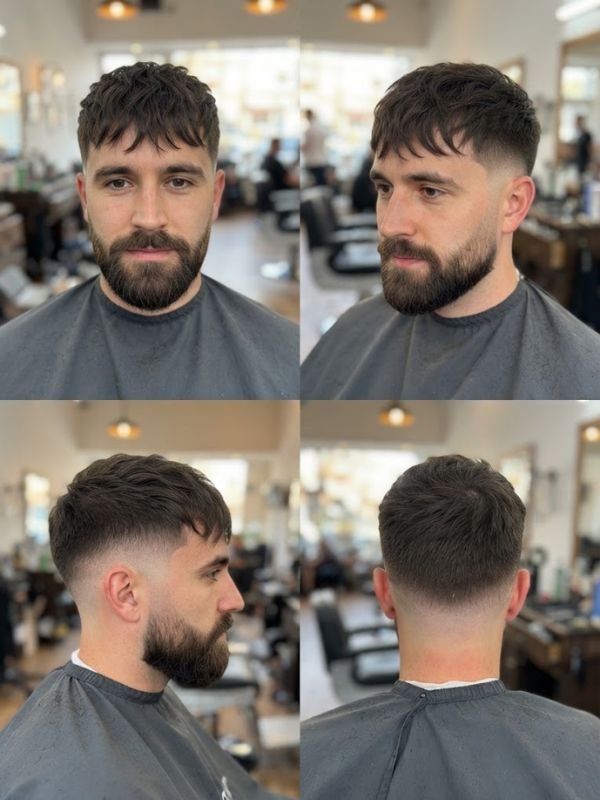
Pairing this crop with a beard works best when the side fade flows into the beard fade, so the cheek line reads as one continuous blend.
Stubble or a short, trimmed beard adds a rugged counterweight to the loose top. A beard can also help balance a narrower chin or add definition along the jaw. Ask for the neckline and cheek line to be set at the same time.
- Ask for: “Blend my side fade into my beard, keep the beard short, around a #2, with a messy textured top.”
- Best for: Men who like a rugged contrast between neat sides and a loose top.
15. Messy French Crop Asian Style
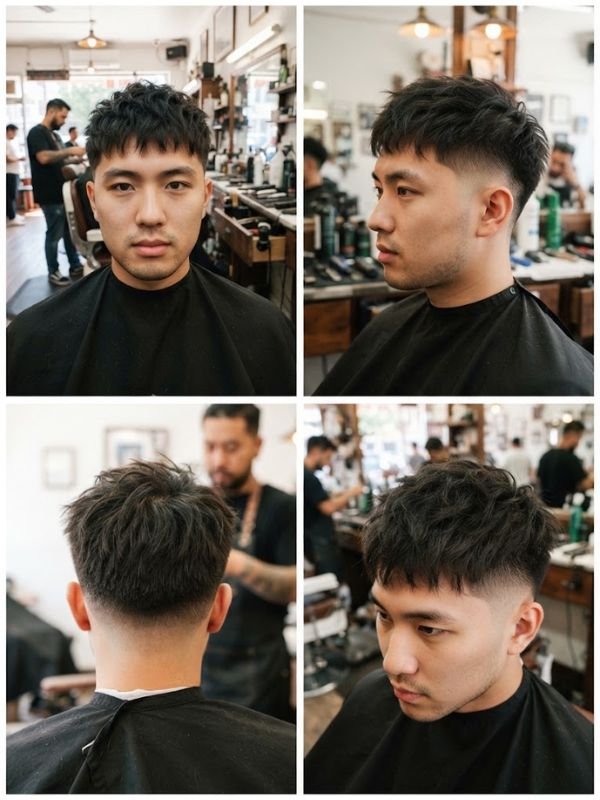
The Asian-style version suits thick, straight, dense strands, using layered texture and often a shorter forward fringe so the hair doesn’t sit heavy.
Hair varies enormously across Asia, but this cut is popular with men whose hair is thick and straight. The barber thins the interior, adds cut-in texture and keeps the fringe short or micro. A softer, longer, wispier variant with a gentle taper and no hard fade is also common.
- Ask for: “Thin out the inside of my thick hair, texturize the top, short forward fringe, low taper on the sides.”
- Best for: Thick, straight hair and low daily effort.
💡 Pro Tip: Dense straight hair often dries as a solid mass. Blow-drying the roots forward first breaks that up before you add clay.
16. Long Messy French Crop
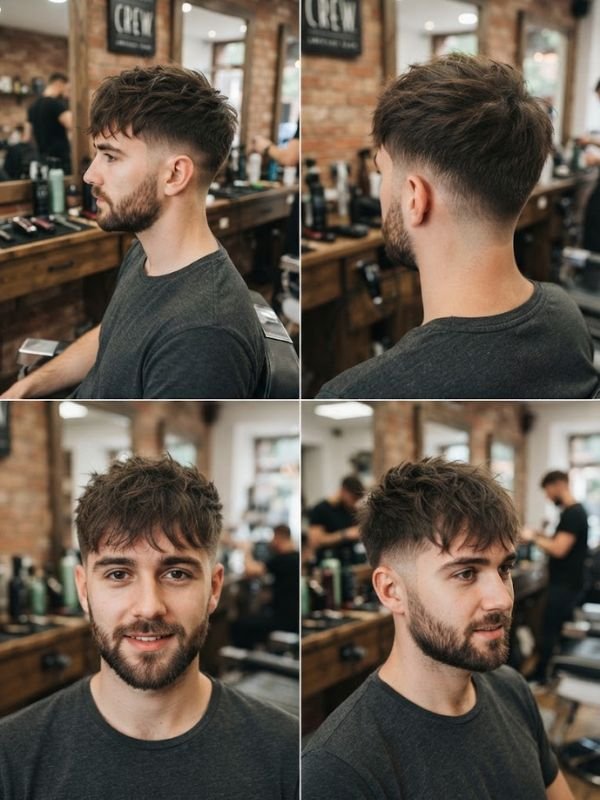
A long messy French crop leaves 3–4 inches on top so the fringe can fall past the eyebrows and the whole top moves freely.
Layers stop the length from hanging like a curtain. Air-dry with a little sea salt spray, then push the hair forward or slightly to the side. The top can wait 6–8 weeks between trims, but the sides still need a tidy-up every 4–5 weeks or the shape turns shaggy.
- Ask for: “Keep the length on top, three to four inches, layered, soft messy fringe, taper the sides.”
- Best for: Guys growing out a shorter crop and wavy or straight hair with body.
17. Modern Messy French Crop for Curly Hair
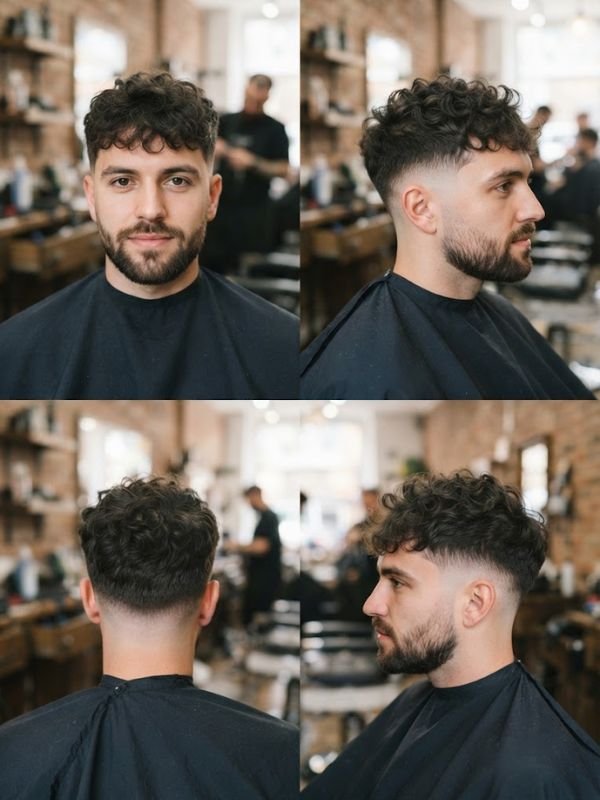
The modern curly version pairs a defined, springy top with a sharper perimeter, usually a temple or skin fade, so the curls look deliberate.
Where the classic curly crop leans on softness, this one leans on contrast. Leave about 3 inches, keep a clean line-up around the temples and use a leave-in plus curl cream. Diffuse on low heat so the curls stay defined instead of puffing out.
- Ask for: “Skin fade with a clean line-up around the temples, leave my curls three inches, shape the fringe but keep the spring.”
- Best for: Curly and coily hair that suits sharp edges around a soft, springy top.
18. Modern Messy French Crop for Straight Hair
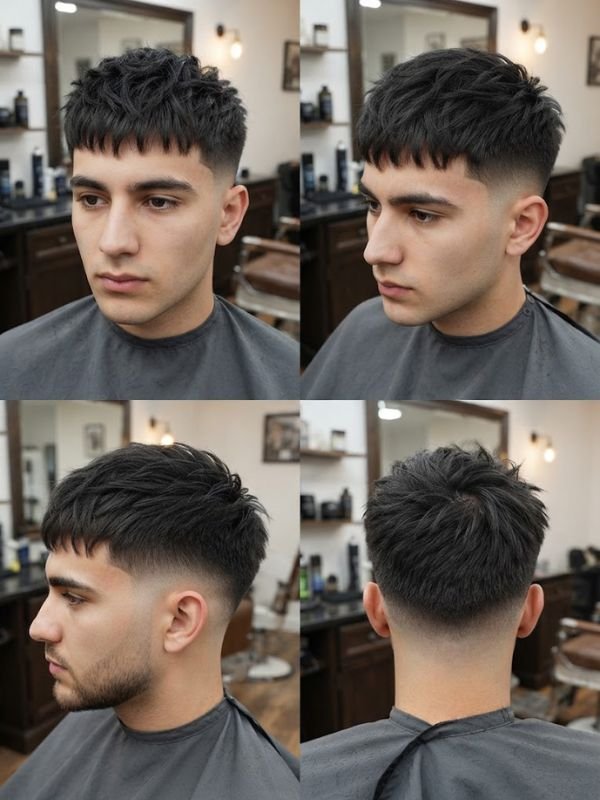
The modern straight-hair version uses a razor-cut, disconnected fringe and a skin fade to make straight hair look deliberately chaotic.
Compared with the softer cut in number 13, this one is more graphic. A razor feathers the ends into a broken edge, and a higher-hold matte clay locks the pieces in place. Razor work can be harsh on very fine hair, so those with thin strands should ask for scissor texturizing instead.
- Ask for: “Razor-texture the fringe for a broken edge, skin fade with a disconnected top, keep about two inches.”
- Best for: Thick or medium-density straight hair and a bold, fashion-led look.
19. Messy French Haircut for Men
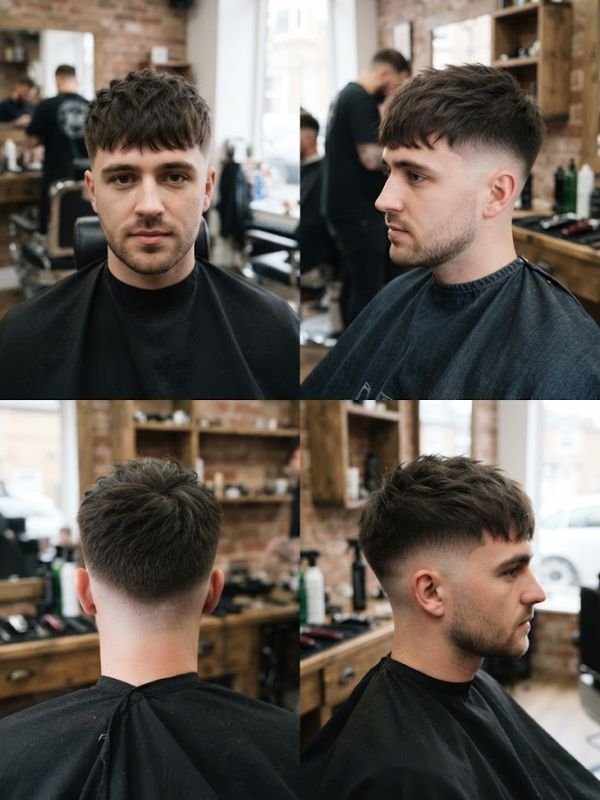
The messy French haircut for men is the all-rounder: a low-to-mid taper, two inches on top and a fringe that suits any setting.
If you want one cut for every situation, this is it. Dress it down with fingers and a little powder, or dress it up with a slightly tighter finish and a cleaner neckline. It also scales easily. You can go shorter in summer and let it grow a little in winter.
- Ask for: “Messy French crop, low to mid taper, about two inches on top, soft textured fringe.”
- Best for: Men who want a single, dependable cut with minimal fuss.
20. Messy French Crop With Mid Fade
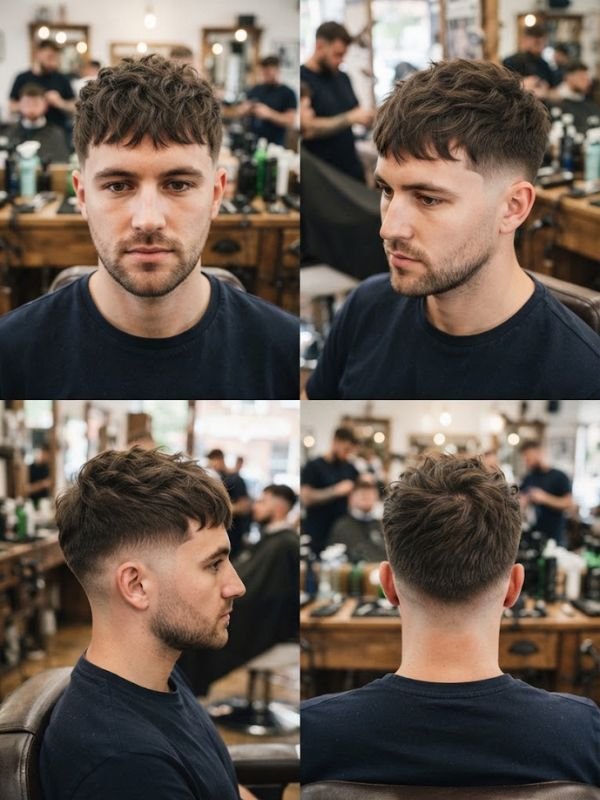
This mid fade version is about how the fade meets the fringe and temples, so a clean line-up or temple fade frames the messy top.
You have three finishing options: a natural hairline, a soft line-up that cleans the edges, or a sharper shape-up for a crisper frame. The line-up is what separates a “just cut” look from a lived-in one. A beard fade pairs neatly here too.
- Ask for: “Mid fade with a soft line-up around the temples, natural hairline in front, messy top.”
- Best for: Men who care about how the edges frame the face.
💡 Pro Tip: A hard line-up softens within days. If you prefer low upkeep, ask for a natural or soft edge instead.
21. Messy French Crop Burst Fade
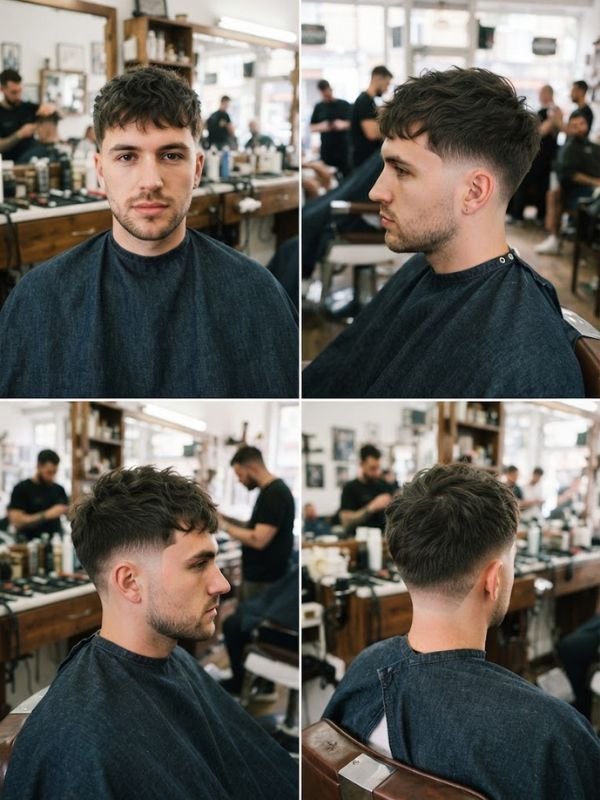
A burst fade curves in a semicircle around the ear and fades down behind it, leaving more length at the nape than a standard fade.
The rounded shape frames the ear and gives the side profile extra detail. With a messy crop, the top and nape keep their length while the arc around the ear stays crisp. It needs a cleanup every 2–3 weeks to keep the curve sharp.
- Ask for: “Burst fade around the ears, leave the length at the back, messy textured top.”
- Best for: Men who want a distinctive silhouette and don’t mind regular upkeep.
22. Messy French Crop Drop Fade
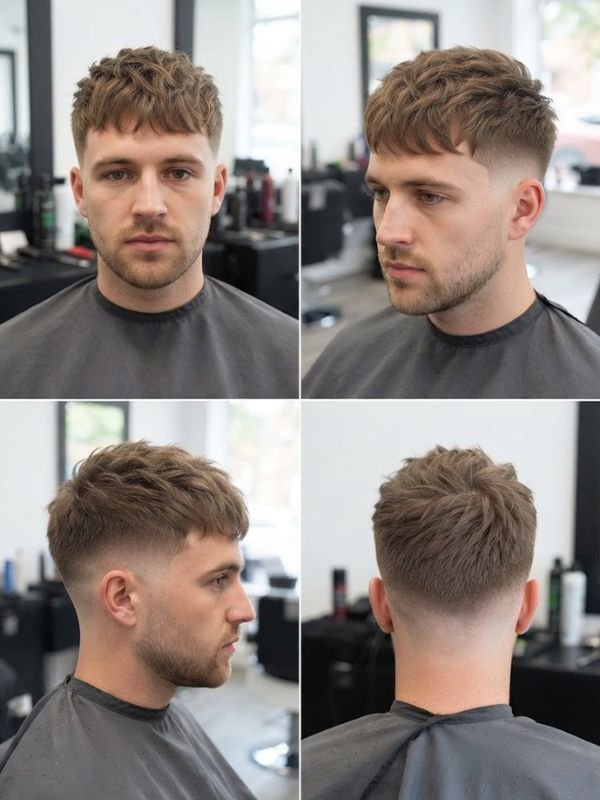
A drop fade follows the curve of the head and dips lower behind the ear, so the fade line sits lower at the back than at the front.
That downward arc gives the back of the head a clean, wrap-around outline, which suits a top full of texture. It can be low, mid or high. Where a burst fade circles the ear, the drop fade simply slopes with the skull.
- Ask for: “Drop fade, curving lower behind the ear, textured top around two inches.”
- Best for: Men who want a modern outline without a dramatic statement.
23. Disconnected Messy French Crop
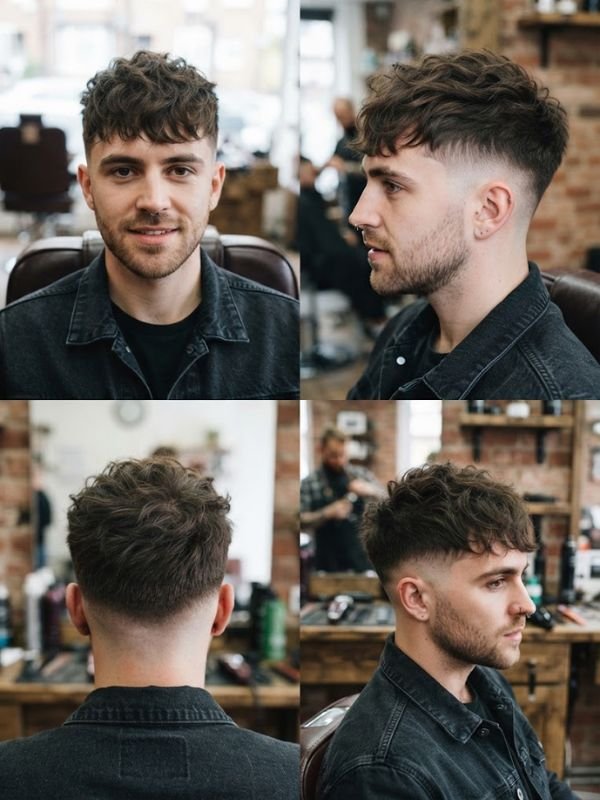
A disconnected messy French crop leaves a visible break between the longer top and the very short sides, instead of blending the two.
The sides are clipper-short, often a #1–#2 or skin, while the top is scissor-cut at 2–3 inches. That ledge exaggerates volume and makes the texture pop. The awkward stage is growth, so schedule regular visits.
- Ask for: “Disconnected cut, short sides with no blend into the top, keep two to three inches with messy texture.”
- Best for: Thick hair and fashion-forward men who like clear separation.
24. Messy French Crop for Receding Hairline
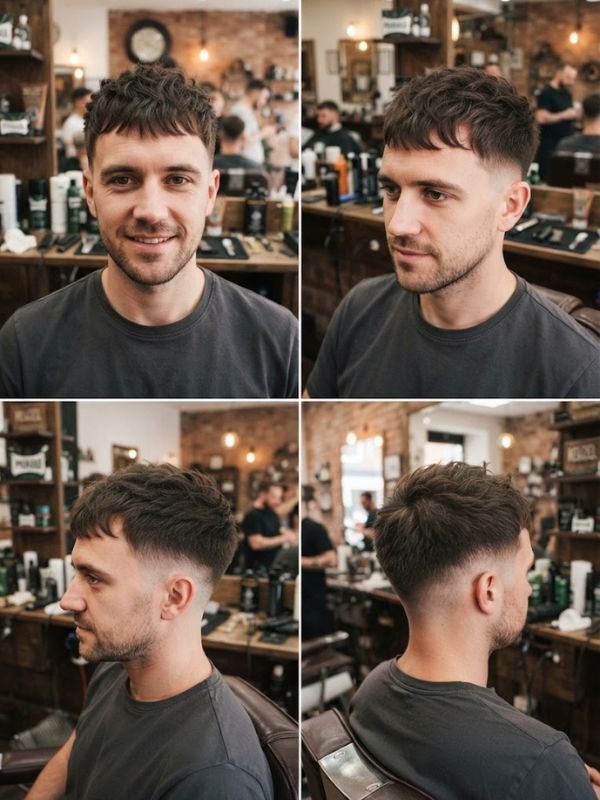
A messy French crop suits a receding hairline because the forward fringe covers the temples while short sides keep the head balanced.
Keep the top around 1.5–2.5 inches and let the fringe fall forward in uneven pieces. Avoid combing it straight across, and skip anything long enough to look like a cover-up. It softens recession but can’t hide advanced loss, so a dermatologist is worth seeing if it’s progressing.
- Ask for: “Messy French crop with a forward, broken fringe to cover my temples, short tapered sides, no hard part.”
- Best for: Early to moderate recession and thinning at the temples.
💡 Pro Tip: Use a light texture powder at the roots. Heavy pomade clumps thin hair and exposes the scalp underneath.
25. Messy French Crop Quiff
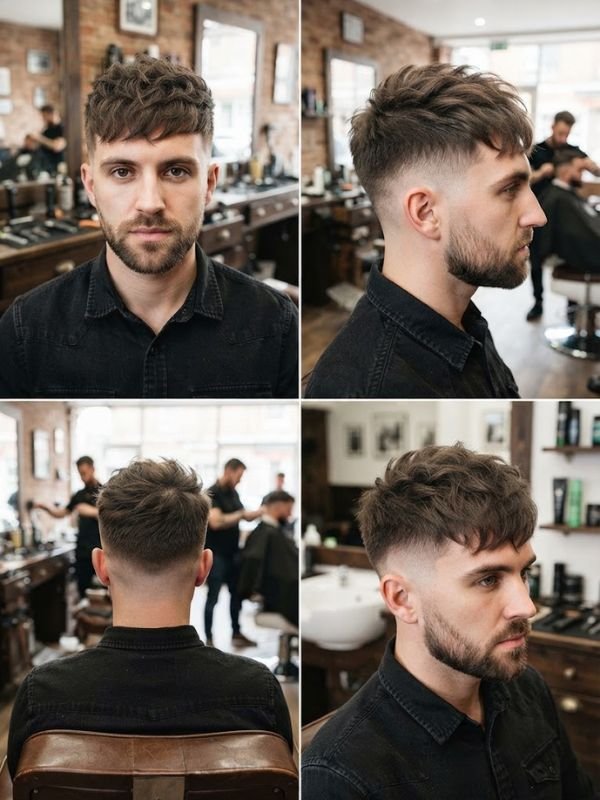
The messy French crop quiff lifts the front upward and slightly back rather than forward, adding height while keeping the crop’s short sides.
You need around 3–4 inches at the front and a shorter crown. Blow-dry up and back with a vent brush, then press in texture powder for lift. Because it adds height, it flatters rounder faces more than very long ones.
- Ask for: “Keep three to four inches at the front for a messy quiff, tapered sides, shorter towards the crown.”
- Best for: Men with medium-to-thick hair who want volume and height.
26. Messy French Crop With Highlights
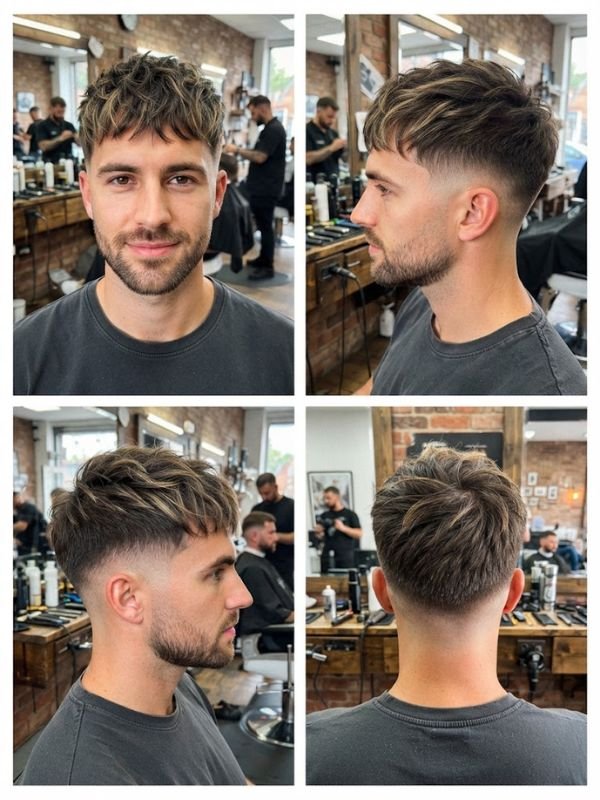
A messy French crop with highlights adds lighter pieces through the top, so the texture shows up in the colour as well as the cut.
Options range from subtle sun-kissed pieces to bleached tips or silver tones. Since colour is a separate service, expect a colourist or a barber who does colour. Bleach can dry hair, so a moisturising conditioner and a toning shampoo help it stay healthy.
- Ask for: “A few lighter highlights through the top, one or two shades lighter than my base, natural-looking.”
- Best for: Men who want extra depth without changing the cut.
Face Shape Guide for Messy French Crop
Face shape only tweaks the messy French crop, mainly through fringe length, fade height and top volume, because the cut works on most shapes.
Treat the notes below as tendencies rather than rules. Your hairline, hair density and personal style matter just as much.
Oval Face Shape
Oval faces can wear almost every version, so choose by hair type and dress code rather than face shape.
The proportions are already balanced, which leaves room to experiment with fringe length, fade height and top volume.
Round Face Shape
Round faces usually do best with height on top and tighter sides, which lengthens the look of the face.
Try a mid or high fade with a 2–3 inch textured top. Avoid heavy volume at the sides, and keep the fringe piecey rather than one thick, low slab.
Square Face Shape
Square faces tend to benefit from a choppy or slightly angled fringe that softens the corners of the jaw.
Skip ultra-blunt, boxy fringes. A low or mid taper keeps the sides clean without emphasising the jawline.
Diamond Face Shape
Diamond faces often look balanced with a fuller, textured fringe that adds width across the forehead.
A low or mid fade avoids stripping the sides too tightly around the cheekbones. A short beard can also add width at the chin.
Heart-Shaped & Oblong Face Shapes
Heart-shaped faces suit a fuller fringe that softens a wide forehead, while oblong faces do better without extra height.
For heart shapes, keep the top textured and the sides tapered. For oblong faces, a forward fringe shortens the look, and side fullness helps balance length.
Which Fade Suits Which Face Shape?
Low fades and tapers suit the widest range of face shapes, while high and skin fades work best on rounder or stronger faces.
| Fade | Tends to work well with | Watch out for |
| Low fade / low taper | Oval, square, heart, diamond | Very round faces may want more height on top |
| Mid fade | Most shapes, especially oval and round | Very long faces may prefer more side fullness |
| High fade | Round and oval | Can look severe on narrow or oblong faces |
| Skin fade | Square and oval | Needs frequent tidy-ups to stay sharp |
| Burst / drop fade | Oval and round | Detail can distract from a very heavy fringe |
💡 Pro Tip: If you’re between two fade heights, choose the lower one. A barber can always go higher next visit, but hair can’t be put back.
Hair Type Guide for Messy French Crop
Hair type changes the cut and styling: straight hair needs cut-in texture, wavy needs control, curly needs shape and long needs layers.
Here’s the quick comparison before the detail.
| Hair type | Top length | Cutting technique | Best product | Drying |
| Straight | 1.5–2.5 in (4–6 cm) | Point cutting, razor on thicker hair | Texture powder or matte clay | Blow-dry roots forward |
| Wavy | 2–3 in (5–7.5 cm) | Light layering, tapered sides to limit puffing | Sea salt spray plus cream | Air-dry or diffuse |
| Curly | 2–3 in (5–7.5 cm) | Cut dry, shape the perimeter | Curl cream or leave-in | Diffuse or air-dry |
| Coily | 1.5–3 in (4–7.5 cm) | Follow growth direction, clean edge-up | Leave-in plus light cream | Air-dry and define by hand |
Messy French Crop for Straight Hair
Straight hair needs point cutting or razor texturizing plus a dry, matte product to look messy rather than flat.
Ask your barber to layer the top so it separates on its own. Then style it in five steps:
- Wash and towel-dry until damp, not dripping.
- Mist sea salt spray or a light pre-styler through the roots.
- Blow-dry the roots forward and slightly up, using your fingers.
- Rub a pea-sized amount of clay or powder between your palms and work it through from back to front.
- Pinch the fringe ends into small, uneven points.
💡 Pro Tip: Powder is easier to control than clay on straight, fine strands. Add it at the roots for grip, not through the ends.
Messy French Crop for Curly Hair
Curly hair needs a shaped top left at 2–3 inches, with defined curls and a faded perimeter so the top looks intentional.
Cut it dry. Curls shrink and spring, so a barber who sees them dry can judge the real length. Then follow this routine:
- Wash and condition, then leave the hair damp.
- Apply leave-in conditioner and a curl cream from roots to ends.
- Scrunch upward to encourage the pattern.
- Diffuse on low heat or air-dry, and don’t brush dry curls.
- Break up the fringe with your fingers only once it’s fully dry.
For coily hair, the crop still works. The barber keeps the top at roughly 1.5–3 inches, follows the natural growth direction and adds a clean edge-up. Moisture matters more than hold, so use a leave-in and a light cream.
Messy French Crop for Wavy Hair
Wavy hair is the easiest to make messy because the natural bends add texture, so the job is controlling volume at the sides.
Keep the top at 2–3 inches and ask for a taper to stop the sides puffing outward. Then:
- Apply a light cream to damp hair.
- Mist sea salt spray and scrunch upward.
- Air-dry, or diffuse briefly for extra lift.
- Finish with a small amount of clay, pushed forward at the fringe.
Messy French Crop for Long Hair
Long hair with a messy French crop means about 3–4 inches on top, cut in layers so the fringe moves instead of hanging as one slab.
The sides still get a fade or taper, which keeps the shape tidy. To style it:
- Towel-dry, then mist sea salt spray.
- Blow-dry forward with a vent brush.
- Rake a little cream through the lengths.
- Twist a few pieces at the front and leave the rest loose.
Thin, Fine or Thick Hair: Density Guide
Density is how many strands you have per patch of scalp, and it’s separate from texture (curl pattern) and strand thickness (fine, medium or coarse).
A man can have fine strands with high density, or coarse strands with low density. Both need different handling.
| Hair profile | Cut approach | Product approach |
| Fine strands, low density | Top 1–2 inches, forward root direction, sides kept short | Texture powder, minimal product |
| Medium density | Most versions work as written | Matte clay or paste |
| Thick, high density | Thinning shears on the interior, avoid very short sides that leave the top bulky | Heavier clay, blow-dry to control bulk |
| Coarse strands | Point cutting to break up stiffness | Cream plus clay for softness and hold |
Shorter sides make a thin top look fuller by contrast. Miguel Lora, a barber and CEO at KleanKut Barbershop in Seminole, Florida with over 12 years of experience, advised in a Latest-Hairstyles guide: “Go as short as you can on the sides.” He also recommends texture powder over gel, which can harden hair and leave skin oily.
If your hair is actually thinning rather than just fine, number 24 in the list above covers the receding-hairline version.
💡 Pro Tip: Thick hair doesn’t always need a tighter fade. Ask for thinning shears on the interior first, so the top loses bulk without you losing length.
Choosing the Right Top Length
For most men the right top length is 1.5–3 inches, dropping to about 1 inch for a short crop and reaching 3–4 inches for a long one.
| Hair type or goal | Suggested top length | Note |
| Straight | 1.5–2.5 in (4–6 cm) | Shorter than this can look flat |
| Wavy | 2–3 in (5–7.5 cm) | Waves shrink as they dry |
| Curly | 2–3 in (5–7.5 cm) | A 3 in stretched curl can spring back to about 1.5 in |
| Fine or thin | 1–2 in (2.5–5 cm) | Shorter reads fuller |
| Thick | 1.5–2.5 in (4–6 cm) | Pair with thinning shears |
| Long messy crop | 3–4 in (7.5–10 cm) | Needs layers and regular shaping |
You’ll see guides suggest anywhere from 1 to 4 inches. Both ends can be right, just for different hair and different levels of mess.
Barber Instructions
A good barber instruction names four things: the fade type and height, the top length in inches, the fringe style and how the top should be textured.
Barbers work from pictures and numbers, not adjectives. “Messy” means one thing to you and something else to them, so the more precise you are, the fewer surprises you get.
Fade Type: Low, Mid, Skin, or Taper
Low, mid and skin describe where and how far a fade goes, while a taper is a gentler trim that only shortens the edges.
| Type | Where it starts | Shortest point | Look | Typical trim gap |
| Low fade | Just above the ear and neckline | Skin to #1 | Subtle | 4–5 weeks |
| Mid fade | Around the temple | #0.5–#1 | Balanced contrast | 3–4 weeks |
| Skin (bald) fade | Low, mid or high | Bare skin | Sharpest | 2–3 weeks |
| Taper | Sideburns and neckline only | #1–#2 | Softest | 4–6 weeks |
Is a taper the same as a fade? Not quite. A fade blends hair down to very short or skin across a larger area, while a taper shortens gradually and keeps more length, usually just around the sideburns and neckline.
Many barbers say “taper fade” for a taper with a fade-like finish at the bottom. If you’re unsure, say how short you want it at the bottom and how high the blend should go.
Guard Number Cheat Sheet
A clipper guard number equals the hair length left in eighths of an inch, so a #1 leaves 1/8 inch (3 mm) and a #2 leaves 1/4 inch (6 mm).
| Guard | Length | Millimetres | Typical use here |
| Bare blade / foil | Near skin | 0–0.5 mm | Bottom of a skin fade |
| #0.5 | 1/16 in | 1.5 mm | Start of a low or mid fade |
| #1 | 1/8 in | 3 mm | Lower part of most fades |
| #1.5 | 3/16 in | 4.5 mm | Middle of a smooth blend |
| #2 | 1/4 in | 6 mm | Upper part of a low or mid fade |
| #3 | 3/8 in | 10 mm | Top of a mid or high blend |
| #4 | 1/2 in | 13 mm | Upper blend or very short top |
| #6 | 3/4 in | 19 mm | Very short top |
Here’s one common way barbers build each fade. Every barber blends slightly differently.
| Fade | Common guard path |
| Skin fade | Foil or bare blade, then #0.5, #1, #1.5, #2 |
| Low fade | #0.5 or #1 at the bottom, rising to #2 |
| Mid fade | #1 at the bottom, rising to #3 or #4 |
| High fade | Skin to #2 or #3, blended near the crown |
| Low taper | #1 or #2 around the sideburns and neckline |
The top of a messy French crop is normally scissor-cut, not guarded. Only very short tops, about 1/2–3/4 inch, use a #4–#6 guard.
💡 Pro Tip: Guard numbers differ slightly by brand and country. Quote the millimetre length alongside the number, and show a photo.
Top Length: Short or Medium
A short top is about 1–1.5 inches and a medium top about 1.5–3 inches, with medium giving more movement and needing more product.
| Short top | Medium top | |
| Length | 1–1.5 in (2.5–4 cm) | 1.5–3 in (4–7.5 cm) |
| Movement | Limited, texture comes from the cut | Natural, tousled |
| Product | Powder or a dab of clay | Clay, paste or cream |
| Styling time | 1–2 minutes | 3–5 minutes |
| Best for | Athletes, thick or fine hair | Wavy, curly or medium-density hair |
If you’re unsure, start medium. It’s easier to cut shorter at your next visit than to wait for growth.
How to Ask Your Barber for a Messy French Crop
Ask by naming the cut, the fade height and blend, the top length in inches and the fringe style, then show a photo.
Copy one of these scripts and adjust the numbers:
- Short version: “I’d like a messy French crop with a low taper, about an inch and a half on top, point-cut for texture, with the fringe just above my eyebrows.”
- Medium version: “I’d like a messy French crop with a mid fade starting at a #1, about two inches on top, thinned out and textured, with the fringe brought forward.”
- Long version: “I’d like to keep three to four inches on top, layered, with a messy fringe, and taper the sides low so it grows out tidy.”
Avoid vague requests like “just a trim,” “short on top” or “make it messy.” Each one leaves the barber guessing.
👉 Quick tip: Screenshot your chosen script from above before you leave the house. Reading a clear instruction beats explaining it from memory.
What to Tell Your Barber
Tell your barber your hair type, how you style it, your dress code and how often you’ll visit, because those decide the fade and top length.
- Hair type and density: “My hair is thick and straight” or “fine and wavy.”
- Cowlicks: Point out any swirl at the crown or front hairline.
- Routine: “I’ve got two minutes and one product.”
- Dress code: Whether the office wants neat edges.
- Visit frequency: Skin fades need visits every 2–3 weeks, tapers can wait longer.
- What you dislike: A fringe that’s too short, sides too tight, or a fade too high.
Reference Photo Tip
Bring at least two photos, one front and one side, of someone with a similar hair type and hairline to yours.
A photo of straight hair won’t translate to curls, and a thick-haired model won’t reflect a thinning crown. Tell your barber what to copy, such as the fade height, and what to skip, such as the colour.
Look for photos in natural light. Heavy filters and studio lighting hide what the cut really looks like.
Also Read This 22+ Best Kids Mullet Haircuts for Boys & Girls (2026)
Styling Products Guide for Messy French Crop
Matte clay, texture powder and light cream give a messy French crop its dry, tousled finish, while heavy gel and shiny pomade work against it.
Gel is the usual culprit. Lora, the barber quoted above, advises against it because it can stiffen hair and leave skin oily. Texture powder is his preferred alternative for volume without a slick look.
Matte Clay vs Pomade vs Cream
Matte clay gives strong hold with no shine, pomade gives flexible hold with more shine, and cream gives light hold with softness.
| Product | Hold | Finish | Best for | Skip if |
| Matte clay | Strong | Dry, no shine | Thick, straight or coarse hair | Your hair is very fine and gets weighed down |
| Pomade (water-based, matte) | Medium, reworkable | Low shine | Wavy hair and mid-length tops | You want a completely dry look |
| Styling cream | Light | Natural, soft | Curly, wavy or dry hair | You need strong hold for a spiky finish |
| Texture powder | Light to medium | Matte, airy | Fine, thin or receding hair | Your hair is very oily |
| Sea salt spray | Light grip | Gritty, tousled | Prep on damp hair | Your scalp is dry, since it can add dryness |
If you’re only buying one product, a matte clay or paste covers most hair types. Curly hair can trade it for a curl cream.
💡 Pro Tip: Warm the product between your palms until it almost disappears before touching your hair. Dabbing it on in lumps is what makes clay look clumpy.
How to Create a Messy Textured Finish
You create the finish by prepping damp hair with sea salt spray, blow-drying forward, then working in a pea-sized dab of matte clay.
- Towel-dry until the hair is damp, not wet.
- Prep with sea salt spray or a light pre-styler, focusing on the roots.
- Blow-dry forward and slightly up, using your fingers to direct it.
- Warm a pea-sized amount of clay between your palms.
- Work it in from the back to the front, using only your fingertips.
- Break up the fringe by twisting and pinching a few pieces.
- Set it with a short blast of cool air.
Total time: about three minutes once you’re used to it.
💡 Pro Tip: The cool shot on your dryer locks the shape in place. Skipping it is why styles fall flat by lunchtime.
Do’s and Don’ts for Messy French Crop
Do keep product light, finger-style the top and book regular fade tidy-ups, and don’t over-comb, overload with gel or let the sides grow out.
Do’s
Do’s include light matte product, cut-in texture, finger styling and on-time trims, all of which keep a messy crop looking deliberate.
- Bring a photo and a script to every appointment.
- Ask for cut-in texture, not just messy styling.
- Use a small amount of matte product.
- Style with your fingers, not a comb.
- Book your next cut before the fade loses its shape.
- Adjust top length to your hair type and density.
- Keep the neckline clean between visits.
Don’ts
Don’ts include heavy gel, combing the top flat, a blunt fringe, an over-high fade and skipping a reference photo.
- Don’t use heavy gel or a high-shine pomade.
- Don’t comb the top flat once it’s styled.
- Don’t cut the fringe blunt if you want a messy look.
- Don’t choose a high fade if you’re unsure. Start lower.
- Don’t wait so long that the fade and top merge.
- Don’t apply product to soaking-wet hair, which dilutes it.
- Don’t copy a photo that doesn’t match your hair type.
Messy French Crop Trends in 2026
In 2026 the messy French crop is moving toward softer tapers, richer top texture and sharper disconnected options, according to current style roundups.
Ape to Gentleman lists the French crop family among the most in-demand men’s cuts of 2026. The trend has split into gentler and bolder branches.
| Trend | What it looks like | Who it suits |
| Soft taper plus textured top | Gradual sides, tousled top, easy grow-out | Most men, especially in offices (Perfect Corp’s 2026 roundup features it) |
| Modern low fade | Fade begins just above the ears, more hair around the temples | Men wanting a conservative, versatile shape (The Fashionisto) |
| Disconnected crop | Sharp break between long top and short sides | Fashion-forward, thick hair (The Fashionisto calls it the editorial option) |
| Burst and drop fades | Curved details around and behind the ear | Guys who want a statement outline (example roundup) |
| Longer crop | 3–4 inches on top with layers | Men easing out of shorter cuts (Ape to Gentleman features a long version) |
💡 Pro Tip: Choose a trend by the trim schedule you can actually keep, not by how it looks on day one. Burst and skin fades reward regular visits, tapers forgive them.
Messy French Crop vs Other Short Hairstyles
The messy French crop is closest to the Caesar cut and crew cut, but it differs in fringe, top length and finish.
The classic French crop, with its neat, straight-across fringe, sits between them. The messy version is what you get when you keep that shape and loosen it up.
Messy French Crop vs Crew Cut
A crew cut is a short, fairly uniform top with tapered sides, whereas a messy French crop keeps a forward fringe and a longer, textured top.
| Messy French crop | Crew cut | |
| Top length | 1–3 in (2.5–7.5 cm) | Short and fairly uniform, a little longer at the front |
| Fringe | Yes, forward and broken | No fringe, hair usually brushed up |
| Styling | Matte clay or powder, finger-styled | Little to none |
| Finish | Undone, textured | Neat, uniform |
| Trim gap | 3–5 weeks | 3–5 weeks |
Pick a crew cut if you want zero styling. Pick the messy crop if you want a fringe and some personality.
Messy French Crop vs Caesar Cut
A Caesar cut has a short, even top brushed into a straight fringe, while a messy French crop breaks that line and usually adds a fade.
| Messy French crop | Caesar cut | |
| Fringe | Broken, uneven | Straight, blunt |
| Top | Textured, layered | Short, even |
| Sides | Fade or taper is common | Often a taper, sometimes just short |
| Look | Casual, undone | Clean, classic |
| Styling | Clay or powder, fingers | Comb or fingers, minimal product |
Messy vs Textured French Crop
Textured describes how the hair is cut, while messy describes how it’s finished, so a textured crop can be styled neatly.
A messy crop needs texture to work, and barbers use the two words loosely, which causes confusion. The fix is to ask for cut-in texture and tell them you’ll style it undone.
| Textured French crop | Messy French crop | |
| What it describes | The cutting technique | The final look |
| Cutting method | Point cutting, slide cutting, razor | Same, plus a slightly longer top |
| Fringe | Choppy to straight | Broken and uneven |
| Style options | Neat or tousled | Tousled only |
| Product | Light to medium | Matte and dry |
Common Mistakes Men Make With This Cut
The most common mistakes are cutting the top blunt, choosing a fade that’s too high, using heavy gel and waiting too long between trims.
| Mistake | Why it goes wrong | Fix |
| Blunt-cut top | Straight hair falls flat and looks neat, not messy | Ask for point cutting or razor texture |
| Fringe cut too short | Wet hair stretches, then shrinks up | Ask for the fringe to be cut dry |
| Fade too high | Looks harsh and grows out fast | Start low and go higher next time |
| Heavy gel or shiny pomade | Hard, greasy, dated finish | Use matte clay, powder or cream |
| Combing everything flat | Removes the texture | Style with fingers |
| Skipping the reference photo | Barber guesses your version | Bring front and side photos |
| Waiting too long between trims | Fade blurs, fringe drops | Book the next visit before leaving |
💡 Pro Tip: If you’re unsure whether to go shorter, say so. A confident barber would rather do a conservative first pass and adjust than over-cut.
Who Should Skip This Cut?
Skip the messy French crop if you dislike hair on your forehead, have a strong front cowlick, or need a uniform, ultra-neat look every day.
A strong swirl at the front hairline can push the fringe the wrong way, and no product will fully fix it. In that case a textured quiff or a short crew cut may sit better.
Very advanced hair loss is another limit. A fringe can soften early recession, but for more extensive loss, a closely cropped cut often looks cleaner. Some workplaces also want a stricter, tidier look, where a low taper with a neat top works better.
How Often Should You Get a Messy French Crop Trimmed?
Most men need a trim every 3 to 5 weeks, sooner for skin and high fades and later for tapers and long tops.
| Cut type | Typical interval | Why |
| Skin fade or high fade | 2–3 weeks | Contrast fades fast |
| Mid fade | 3–4 weeks | Blend loosens gradually |
| Low fade | 4–5 weeks | Regrowth hides low |
| Low taper | 4–6 weeks | Softest edge |
| Short top (1–1.5 in) | 3–4 weeks | Shape softens quickly |
| Long top (3–4 in) | 6–8 weeks for the top, 4–5 for the sides | Length can wait, edges can’t |
💡 Pro Tip: Ask for a quick neckline and sideburn cleanup between full cuts. Many barbers offer it at a lower price, and it stretches a fresh look by a week or two.
Frequently Asked Questions
These seven answers cover the most common questions about the messy French crop.
What is a messy French crop haircut?
A messy French crop haircut is a short, textured cut with a forward, broken fringe and faded or tapered sides.
The top is usually 1–3 inches and styled with matte product for a tousled finish.
How long should hair be for a messy French crop?
Most men need 1.5–3 inches on top, with about 1 inch for short versions and 3–4 inches for a long messy crop.
Curly hair needs more length because curls spring up as they dry.
Which fade is best for a messy French crop?
A low fade or low taper is the safest choice, while mid, skin and high fades add more contrast.
Choose lower if you want subtle edges and longer gaps between trims.
Can you get a messy French crop with curly hair?
Yes, a messy French crop works well on curly hair when the top is left at 2–3 inches and the sides are faded.
Ask your barber to cut it dry so they can see the real curl pattern.
Does a messy French crop work for thinning hair?
Yes, the forward fringe and cut-in texture can soften early thinning and receding temples.
It won’t hide advanced hair loss, so a shorter, cleaner cut may suit those cases better.
What product is best for a messy French crop?
Matte clay or texture powder is best, because both give hold without shine or stiffness.
Curly hair does well with a curl cream, and heavy gel should be avoided.
Is a messy French crop suitable for the office?
Yes, a messy French crop suits most offices when paired with a low fade or taper and lightly styled.
Keep the fringe above the eyebrows and choose a soft, matte finish.
Final Thoughts
The messy French crop rewards a clear plan: pick the fade height, set the top length in inches and give your barber a photo. That’s what turns a trend into a cut that suits your hair.
Whichever of the 26 styles you choose, the routine stays simple. A trim every few weeks, a small amount of matte product and a few minutes with your fingers keep it looking sharp.
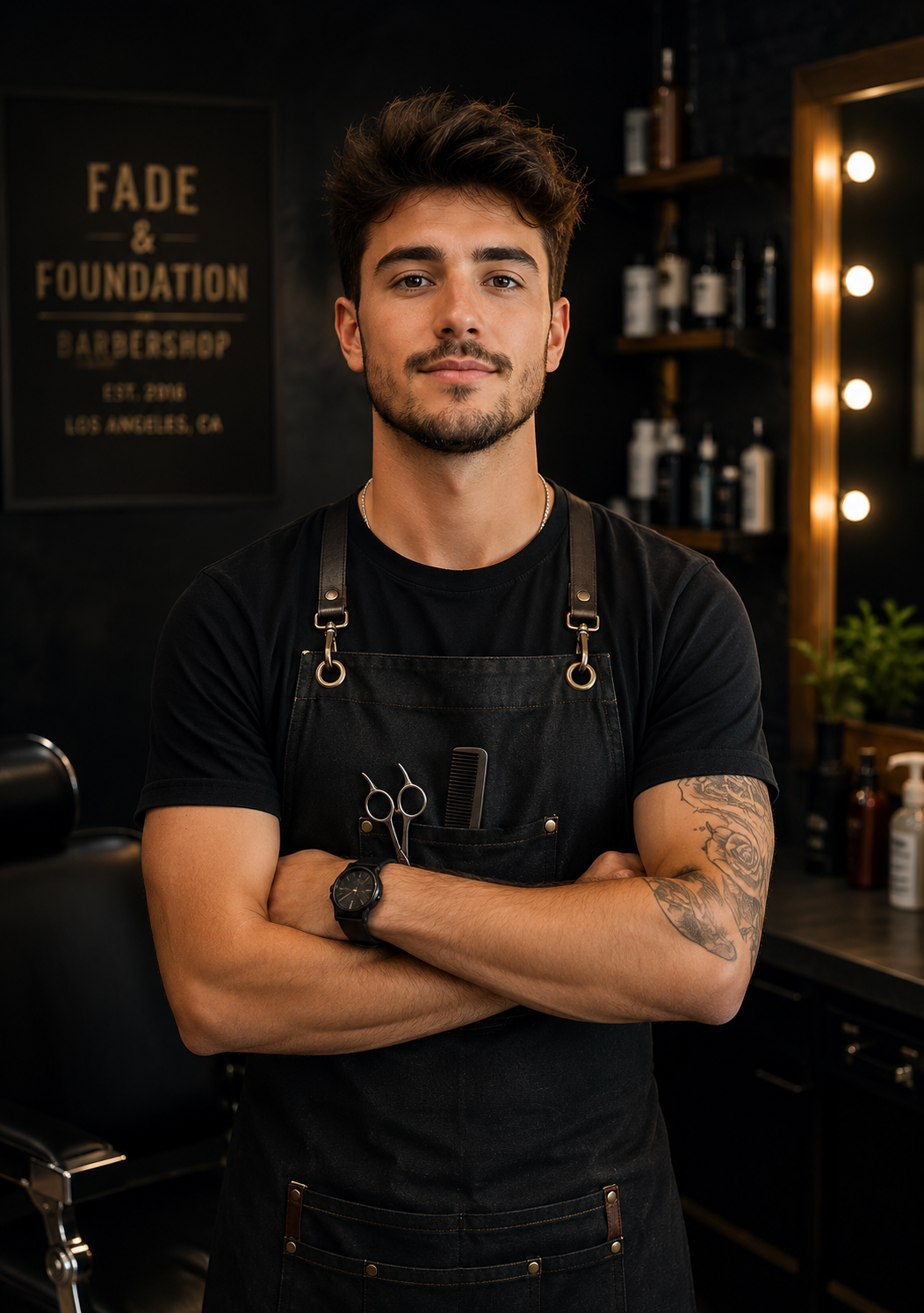
Hi, I’m Jake Miller a passionate barber based in Los Angeles, California, with over 3 years of hands-on experience in the craft. I specialize in modern fades, clean cuts, precision beard grooming, and classic barbering techniques, blending sharp technical skill with a relaxed, personal touch.
Over these years, I’ve had the opportunity to work with all kinds of clients, each with their own style and personality and that’s exactly what I love about this craft. For me, it’s never just about a haircut. It’s about understanding who you are and bringing that out through precision and care.
Every client who sits in my chair gets my full attention and expertise, because I believe great barbering is where confidence meets individuality. My goal is simple: to make sure you walk out looking sharp and feeling like the best version of yourself.

1 thought on “26 Messy French Crop Haircuts for Men (2026 Guide)”