

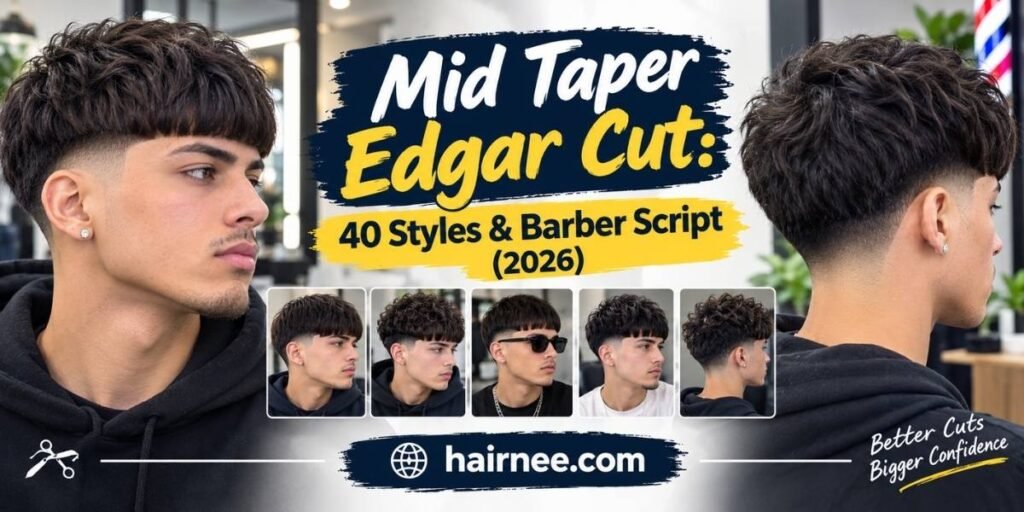
A mid taper Edgar cut is a blunt, straight fringe on top with sides that fade out from the temple down. It looks sharp, feels clean, and works on most hair types if you pick the right version.
This guide gives you 40 styles, a copy-paste barber script, guard numbers, face-shape tips, and a simple care plan. Read it once and you can walk into any shop and ask with confidence.
What is a mid taper fade Edgar?
A mid taper fade Edgar is an Edgar haircut with a straight, forward fringe and sides that start to fade around the temples.
Think of it as two choices in one cut. The fringe makes it an Edgar, and the fade height makes it a “mid” taper. Mid sits between a low taper (near the ear) and a high taper (above the temple), so you get a clear difference between top and sides without going too far. Pro tip: when you talk to your barber, say both parts out loud: “mid taper” and “blunt fringe.” That one sentence removes most of the guesswork.
| Part of the cut | Typical setting |
| Fringe | Straight line just above the eyebrows |
| Fade start | Around the temples |
| Top length | About 1 to 2 inches (2.5 to 5 cm) |
| Shortest point | Skin, short guard, or soft shadow |
| Barber visit | Every 2 to 3 weeks |
What makes an Edgar an Edgar?
The straight fringe across the forehead makes an Edgar, not the fade height. Pro tip: ask your barber to check the fringe when your hair is fully dry.
Wet hair lies longer, and in real shops a fringe that looked perfect wet often jumps up half an inch once it dries. A good Edgar also has a clean outline around the fringe, temples, sideburns, and neckline, plus enough weight on top to fall forward instead of flat. Take away the hard front line and you have a French crop or a Caesar cut, not an Edgar.
Terminology and cultural context
The Edgar is closely linked to Latino, and especially Mexican-American, youth style in the US. You will also hear it called the takuache cut.
The exact origin of the name is not clear. One popular story ties it to baseball player Edgar Martinez, and others link it to the Caesar cut, but none of these is proven, so treat them as stories only. The cut carries real cultural meaning for the community that made it popular, so it helps to know that background before you wear it. Pro tip: at the shop, say “Edgar cut” or “takuache cut.” Most barbers know both names.
What does the mid taper change?
It changes how much sharp contrast and side bulk you see under the fringe. Pro tip: pick the taper height and the shortest length as two separate choices, because a mid taper does not have to end at skin.
A mid taper leaves more hair on the upper sides than a high taper does, and it looks bolder than a low taper. You also choose how short the bottom goes: bare skin, a short guard, or a soft shadow. The neckline can stay natural, taper into the hairline, or be blocked square. The fringe itself stays the same.
Mid taper vs mid fade: what is the difference?
In most shops the two names mean the same thing. Technically, a taper blends gradually and often stops at a short guard, while a fade usually goes closer to bare skin.
The gap matters only at the bottom of the cut. A taper looks softer and grows out more gently, and a skin fade looks sharper but shows regrowth faster. Pro tip: skip the label and give a number. Say “finish at a #1 guard” or “take it down to skin,” and nobody can misread you.
Also Read This Middle Part Low Taper Fade: 40 Styles & Barber Guide
| Term | Usual finish | Look | Regrowth shows |
| Mid taper | Short guard or shadow | Soft and clean | Slower |
| Mid fade | Closer to skin | Sharp and high contrast | Faster |
| Mid skin fade | Bare skin | Strongest contrast | Fastest |
Mid taper vs low taper, high taper, and the French crop
The Edgar fringe stays the same across low, mid, and high tapers. Only the height of the fade changes. Pro tip: show a side photo and point to the exact spot where you want the fade to begin.
Placement names can differ from barber to barber, so a photo helps more than a label. A French crop keeps the short sides but softens the fringe, so it is the closest cousin if you want a gentler front.
| Style | Fade placement | Fringe | Why choose it |
| Low taper Edgar | Near the ears | Blunt | Softest look, easiest grow-out |
| Mid taper Edgar | Around the temples | Blunt | Balanced contrast, not too extreme |
| High taper Edgar | Above the temples | Blunt | Strongest contrast, classic look |
| French crop | Varies | Soft, textured | Short sides without a hard front line |
Is a mid taper Edgar right for your hair and face?
For most people, yes, with small changes. Hair texture, face shape, and growth patterns decide how you should adjust the length and the fade height.
Very few people are ruled out. Most just need a modified version instead of the textbook one, and the sections below show how. Pro tip: before you book, check three things in a mirror: your hair texture, your forehead height, and any cowlick. They decide most of the changes.
Which hair types work best?
Straight, thick hair works best because it falls forward and holds a flat line with little product. Pro tip: if your hair is fine, ask for a little extra length and light added texture, not heavy thinning, so the front does not look see-through.
Wavy hair can hold the shape, but you may need to blow-dry the fringe straight. Tight curls and coils do not lie flat on the forehead without heat, so a rounder, textured fringe looks better and feels more natural.
| Hair type | Fit | What to change |
| Straight, thick | Excellent | Keep fringe blunt, use little product |
| Straight, fine | Good | Keep more length, add light texture |
| Wavy | Good | Blow-dry fringe straight or go softer |
| Curly | Good with changes | Rounder fringe, longer top, plan for shrinkage |
| Coily | Good with changes | Shaped, textured fringe instead of a ruler-flat one |
Which face shapes suit a mid taper Edgar?
A mid taper Edgar suits every face shape with the right fringe length. Oval faces can wear it as is, and the other shapes need small tweaks.
The horizontal fringe adds width, so it flatters some faces more than others. Pro tip: if you are unsure of your face shape, take a straight-on selfie with your hair pulled back and check where your face is widest.
| Face shape | How it looks | Adjustment |
| Oval | Balanced | Wear it as is |
| Round | Fringe adds width | Slightly longer top, avoid a very low, heavy fringe |
| Square | Strong jaw plus strong line | Works well, keep the outline crisp |
| Long or oblong | Fringe breaks up the length | Great fit, keep the top short |
| Heart | Fringe softens a wide forehead | Keep sides tight, not too high |
| Diamond | Wide cheekbones | Slightly softer, textured fringe |
Which proportions and growth patterns need adjustment?
Cowlicks, receding hairlines, big ears, and a low forehead are the main things to plan for. Pro tip: point out your cowlick or hairline before the first cut, because a barber who knows early can plan around it.
Barbers see these every day, and a good one will adjust without being asked. Each point below changes how the fringe or the sides should be cut.
- Front cowlick: leave a bit more length or layer lightly so the hair does not fight the line.
- Receding hairline: use a softer, less severe fringe. It ages better between visits.
- Low forehead: keep the fringe slightly higher so it does not feel heavy.
- Big or sticking-out ears: keep a little more hair on the sides, because a tight taper shows the ears more.
- Double crown: keep the top a little longer to hide the swirl.
Is a mid taper Edgar professional enough for work or school?
Yes, in most offices and schools, if you keep the fringe neat, the top short, and the fade soft. Always check your own dress code first.
A taper that stops at a short guard looks calmer than a skin fade, and a slightly textured fringe looks less bold than a ruler-flat one. Schools may have rules about shaved designs or very sharp fades, so ask before you book. Pro tip: if you need a safe version, ask for a “soft mid taper Edgar, #1 at the bottom, no designs.”
Which mid taper Edgar styles should you consider?
Start with three base styles: classic blunt, fluffy or textured, and curly or wavy. Then pick from 37 more variations, which gives you 40 styles in total. Pro tip: if you cannot decide, think about how much time you want to spend on your hair each morning, then pick the style with that much effort.
Choose the top shape first, because the fade height is the easy part. The table gives a quick match between each base style and your hair.
| Base style | Best for | Daily effort |
| Classic blunt | Straight, thick hair | Low |
| Fluffy or textured | Most hair types | Medium |
| Curly or wavy | Waves, curls, coils | Medium |
Classic blunt mid taper Edgar
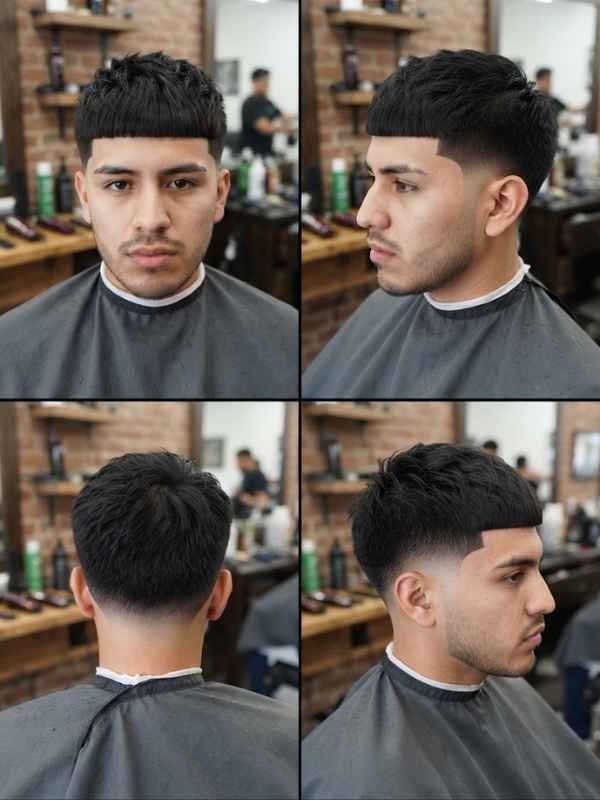
The classic blunt version has a dense, straight fringe, a flat top, and a crisp outline. It is what most people picture when they say “Edgar.”
It looks great in photos, but it needs the most touch-ups because any softness in the fringe or blend shows right away. In real life, this style looks its best in the first 10 days. Pro tip: if you want it extra sharp, ask for a quick line-up between full cuts.
Fluffy or textured mid taper Edgar
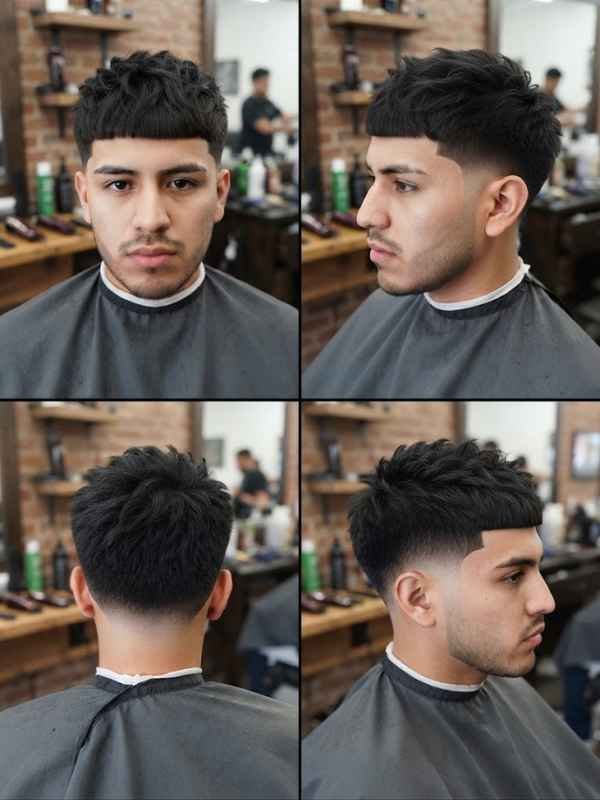
This version keeps the blunt front but adds length and lift on top. Pro tip: use a little texture powder or sea salt spray on dry hair and push it forward with your fingers, not a comb, because a comb flattens the volume.
The barber point-cuts the top, which means cutting small notches into the ends, and then you dry it up and forward. It looks more relaxed and forgives a few extra days of growth, so it fits busy people better than the classic.
Curly or wavy mid taper Edgar
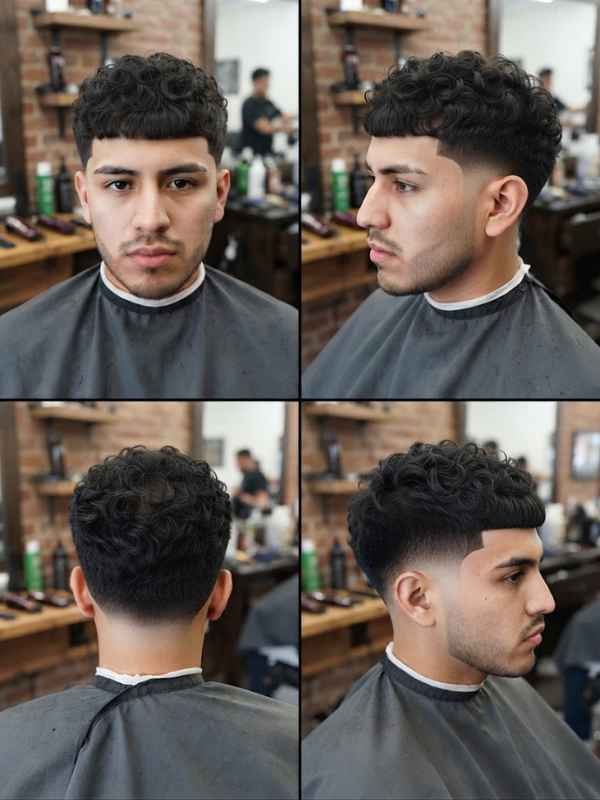
Here the fringe follows your curl instead of fighting it. The line is rounder and softer, and the top stays longer so your pattern shows.
Curl shrinkage is the one thing to plan for. Curls look shorter dry than they do wet, so a fringe that looks right wet can end up too short. Pro tip: ask the barber to cut your curls dry, or leave about half an inch extra at the front.
More mid taper Edgar variations to try
Here are 37 more mid taper Edgar variations beyond the three base styles. Each one changes something real: the fade finish, the fringe, the top, the extras, the color, or the hair need.
Pick one or two and bring photos. Pro tip: do not mix more than two big changes in one visit. A widow’s peak fringe plus a disconnected top plus a shaved design is hard to repeat at home.
| # | Variation | What changes | Best for |
| 1 | Skin mid taper Edgar | Sides go to bare skin at the bottom | Strong, clean contrast |
| 2 | Shadow mid taper Edgar | Stops at a #0.5 or #1 guard | Sensitive skin, office |
| 3 | Mid drop taper Edgar | Fade line curves down behind the ear | Extra shape from the side |
| 4 | Mid burst taper Edgar | Fade curves around the ear | Curly top, longer back |
| 5 | Temple-only taper Edgar | Only the front sides are tapered | Lower upkeep |
| 6 | Blocked-neckline Edgar | Squared neckline at the back | Neat, defined back view |
| 7 | Widow’s peak Edgar | Fringe cut to a soft point in the middle | Strong hairlines |
| 8 | Jagged Edgar | Choppy, angled fringe edge | Casual, playful look |
| 9 | Side-swept Edgar | Fringe angled to one side | Uneven hairlines, cowlicks |
| 10 | Long-fringe Edgar | Fringe sits closer to the eyebrows, top 2 to 3 inches | Thick hair, fluffy look |
| 11 | Micro-fringe Edgar | Short fringe, higher on the forehead | Low foreheads |
| 12 | Point-cut Edgar | Broken, softer fringe edge | Wavy hair, softer vibe |
| 13 | Slick-forward Edgar | Combed forward with a wet-look product | Dressy, sharp finish |
| 14 | Hard-part Edgar | Razor-shaved part line on one side | Adds detail to the top |
| 15 | Short spiky Edgar | Top about 1 inch, styled up with gel | Short, sporty look |
| 16 | Scruffy Edgar | Messy top, matte clay | Casual, no-fuss style |
| 17 | Buzzed-top Edgar | Top cut with a #4 or #5 guard | Lowest daily effort |
| 18 | Layered volume Edgar | Layers add lift and movement | Flat or fine hair |
| 19 | Bowl Edgar | Top cut evenly around, sides tapered | Bold, retro look |
| 20 | Disconnected Edgar | Visible gap between top and sides, no blend | Strong statement |
| 21 | Caesar-Edgar hybrid | Shorter, textured, forward fringe | Softer take on the cut |
| 22 | Short-tail mullet Edgar | Back kept a little longer | Creative, bold style |
| 23 | French crop Edgar hybrid | Blunt edge with a softer, textured front | Work-friendly option |
| 24 | Korean two-block Edgar | Longer top, short sides | Thick, straight hair |
| 25 | Beard-matched Edgar | Beard fade joins the sideburns | Men with beards |
| 26 | Shaved design Edgar | A line or small design at the temple | Personal detail |
| 27 | Eyebrow-slit Edgar | Small slit cut in the brow | Trend-led, youth style |
| 28 | Grown-out curtain Edgar | Fringe parted in the center after 3 months | Growing the cut out |
| 29 | Platinum blonde Edgar | Bleached top, dark or natural sides | Short tops, high contrast |
| 30 | Silver or grey Edgar | Soft grey or silver color | Light, modern look |
| 31 | Color-pop highlights Edgar | Highlights on the fringe tips | Short, textured tops |
| 32 | Fine-hair Edgar | Extra length, light texture | Thin or fine hair |
| 33 | Thick-hair Edgar | Weight removed from the top | Dense hair that puffs out |
| 34 | Afro-textured Edgar | Rounder, shaped fringe | Coily hair |
| 35 | Cowlick-friendly Edgar | Extra length at the front, soft layers | Front growth swirls |
| 36 | Receding-hairline Edgar | Softer, less severe fringe line | Men with a changing hairline |
| 37 | Office or school-safe Edgar | #1 taper, soft fringe, no designs | Strict dress codes |
How do you ask your barber for a mid taper Edgar?
Say the cut name, then give five details: fade height, shortest length, top length, fringe, and outline. The name alone leaves the key choices to the barber.
Here is a script you can copy: “I want a mid taper Edgar. Start the taper around my temples, finish at a #1 guard, leave about an inch on top, cut a blunt fringe just above my eyebrows, and give me a clean line-up with a tapered neckline.” Pro tip: keep this script in your notes app or text it to the shop before you go. Barbers like a client who is clear.
- Fade height: say “mid” and add “around the temples.”
- Shortest length: skin, #0.5, #1, or soft shadow.
- Top length: give a number, like 1 to 2 inches, or point to a photo.
- Fringe: say where it sits and whether it is ruler-straight or slightly broken.
- Outline: natural or sharp line-up, tapered or blocked neckline.
- For wavy hair, add: “Keep a little extra length at the front.”
- For curly hair, add: “Cut it dry and leave room for shrinkage.”
Which clipper guards and measurements does a mid taper Edgar use?
A mid taper Edgar usually starts at a #0 to #1 guard at the bottom and blends up through #2, #3, and #4 near the temple. Pro tip: if your barber uses a different system, ask “what is the shortest length at the bottom in millimeters?” and compare it with the table.
Guard sizes can vary a little between brands, so use this chart as a guide. The top then blends into 1 to 2 inches of length.
| Guard | Length (mm) | Length (inch) | Where it is used |
| No guard (#0) | About 0 | About 0 | Skin finish at the bottom |
| #0.5 | 1.5 | 1/16 | Soft shadow finish |
| #1 | 3 | 1/8 | Short taper bottom |
| #2 | 6 | 1/4 | First blend step |
| #3 | 10 | 3/8 | Middle blend near the temple |
| #4 | 13 | 1/2 | Upper blend into the top |
What reference photos should you bring?
Bring two or three photos on hair like yours: one front, one side, and one back. A front photo alone leaves the sides and back to guesswork.
The front photo shows the fringe position, the side photo shows the exact fade height, and the back photo shows the neckline. In real life, the same photo can mean different things to different people. Pro tip: write a short note on each photo, like “I like this fringe” or “make the fade a bit higher,” so the barber knows what to copy.
Also Read This Middle Part Low Taper Fade: 40 Styles & Barber Guide
What happens in the barber’s chair?
The barber sets the shape first, blends the sides second, and finishes the details last. A full visit usually takes around 30 to 45 minutes, and the steps are below.
- Consult: confirm fade height, shortest length, top length, fringe, and neckline.
- Section and fade the sides: set the guideline at the agreed temple height and work up from the shortest point.
- Cut the top and fringe: bring the top to length and set the front line.
- Blend: use longer guards or clipper-over-comb work until the fade looks smooth.
- Dry, texture, and outline: dry the hair forward, refine with shears, and clean the sideburns and neck.
Pro tip: before you stand up, look at the cut in the mirror from the front, side, and back with your hair dry. It is much easier to fix a fringe that is slightly off at the shop than at home.
How do you style a mid taper Edgar at home?
Dry the top in the direction you want it to fall, then use just enough product to hold it. Pro tip: style on slightly damp hair, not soaking wet, and use less product than you think you need.
The routine takes about five minutes. Too much product weighs the fringe down and blurs the line, and the right product and drying method depend on your hair type.
Straight hair
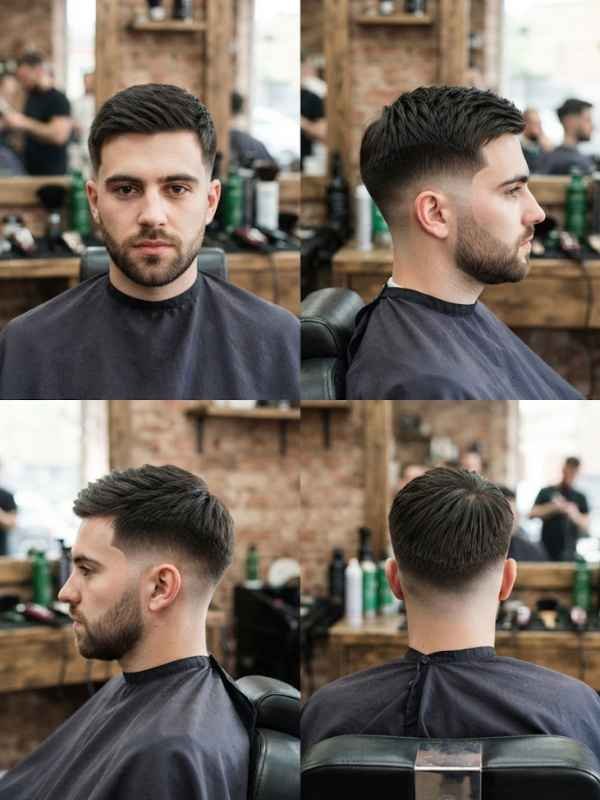
Blow-dry the top forward while it is slightly damp, then work a small amount of matte paste or clay through with your fingers. Straight hair holds a clean line with very little product.
Use a pea-sized amount to start. Pro tip: if the fringe lifts at the center, press it down with your hand while you blow-dry on low heat. The result looks natural, not stiff.
Wavy or curly hair
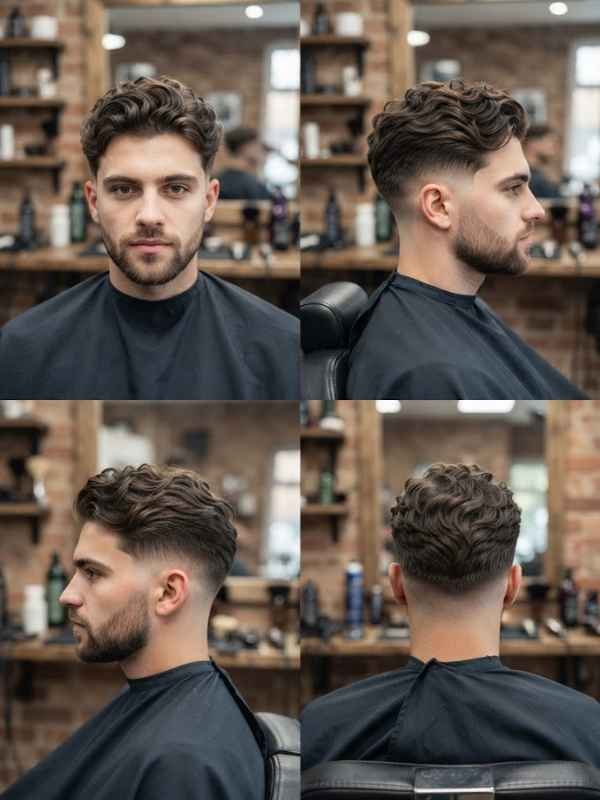
Apply a light curl cream to damp hair, then dry it with a diffuser or let it air-dry, without brushing the pattern flat. Pro tip: scrunch gently once while the hair is half-dry, then leave it alone, because touching it again creates frizz.
A little texture powder at the roots adds lift without breaking up the curl. Avoid heavy pomades, because they weigh the curls down and blur the front line. If you want a flatter look on wavy hair, blow-dry the fringe straight most days.
Which products and tools do you need?
You need a hair dryer, a small comb or your fingers, and one styling product that fits your hair. Start with that and add more only if you need it.
The wrong product is a common mistake, so match it to your hair type. Pro tip: buy a small size first. A product that feels great in the store can feel greasy or crunchy on your own hair.
| Product or tool | Best for | How to use |
| Matte paste or clay | Straight, thick hair | Small amount through dry or damp hair |
| Texture powder | Flat or fine hair | Shake at roots for lift |
| Sea salt spray | Wavy hair, fluffy look | Spray on damp hair before drying |
| Curl cream | Curly or coily hair | Apply to damp hair, then diffuse |
| Hair dryer with diffuser | Curls and waves | Low heat, forward direction |
| Soft brush or fine comb | Straight fringe | Set the line once, not repeatedly |
How often does a mid taper Edgar need maintenance?
Plan a barber visit every two to three weeks. Pro tip: a skin finish shows regrowth sooner than a short guard, so if you want longer between visits, ask for a #1 at the bottom.
Hair grows about half an inch a month, according to the American Academy of Dermatology, and that is enough to blur a cut made of hard lines. The fringe usually loses its sharpness before the sides do, and many people feel the cut is past its best by week three. In real life, most regulars book the next visit before they leave the chair.
| Time | What you see |
| Week 1 | Sharp fringe and clean fade |
| Week 2 | Fade still tidy, fringe slightly softer |
| Week 3 | Visible regrowth in the taper, fringe loses its edge |
| Week 4 and later | Blend looks stepped, line-up is gone |
What can you do between visits?
Keep the top styled and trim only small flyaways with sharp scissors. Do not try to fix your own fade.
Running clippers over your own taper is how a two-week-old haircut turns into a four-week problem. Pro tip: if the blend starts to look stepped, book earlier instead of waiting. A quick clean-up often takes less time than a full cut, and some shops charge less for it.
What are the downsides and common mistakes?
The main downside is upkeep. A mid taper Edgar is not a low-maintenance cut. Pro tip: do not book right before an event. Go a few days earlier so the fringe settles and you have time to fix anything.
Small errors show more on hard lines than on soft styles, and most problems come from rushed instructions or skipped photos. The table shows the usual slips and how to fix them.
| Mistake | What goes wrong | Fix |
| Curving the fringe | Loses the flat Edgar line | Ask for a straight line, check it dry |
| Leaving too much top length | Shape loosens and looks like a grown-out crop | Keep the top around 1 to 2 inches |
| Stopping the blend early | Visible step under the top | Ask for a longer blend |
| No reference photos | Barber guesses the height and neckline | Bring front, side, and back photos |
| Going to skin on sensitive skin | Razor bumps and redness | Choose a short guard |
Can a close fade or line-up irritate skin?
Yes, it can, especially on coarse or curly hair. Very short hairs can curl back into the skin and cause bumps.
The American Academy of Dermatology explains this problem as razor bumps. If you get them often, ask for a short guard at the bottom instead of bare skin. Pro tip: skip alcohol-based aftershave on a fresh line-up and use a plain moisturizer or a soothing balm instead. If the bumps last or hurt, see a doctor.
What are the alternatives if the Edgar is not for you?
If the hard front line is the part you dislike, pick a cut that keeps the short sides and softens the front. Pro tip: show your barber a photo of the alternative and say, “I want this, but with the same mid taper I would use for an Edgar.”
The options below all keep a clean, short side and remove the ruler-straight edge.
- French crop with a mid taper: short, textured fringe with no ruler-straight edge.
- Caesar cut with a mid taper: short, even top with a small forward fringe.
- Textured crop: point-cut top with a softer front.
- Plain mid taper: clean sides and a normal top, no statement fringe.
- Low taper with a textured fringe: a calmer fade with a loose front.
Fluffy Edgar cut
A fluffy Edgar cut is an Edgar with a longer, lifted, soft top. Here we look at it with a low or high taper, so you can compare it with the mid taper version above.
A low taper keeps more weight at the sides, so the top looks fuller and the look is softer. A high taper makes the top look even bigger and gives a stronger contrast. Pro tip: if you like the fluffy look but want less upkeep, pick a low taper. It grows out the most gently.
Summary
A mid taper Edgar cut gives you a clean, balanced fade with a sharp, straight fringe. You choose the fade finish, the top length, and the fringe style to fit your hair, face, and daily routine.
- The straight fringe makes it an Edgar, and the temple-height fade makes it a mid taper.
- Ask for fade height, shortest length, top length, fringe, and outline in one clear sentence.
- Straight and thick hair gives the sharpest line, and waves and curls need a softer, textured version.
- Use a #0 to #1 guard at the bottom and blend up through #2 to #4.
- Book a barber visit every two to three weeks to keep it crisp.
- If the hard line is not for you, try a French crop or a plain mid taper.
Frequently Asked Questions
Is a mid taper Edgar the same as a mid fade Edgar?
In most shops, yes. A taper usually stops at a short guard, and a fade often goes closer to skin, so tell your barber how short you want the bottom.
What guard should I use for a mid taper Edgar?
Most barbers finish at a #0 to #1 guard at the bottom and blend up through #2, #3, and #4. Use a #1 if you want a softer look or have sensitive skin.
How long should the top be for a mid taper Edgar?
About 1 to 2 inches (2.5 to 5 cm) works for most people. Go a bit longer for a fluffy look and for curly hair, because curls shrink when dry.
How often should I get a mid taper Edgar trimmed?
Every two to three weeks. The fringe and the taper both soften quickly, so a regular visit keeps the lines sharp.
Can curly or wavy hair get a mid taper Edgar?
Yes. Ask for a rounder, textured fringe with a longer top, and plan for curl shrinkage so the front does not end up too short.
Is a mid taper Edgar professional enough for work or school?
In most places, yes. A soft taper, a short top, and no shaved designs keep it neat, but check your dress code first.
Can I get a mid taper Edgar without going down to skin?
Yes. Fade height and shortest length are separate choices, so you can finish at a short guard or a soft shadow. That also helps with razor bumps and lasts a bit longer between cuts.
How long does it take to grow out a mid taper Edgar?
Allow about three months for the fringe and fade to soften a lot. After three to six months most people have enough length for a textured crop or a curtain fringe.
Hi, I’m Jake Miller a passionate barber based in Los Angeles, California, with over 3 years of hands-on experience in the craft. I specialize in modern fades, clean cuts, precision beard grooming, and classic barbering techniques, blending sharp technical skill with a relaxed, personal touch.
Over these years, I’ve had the opportunity to work with all kinds of clients, each with their own style and personality and that’s exactly what I love about this craft. For me, it’s never just about a haircut. It’s about understanding who you are and bringing that out through precision and care.
Every client who sits in my chair gets my full attention and expertise, because I believe great barbering is where confidence meets individuality. My goal is simple: to make sure you walk out looking sharp and feeling like the best version of yourself.

1 thought on “Mid Taper Edgar Cut: 40 Styles & Barber Script (2026)”